
Welcome to your online lesson notes page Don!

2026 goals
Orchestra music: work in different ways according to how close the concert is
Bowing technique, tuning & vibrato
How to be a good desk partner
Work through Mum’s repertoire
Follow a syllabus (but no exam)
Thu 19th March 2026
Brahms 4
Fri 6th February 2026
Brahms 4 – 1st movement
- Practice bars 31 and 32 slowly for intonation.
- Practice going from arco to pizz by alternating between the two for a while, perhaps in a scale.
- At figures D and N, try to keep your fingers on the string.
- For long slurred quavers (like the ones before fig. O), keep the bow light and don’t think about pulling it – concentrate more on the string crossing.
Thu 8th January 2026
Beethoven 5
- On long notes, try to use as little bow as possible.
- In long quaver passages, keep the bow close to the string.
- In the slow movement, in string-crossing slurred passages, keep the bow flowing and keep the angles shallow.
Fri 12th December 2025
Bachianas Brasilieras
- Add bar numbers.
- Make sure you know the distance for every shift, no matter how small or big.
- For your first big shift in bar 4, and in all other similar spots, shift early and keep your bow strong and connected.
- Think lots about bow distribution – on the first line, focus on keeping composure all the way to the end of each bow, rather than lightening the bow and speeding up towards the end. Also, remember not to use too much bow on the shorter slurs.
- Also for bow distribution: make sure you are saving/using bow accordingly when crescendos and diminuendos are present.
- On the f in bar 14 (fig. 1), make sure you shift down but reach back up.
- Keep fig. 1 strong all the way down the sequence.
Thu 30th October 2025
Telemann Giga
- See if you can get some lightness into the opening f, and in general, see if you can find spaces for some more air between phrases (use your baroque bow to help find some of these).
- With the baroque bow, use the lower half a bit more, but make sure you don’t lift your right shoulder as you do this.
- For bars 3-5, try to adjust to each new pair of strings quickly, so that the string crossing angles for each beat are shallow. Practice any slurred notes that cross the string as double stops for intonation.
- Play the 4th bar of B slower, pushing out with your right hand so that your bow stays straighter on the lower strings.
Thu 4th September 2025
Tchaikovsky R&J
- As a warm-up, try C chromatic 2 octaves, imagining it in 12/8. Slur each octave. Try the fingering 2 ways, 121234, and 112234.
- Highlight any passages in the music which need slow work.
- Be picky with your tuning around any particularly chromatic phrases.
Thu 14th August 2025
Tartini
- Can everything contribute to the calmness of this piece? Vibrato, string crossings, bow changes, left hand pressure (or lack of!).
Leclair
- Moving the barlines to the middle of each bar will help with shape in this piece.
- Again, keep everything relaxed, especially the string crossings – they should never be jerky movements.
Vivaldi Giga
- Don’t try this too fast for now, and really focus on your left hand structure so that the intonation is spot on.
- At the start of the second half, Keep your fingers on as you build them up on the A string, so that they are in place ready for the next bar. (Watch out that your D isn’t too high at the end of the bar).
- Work on the tuning of the two bars before C. Pick out a few notes (eg. the first 3 notes) and work with a tuner. Remember not to slide your fingers into tune – if something is out of tune, return to previous note so that you learn what the correct interval feels like under your fingers.
Thu 17th July 2025
Bach Bourée
- Keep this steady for now and work mostly on tuning – how can you hang onto fingers a bit longer to help with stability of hand shape?
Bach Menuett
- 3 bars before B, use less bow at the start of the bar.
Skoryk
- When shifting down (eg. end of 1st bar), listen to make sure your bow doesn’t bulge (try leaning on the first note of the semiquaver group instead).
- At the start of line 3 (and similar bars, push out with your bow so that it stays straight.
- Make sure bar 10 doesn’t creep sharp.
Thu 26th June 2025
Bach Bourée
- Make sure your bow has good contact with the string, especially as you get into the upper half of the bow. Keeping the bow straight at the end of down bows will help with this.
- Embrace the upside-down bowing when it happens! How can you make your up bows sound string, yet different to the down bows?
Handel Menuett
- Watch out for tuning, especially in the second half of the theme.
- Before you play the Variation, play a few bars of open As in a crotchet-quaver-quaver-crotchet rhythm.
Thu 27th March 2025
Sibelius 5
Elgar Cello Concerto
- Practice your beautiful quiet playing at bar fig. 1 & 3.
- Lots of vibrato at fig. 5.
The Swan
- Try not to start this with a still left hand – get it moving before you play your first note.
- Work your way gradually up the bow in the scales, such as bar 4.
- Work on continuous vibrato from bar 10.
- Think of a swan’s majesty in the hairpins.
Thu 13th February 2025
Start your vibrato practice with some silent sliding of your fingers up and down one string. Try not to flex the wrist too much as you do this.
The Swan
- This is really coming to life now! There are moments of real beauty in the vibrato.
- In bars like your first bar, make sure the shift doesn’t make your bow louder.
- Plan your shifts well (starting with your first downward shift!), so that you land confidently and can vibrato immediately. Remember that shifting systematically keeps your hand in shape, making whatever comes next easier to navigate.
- Keep your vibrato slow, to match the mood of the melody.
- At fig. 3, try out the continuous arm vibrato idea.
Dvořák 7 – scherzo
- If the bowing feels tricky, just slow it down slightly.
- At fig. C, retake in the crotchet rests and not in the quaver rests.
- Practice the quaver runs in smaller chunks, first in 2s, then in 4s, then the whole bar.
- Practice 241 very slowly, making sure each note is really centred.
Dvořák 7 – Finale
- Practice E by just playing the first 2 notes of each group of 4. Play them slowly and, again, make sure everything is as centred as possible before adding the octaves back in.
Thu 23rd January 2025
Scales: see how you’re getting on with the list of grade 7 scales.
The Swan
- Use this for vibrato practice.
- Warm up with a G major vibrato scale (like we did in the lesson). Quavers, then quaver triplets, then semiquavers etc.
- Be precise in your shifting, so that your hand is always in the best position for vibrato.
- Once you’re more familiar with the notes, for one of your practice sessions, focus on your proximity to the bridge. Try to make any movements towards and away from the bridge gradual movements. Use the variety of sounding points as tools.
Bach 1st suite last movement
- Try to keep your bow nice and straight.
- Experiment with using the lower half of the bow even more.
Fri 18th October 2024
A look through some Berlioz after your first rehearsal for the next MSO concert.
Tue 24th September 2024
Prokofiev
- 1st movement – Practice fig.13 at quaver = 70 with a metronome.
- Fig. 21 – start working on this at quaver = 70 too, but with single notes. Experiment with the fingerings for now, but write them in gradually as you discover good ones (whilst keeping it as simple as possible).
- 3rd movement – play some E major and C sharp minor scales.
Wed 28th August 2024
See if you can download Mobile Sheets on your tablet.
Bach BWV 1027 – Allegro mnt.
- Steady in the semiquavers, with light right hand.
- When practising the bariolage sections, keep checking that your bow is straight. Work slowly at first, thinking about moving the bow angle towards the next required string a bit earlier.
- Aim for the semiquavers to be a bit nearer your bow hand – this should help with clarity. You may need to think a bit more about flexible RH fingers when experimenting with this.
Thu 4th July 2024
Bach Gamba Sonata no.1 – Adagio
- Think about articualation based on the intervals between the notes – keep scaly things fairly brushed and big leaps quite articulated.
- Play the “unusual” notes confidently!
Allegro ma non tanto
- In bar 12, anticipate the string crossing with your left elbow and bow.
- Even though we’ve changed the bowing in bar 20, try to still get the bounce that you had with the two up bows.
- Practice 26 & 27 in rhythms (pairs and then 4s), focusing on the tuning of the longer note in each permutation. Finish by playing it as written, to see how much easier it now feels. Do this for another 3 practices at least.
- Keep everything nice and light – cleaning your strings will help with the clarity when using light bows.
Thu 27th June 2024
Chanson de Nuit
- Listen to a recording before you start to get the right soundworld and mood in your head.
- Make sure you are giving enough care to every note – keep vibratoing as much as you can on all the long (and not-so-long) notes.
- At bar 18, save your bow so that the crotchets have enough character and care.
Chanson de Matin
- Work on the intonation of the climbing passage 45-52.
- Experiment with how to use your bow for maximum dynamic impact 53-57. Let the end of 56 melt into the barline of 57 (and give it the time it needs!)
Fri 14th June 2024
Chanson de Matin
- Play the music, not the fingerings!
- Aim for the overall lyrical line in the opening phrase.
- From bar 13, experiment with getting the delicate character in different ways other than just lightening off the bow pressure. Practice first without the mordents.
- When you add the mordents back in, make sure the emphasis is still on the length quaver, not on the twiddle.
- Work on how you use your bow in bar 20 – lighten it off as you approach the shift. See if the shift can echo the character of the piece.
Chanson de Nuit
- Think of something slow and comforting at the start of this – maybe thick hot chocolate sitting by the fire?
- Count yourself in before you start with a really steady 4. The accompaniment consists of pulsing crotchets at the start.
- From 18, it’s ok if the tempo starts to move forward a little.
- In the section from 18, think really carefully about intervals across the string to help with finding the notes.
Wed 29th May 2024
Mozart Clarinet, Viola & Piano trio.
Mon 29th April 2024
Concerto for Orchestra
- P.8 fig.62 – practice in 2-bar phrases in 1st position until you are really certain of how the notes sound. If you can sing them, even better!
- P.10 fig.43 – Aim lower on the flats and play your heart out!
- P.15 fig.300 – Split this section into smaller chunks too. For the glissandi, slide early and slowly, with a clear bow. Be aware of the A naturals in 302 and 304.
Thu 18th April 2024
Mozart Clarinet Concerto
Debussy Clarinet Rhapsody
Concerto for Orchestra
- Practice 254 and 494 slowly with single notes.
- In the last movement, rest your thumb on the fingerboard as you strum.
Mon 19th February 2024
Mon 15th January 2024
Wagner
- At E, careful not to lose any tempo on bow changes.
- Work in 2-bar phrases with a metronome, starting at crotchet=60.
- Beware A naturals – they need to be pretty low.
Mon 17th December 2023
Skoryk
- To help with memory, work section by section under a microscope. Don’t let yourself move on until each section feels safe! Work on shifts from memory, and where necessary, play 1 or 2 bars over and over until they feel safe.
- If you stumble on any notes, identify the interval (eg. The interval between the first note of the piece and the first minim).
- Try to notice as many patterns as possible as you scrutinise all these details.
- Work on shifting as much as you can. Use ghost notes, identify the distance you are shifting and the spacing of the fingers once you have arrived in the new position.
Tue 5th December 2023
Skoryk
- The work you have done on bow distribution is really paying off! So keep up the good work!
- Have a go at playing the first section repeat an octave higher – write the fingering underneath.
- Check the tuning of all your crotchets on lines 3 and 4.
- In the final section, work on the chords in isolation for tuning and sound quality (bow flow). Then add a few notes either side to connect everything.
- Work on the tuning in bars 33-34 with a tuner, thinking about the ghost note in the shift. Once you have found the right tuning with the tuner, make sure you have really registered the feeling in your fingers so you can recreate it without your tuner.
- Remember the harmonic isn’t much higher than 3rd position.
The tuning app I use is called Pano Tuner.
Mon 27th November 2023
Coleridge-Taylor
- On line 3, practice with the melodic line in mind. Make sure your bow is straight for any string crossings and think about the dynamics.
- Work on bars 27-32 with bow distribution in mind, taking the dynamics into account.
- In the 2nd movement, keep thinking about the melodic lines as you shift.
- In the 3rd movement, practice the semiquaver passages on p.9 with a metronome.
Mon 13th November 2023
Falstaff
- Make friends with your metronome!
- Keep your left hand light in all the fast passages.
- From 44, whenever you have a retake, hold the note before the retake as long as you can.
- At 65, try to memorise a bar at a time and use your metronome.
- Work on your lyrical shifting and string crossings at 98. Listen out for any bumps and try to smooth them over. Keep your left hand light and add a gentle vibrato to everything, especially any single notes on the opposite string.
Skoryk Melody
- In the f passages, think about your whole arm moving as a unit from the shoulder, with a heaviness in the elbow which will really draw the sound out of the string and release it. Be careful especially that there is no tension in the right forearm.
- Make all your bow changes “sticky” – try to sustain the resonance over your bow changes.
- Keep listening out for consistency of tone in your semiquavers, whether they are 2-note slurs or 4-note slurs.
Mon 16th October 2023
Mozart Duo I
- For the bar before A, try some open string practice to help neaten the string crossings and get a string sound quality. Experiment with different parts of the bow, bow angle and amount of bow.
- Spend a fair amount of time on the bow strokes in the second half, especially around fig. C.
Tue 26th September 2023
Brahms 1 and Bartered Bride
- Remember to stop and play a scale if the notes in a particular passage are feeling particularly awkward.
Thu 31st August 2023
Mozart Duo I
- Play the first 5 notes of bar 2 several ties, listening to your 4th finger tuning. Then add a note and keep doing that til it’s secure. Next, practice the first 2 bars on a loop, keeping the rhythm very steady.
- For the semiquavers into A, make sure your B is high enough. Play just the first 6 notes until it all feels completely secure.
- Practice the notes into B with a gap after the 4th note to start with. Gradually shorten the gap.
- Practice the double stops at the end of the first half, using a smaller stroke nearer the heel. Listen to the tuning of the Ds and aim for them all to match.
- Work slowly on the 3rd bar of the 2nd section, keeping your left hand as relaxed as possible.
- At C, keep your bow as straight as possible and make the string crossings as shallow and wave-like as possible. Always be listening out for tuning and making sure you’re not catching any next-door strings.
Mon 10th July 2023
Mozart 1st duo, I
- In the double stops on line 2, use less bow, off the string in the lower half.
- Pick out each semiquaver passage to work on for tuning, bow stroke and neat string crossing. Consider open string practise on any with awkward crossings, always aiming for neatness before adding fingers.
- Bar before B get hand in shape in rest, quick shift and tuning.
Thu 22nd June 2023
Vaughan Williams I
- Practise the shifting on line 4 for confidence – careful not to get too sharp.
Vaughan Williams II
- Choose some good fingerings!
Vaughan Williams III
- Work on the tuning in the first few bars.
- Keep a lovely flowing bow throughout.
Vaughan Williams IV
- Just practise the shifting at the end a little more, again for confidence to make it sound effortless!
Vaughan Williams V
- Don’t try too hard with the vibrato – take the “tranquillo” frrom the tempo marking as guidance.
- Try it all in 3rd position.
Vaughan Williams VI
- Try to get the whole thing working at crotchet=70. You may need to do the chord-y section at a slower speed at first.
Telemann I.
- Try this with your other bow!
- Get into the Largo mood before you start.
- Try and follow the phrasing with the dynamics you add, using just your bow – no vibrato.
Telemann II.
- Work on the semiquaver passages slower.
- Use smaller bows, a little closer to the heel.
- When string crossing, keep the angle shallow.
Telemann IIII.
- Make sure you are feeling this in 4, not in 8.
Telemann IV.
- Focus mainly on the quaver passages, and building the dynamics as you go through phrases with rising sequences.
Mon 29th May 2023
Keep an eye on your bow angle this week,
Rebecca Clarke
- In the ppp section, aim for a really ghostly bow and vibrato.
- At 23, aim to match the sound quality that you had on the D string.
Tue 16th May 2023
Nardini Andante
- In bars 1 and 32, see how invisible you an make your shift.
- Play bar 6 as a crotchet appoggiatura instead of an acciaccatura.
- Scrutinise the tuning on the second line as the notes are quite unusual!
- For the trill in bar 13, start on the upper note and add in a termination at the end of the bar.
- To help with the shift, write an A flat notehead and a 3rd finger on the barline of 28 into 29.
- Try to match the speed of the trills to the mood of the piece.
Nardini Allegretto
- Keep your right hand relaxed when playing the semiquavers so they don’t rush.
- Practise from bar 80 making sure your 1st finger is ready for the A in 81, and when you shift make sure the thumb shifts too.
- Practise the section from 116 just with your left hand to try to loosen up the left hand.
- At 127, make sure you’re trilling the right note! Practise that with as relaxed a left hand as possible too and without the bottom note.
Tue 2nd May 2023
Prokofiev Scherzo
- At the start, try a little nearer the middle of the bow and listen out for even rhtyhm.
- When you have to shift in these octaves, take advantage of the open string and move your hand early.
Tchaikovsky
- 1st movement: Practise H-I as an excerpt, working slowly and calmly to get to know the tones and semitones really well.
- 3rd movement: practise the tricky bits arco for now, but also practise some simple scales pizzicato trying to alternate between two fingers.
- 4th movement: practise from the start to the start of bar 38 at crotchet=60. When it feels easy, up it to 70, etc.
Tue 21st March 2023
Nardini I.
- Warm up with an A flat major scale – not too fast, so you can really take care over the tuning of every note.
- Careful the semitone at the start of bar 7 isn’t too close.
- Bowing bar 17.
- Practise 18-22 a fair bit until the bowing feels comfortable and safe.
- Play the second half of bar 27 without your fingers a few times, like we did in the lesson. Once you add the fingers, again repeat it until it feels comfortable. You’ll need to think lots about the journey of your 2nd finger from the first semiquaver to the third.
- Make sure you’re holding the dotted minim for long enough in bar 29.
- Relax your right elbow at bar 46.
- In bar 67, see if you can get our new double up bows to sound the same as the surrounding separate bows.
- Practise 75-77 with a metronome, starting at a speed that feels easy and gradually upping the tempo. Make sure the rhythm is really even in bar 75.
- Watch out from 78 that the tuning isn’t wandering too high.
Nardini II.
- In 12, make the difference between B flat and B natural very clear.
Wed 8th March 2023
Nardini
- In bar 3, aim for both excellent rhythm and intonation of the smaller notes.
- Make sure bar 4’s trill has an upper note.
- Aim for a beautiful top note on your chord in bar 14.
- Be really ready for the string crossing in bar 27!
- In 29, use the length of the trill’s upper note to help you change your 1st finger position calmly.
- Check the tuning of your C flat in 29 and the B in 30 with a tuner a few times.
- To make 75 more comfortable, use each down bow to scoot into the upper half.
- In 82, don’t use too much bow on the semiquaver – the first 3 notes should feel like a long down bow with an up bow hiccup in the middle.
- Leave the turn to the 3rd beat in 83.
Mon 20th February 2023
Marriage of Figaro
- Start the first down bow very near the tip and use hardly any bow.
- Keep all the string crossings nice and shallow
Bruckner 4
- 1st movement: Before practising bar 83, play a G flat major scale.
- 1st movement: Practise E in single notes to get really comfortable with the tuning.
- 1st movement: Practise the bar before R plus one note to get really secure on the landing.
- 2nd movement: Play the melody at D with confident, flowing bows. Make the dynamic changes really sudden.
- 2nd movement: keep the lang bezogen slurs smooth.
- 3rd movement: practise 143 with long, smooth bows and with a metronome set to dotted crotchet=40 until it feels easy. Then move up to 50 until that feels easy. And so on!
- 4th movement: remember slow and steady wins the race!
Mon 6th February 2023
Glazunov Elégie
- Warm up for the first section with a G minor scale.
- Practise 39-44 slowly and work on any sifts and clef changes.
- Warm up for the middle section with an E flat major scales.
- Work in the new fingerings in the middles section.
Nardini Sonata
- Warm up with an F minor scale.
- Make sure bar 3’s rhythm is precise.
- Enjoy getting to know all the new fingerings!
- We’ll carry on from there next time.
Fri 6th January 2023
Beethoven 7: 1st movement
- Bars 1-62: Practice into the string bowing on the semiquavers and precise rhythms on the bars like 30, 32, 36 etc.
- Bars 81-88: Freer on the first note of each slur, generally nearer the middle of the bow.
- From 88 to the downbeat of C: practice with a metronome at 50. Make decisions on which shifts you’ll do.
- 119-124: work with the metronome at 50.
- 146-E: work with the metronome at 50.
- 164-171: practice this at quaver=120. You could try working on this section without shifts.
- Work on the first 4 bars of F slowly to get to grips with the bowing.
Mon 5th September 2022
J.C. Bach II.
- Really embody the mood before you start, imagining how you wil will use the bow.
- Play from 6 bars before 13 quite a bit, first of all stopping in 3 bars before 13 after the tied A flat, then singing the next few bars.
Sat 23rd July 2022
J.C. Bach I.
- Always push out with your bow, especially on down bows. Practise in front of the mirror so you can keep an eye on this at key moments (such as fig. 5 and bar 135).
- In 25, slow the bow down to make sure you get to the right part of the bow for 26.
- Work on adding dynamics now, thinking not only about volume but mood too.
- Work on your tuning in 55-58 with slow light double stops. You could even break it down further and play the lower line only, checking your tuning with the open strings.
- Practise 91 and 92 really slowly to scrutinise each note’s tuning. Do this too with any other passages where the tuning isn’t quite locked in.
J.C. Bach II.
- Use a slower bow to help give a more reserved mood, as if you’re playing to yourself. Have our lonely character in the woodland scene in mind.
- Never be in a hurry to move on from longer notes.
- Careful not to go too piu mosso – the demi-semis should never sound rushed.
- Make sure you return to the opening mood at fig. 15.
- Practise the shift in 2nd bar of fig. 18 using the ghost note method we used in the lesson.
Tue 13th June 2022
Scales – before tackling high scales like G minor, try the Benedetti trick of sliding your fingers all the way up the A string and noticing where your thumb goes.
J.C. Bach
- Despite the f at the beginning, aim for lightness in the sound. Try not to sustain the chords and the 2nd notes of slurs. You could gelp get the idea of this by playing it with your baroque bow first.
- Get into the upper half of the bow for bar 27 to help with the logistics in bar 28.
- Keep checking the angle of your bow and push out in front of you when in the upper half.
- Work on the tuning from fig. 3 and make a note of what your thumb is doing – it needs to move with your fingers as you shift to help keep your intonation reliable.
Tue 24th May 2022
J.C. Bach
- Warm up with a C minor scale and arpeggio, keeping the E flats low in every octave of the arpeggio.
- Work on your bow distribution from fig. 2.
- Get used to all the new fingerings!
- When there are a lot of notes to squeeze into one bow, use that as a way to get a sweet piano tone.
Mon 28th February 2022
Franck
- Practice the quaver passage at the bottom of page 4 with a metronome starting at crotchet = 70 and be very strict about tuning. Next practice, try it at 70 first then up it to 80. Next practice, start and 80 and up it to 90, etc.
- Repeat the exercise on page 8.
- Practice the semiquavers on page 10 with a metronome too, starting at crotchet = 50.
Corelli
- Prelude – be convinced of your tempo before you start.
- Try to avoid the tip as much as possible.
- Keep any pairs of quavers light.
- Allegro – practice the double stop sections open strings then with fingers. You could alternate between these two versions and notice what you’re doing differently with your bow.
- See if you can get to the trill at the end of line 4 without a gap – you can practice this with just the top line of the double stops.
- Make sure your bow hair is flatter on the double stops.
- Sarabande – keep the tuning low on your Bs and Cs.
Mon 14th February 2022
Corelli Sonata da Camera
- Try the whole thing with your baroque bow! Start right at the heel and try to keep returning to that part of the bow, like your elbow is in an elastic band sling.
- Prelude – aim for lighter quavers, with a bit of air between them. Let the bow come off the string on the light up bows, keeping your right arm really relaxed.
- Allegro – sorry for changing the fingering!! When moving from chord to hord, miimic the release you have in the baroque bowing in your left hand as the fingers re-configure.
- Allegro – ignore any tenuto marks. In the separate bow triplet passages, use a slightly faster (not heavier) bow on the first of each 3 to highlight the main notes.
- Sarabande – try without vibrato at first, using the bow to add shape. After you have stripped it back you can decide where to add a touch of vibrato.
- Gavotta 1 – get used to the new bowings!
Fauré
- Do some vibrato warm-ups before you start (see below).
- Keep asking yourself if your upper bow arm could be more relaxed.
Vibrato warm-ups
- Touch each fingertip on the side of your thumb and wiggle the top joint.
- On your violin, rest the left fingertips on the string. Open and close from the elbow, sliding the fingers lightly up and down the string. Gradually localise the movement and squeeze slightly with the fingertip you want to land on. Repeat several times on each fingertip.
Mon 31st January 2022
Corelli Sonata da Camera
- Prelude – Keep this in 1st position as often as you can.
- Prelude – If you hear any other places that could do with trills, give them a go! In this style, they start on the upper note and often have a terminaation.
- Allegro – practice the chords so you know them from memory.
- Allegro – keep the bow as relaxed as possiblle on double stops.
- Allegro – in the staccato section, can your articulation be consistent, especially when crossing strings?
- Largo – imagine the moving quaver line underneath.
- Gavotta 1 – Aim for a nice clear sound when in higher position.
- Gavotta 1 – roll into the chord at the end.
- Gavotta 2 – dainty bow strokes.
Après un rêve
- Do some slow silent vibrato on the first two notes before you start and make sure your hand continues to rock back and forth as you transfer the weight onto the other finger.
- Try to relax into the melody so we get lots of lovely resonance in this piece.
Mon 22nd November 2021
Italian Girl
- Practice the tricky bits on one note to get the bow working well. Generally you need to be lower in the bow (lower middle).
Brahms
- Practice the exposed semiqaver sections in rhythms, elongating the 1st of each 4, then the 2nd of each 4, etc. In the next practice, try elongating the 1st of each 8, then the 2nd etc.
Bach Allemande
- Keep practising the scale in 3rds! If you can practice it from memory, your will be freer to listen even more carefully.
- In bar 6 of your Bach, take the fingers off the string after every double stop to help them regroup in the air.
- When practising these bars, make sure you play a version every now and then where you focus exclusively on the bow and sound quality.
- Spend some time in some of the easier bars working on a stright bow and using the lower half more.
- Whenever you have individual low notes, listen carefully for the sound quality (eg. bar 11).
- For any 3- or 4-note choords, mae sure you land on the bottom two notes together.
Mon 8th November 2021
Bach Allemande
- Warm up with a C major scale and arpeggio, listening really carefully for tuning and resonance.
- Next, improvise any kind of C major scale using the rhythm from bar 1.
- Then try a C major scale in broken steps.
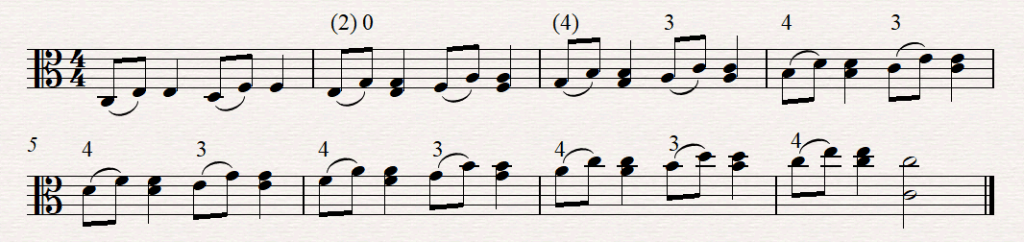
- Try the chords in 6 and 7 in the same way.
- Practice bar 5 with all open strings in the chord a few times to get the right feeling in your bow arm.
- Practice the 2nd half of bar 7 holding the top G as a long note to check with the tuner. Try to get it in tune 3 times in a row each practice.
- In bars 8, 10 and 11 listen for clarity on the 1st and last notes of each beat.
- Play this metronomically for a about a week before adding back in some of your lovely scurries!
Ferguson
- Keep the first section in tempo for now as you get to know the feel of the piece.
- From 33, make more of a difference between triplets and real quavers.
- Make sure you count any 5-beat notes and really saving your bow.
- Practice bar 34 slurring all 3 triplet notes, making sure the triplet fits neatly into the last beat of the bar. Then try a few times with the printed bowing but keeping the rhythm just as even.
Mon 11th October 2021
Telemann
- Practice this on your big viola and don’t shy away from the sound!
- Do some bow warm-ups looking in the mirror for a straight bow. Your hand should be travelling out in front of you.
- Aim for real clarity on your staccato quavers.
- Start your first note in the right part of the bow.
- Stick a corn plaster on your bow to help keep your hand down near the heel.
- Practice the Adagio for a clear p dynamic.
- In the Allegro, work on neatening up the trills using a strong bow and fast neat fingers.
Tue 20th July 2021
Scales focus
- As you play your scales this week, think a lot about the swing in your left elbow. Are you reaching the notes on the A string by kinking your wrist or are you moving your elbow?
Shifting study
- Remember to think about shifting to a semiton above your 2nd finger.
- Keep the bow strong throughout.
Bach
- In your open string warm up, think of the 2 up bows adding up to the same length of bow as the first down bow. Imagine a nice big stretch first thing in the morning!
- Make sure you keep returning to the heel throughout.
- Work on bow distribution bars 7-12.
- Focus on the tuning meticulously at the start of your practice to set yourself up well.
- Do some left elbow swings to help with bar 20.
- Aim for a richer sound from 37, really getting into the string but using the bottom notes as springboards rather than heavy weights.
Tue 29th June 2021
Bach Prelude
- Try the first bar +1 open strings many times. Think about tone, direction and fluency. Only when it feels like it’s on autopilot can you then add in the left hand. Do this every practice.
- From bar 2, let the line of the melody lead your phrasing.
- Try some right wrist circles on two open strings before then practising the ends of bars 7-12.
- Watch out on the A string in particular that you’re not going slightly sharp.
- Spend some some time from 19 working on your bow distribution, staying as much in the lower half as possible.
- From 27, consciously choose which bars you want to emphasise the starts of.
- At 38, 40 and 42 make sure you’re not getting stuck on the middle note of each slur.
- From 45, try to keep your left hand as relaxed as possible!
- Practice 45 open strings to get the right tone, flexibility, evenness of rhythm etc. before putting the left hand back. You may need a slightly higher elbow for this (but keep that shoulder loose!).
Vocaliise
- Aim for a pensive feel at the start with incredibly smooth bow changes.
- For your shift in 3, aim for late but in character!
- In 7, start stronger from he very beginning of the E and then crescendo gradually.
- From 19, make sure the left hand is alive on quavers as well as minims.
- In this section, when you’re shifting make sure your bow is accelerating smoothly, perhaps from just before the shift.
Mon 7th June 2021
Bach Prelude
- In places where you have to pause to get your fingers around the notes, ask yourself if you might have rushed in the previous beat (ie. 19 into 20).
- Practice 45-60 without the 3rd note of each 4, focusing on tuning, tone and keeping to the lower half of the bow. Keep it like this until your tuning is reliable.
- Start looking at the next movement.
Vocalise
- Explore the idea of the bow sinking into the string in the lower sections. Show off the tone of your viola a bit more! Leading with your elbow on the down bows will help achieve this.
- Work on the shift at the end of 34 so that it honours the diminuendo.
- Keep the bow flowing smoothly from 36.
Mon 17th May 2021
Vocalise
- Use the long bows in this piece to think about how your bow hand changes shape as we travel up and down the bow.
- For the start of the first note, come to the string from beyond the heel, and have a gentle touch-down just before you play.
- Watch out in the middle section that you don’t stray sharp with your intonation.
- Think warmth with your vibrato – keep it constant rather than thinking of individual fingers.
- Make sure your crescendos are even, especially if you are shifting (eg. 12-13).
- Think about how you land on the downbeat of 26 – it should serve the phrasing.
Bach Gigue
- Warm up with a D minor scale.
- Let the piece’s character lead you rather then any worries you may have about notes.
- Practice any bits that have an open string drone underneath and work on the clarity – only play the open string but do the left hand fingers at the same time. Check the bow is straight as you practice this.
Bach 3rd suite Prelude
- Try not to waste too much bow in sections with 3-note slurs, especially when srting crossings are involved.
Mon 10th May 2021
Vocalise
- Watch your right elbow isn’t too high.
- To get the sinking into the string feeling at the start, play the first down bow slur a few times with some nice big bow circles in between.
- Imagine the down bows as exhaling and the up bows as inhaling.
- Keep an eye on your vibrato – experiment with widening it a little. Always use your ears as a guide, imagining the sound you’d like rather than how the vibrato feels.
- Listen out for tuning fro 19.
- Don’t run out of steam on your cresc. in 38!
Bach Gigue
- Don’t be in a hurry whilst you’re getting used to the new fingerings.
- Even at a slower tempo, keep it light and in the lower half (especially on 3-semiquaver slurs).
Mon 19th Apr 2021
Hindemith Meditation
- Make sure you have the heart-on-sleeve character in your mind before you start playing.
- Work on putting some more heaviness into the tenuto quavers – I feel most of the piece’s emotion and anguish is in these notes!
- From 25, focus a bit more on what your bow needs to do to get the desired tone and flow.
- When changing bow on a long note, keep the energy flowing over the bow change.
Bach Suite 2: Menuetto n.1
- Keep this a little slower for now to take any panic out of finding the chords.
- Wrist down for the first chord so your hand feels nice and open.
- In bar 8, keep the bow light as you approach the heel.
- Keep reminding yourself that the left hand needs to be as relaxed and open as possible.
- Try the 3rd bar from the end without the top notes of the chords several times for tuning.
Bach Suite 2: Menuetto n.2
- To avoid the trill holding us up right at the start, think about the melody and how it fits within your ideal tempo.
- Try not to let the big string crossing get in the way of the overall flow – use the middle strings as a pivot, and keep the tempo steady just before you change to the C string.
Mozart Minuet
- Work on the opening with open ears for good intoniation – it needs to match the accuracy of your style!
- Try 67 and 68 slower til it feels really secure.
Thu 1st Apr 2021
Hindemith Meditation
- A slow piece like this is a great opportunity to think about how straight your bowing is.
- Work with a tuner on sections like 14-17 that you’re not as secure with.
- Pay particular attention to the dynamics and how they affect the mood, not just the volume, of the music.
- From 27, make sure you really count the long notes – find out what the piano is doing in this part so you can really feel the music.
- For the shift between the E flat at the end of 29 and the B flat at the start of 30, practice sliding down and up between these notes til you have it spot on 5 times in a row. This way you will really understand the size of the shift. Then put it back into context.
Bach Suite 2: Menuetto n.1
- Work in great detail on the first 4 bars, leaving notes out of chords to get the shape of the melody, then work on the chords in bits like we did in the lesson.
- Work in 4-bar chunks and split it up within your practice so your hand doesn’t tense up too much!
Bach Suite 2: Menuetto n.2
- In bar 5, use your 4th finger for the F# then stay in 1st position.
- Listen as if you’re not playing it yourself and notice how the phrasing is shaped.
Mozart Minuet
- Think “elegance” – it can feel more laid back.
- At 2, keep the flow going over the quaver rests.
- At 3 use less bow and listen for good rhythm – it’s tricky with the combination of finger movement and string crossings.
Mon 22nd Mar 2021
Keep going with your spiccato scale practice – make sure the bow is straight as you do these and try at a slightly faster tempo.
Mozart
We worked from the 2nd page today.
- Practice keeping 99 p.
- Start the trills at 101 on the note.
- In 111, bigger movements to help open out at the top of the crescendo.
- Think of the sinister mood you can create at fig. 6.
- Be sure of the last note of 129.
- Work on the quavers from 137 under tempo a few times for tuning.
- A nice clean start at 158, nice and strong for the whole bar.
- At 184 put your energy into the start of each note rather than the length of bow.
Hoffmeister
- Imagine the sound you want before you start and preapre your vibrato so the balance of your hand is ready.
- Practice 16 for flow and security.
- At 21, careful not to make the staccatos too abrupt.
- Watch the tuning of your E natural in 29.
- 40 and 47 bowing needs to sound connected.
- 43 think of where you would like your arm for the down bow, as if there was no semiquaver. Then add the semiquaver but keep that feeling in your bow arm.
- Shorter staccato at 59.
- Work on the tuning slowly at F.
- Be convinced of where your C# is at 64.
- Think of how 66 and 67 work together, in terms of tempo and whether or not you slow down at the end of 66.
Mon 8th Mar 2021
Mozart
- Warm up with an E minor spiccato scale with 4 on each note, then a version with 4 quavers and a crotchet on each note.
- Follow this by practising just the spiccato sections, maybe without upbeats first.
- You could try the spiccato at 2 with double notes.
- From the start, try to feel it in 1.
- Start at bar 9 with your bow on the string for a strong start.
- Can fig.1 be mysterious? A bit less bow, in the upper half.
- Be on the lookout for how clean the beginnings of staccato notes are. They should almost always start with the bow on the string.
- Remind me to do the 2nd half first next lesson!
Hoffmeister
- Pick a speed that the fastest nots feel relaxed in (ie. bar 21) before you begin.
- Think about the sound quality at the start of your first note. Practice just the first note a few times to get the right feeling in your arm – imagine a plane gently touching down, or putting your hand in water causing as few ripples as possible.
- Focus also on how you’re starting each note after a rest – each one will be slightly different, depending on the dynamic, but think about starting each one on the string in the right part of the bow.
Tue 23rd Feb 2021
A general point: be a doctor and analyse where problem points are – then you can work out how to fix it.
Mozart
- Spiccato bowing – very little movement from your arm, and just a tiny bit more in the wrist. Keep as relaxed as possible.
- In the second movement, focus on tuning in the opening section.
- Practice the start of the 3rd line just as far as the first note of fig. 2 to get the shift really secure.
- Practice any bars from figure 2 that aren’t quite in tune by starting with two notes, then add one etc. Stay on each stage til you’re super secure, checking each last note with a tuner.
- At 3, lighter staccatos to enable you to travel when the bow is off the string.
- Build the tension from 140 with an intense vibrato on the tied notes.
- Practice the last 3 chords on their own a few times.
Hoffmeister
- Sing through the phrases – let this dictate how you use your vibrato.
- Focus on tuning here too – stop yourself if it’s not quite on the money, as fixing tuning early in a practice session will help get it settled much quicker so that you won’t need to work on it as much for the rest of the session.
- Make sure each long note (i.e. minims and dotted crotchets) have some shape to them.
Tue 9th Feb 2021
Rebecca Clarke Passacaglia
- Imagine the mood before you start – a sombre, deep viola sound.
- Shift to 2nd position on the second note.
- Change the colour at the mp section.
- Memorise as much of the chordal section as you can, but certainly bat 26.
- In general, try to broaden and slow down your vibrato.
- Make sure you have at least one word to describe the mood of each section – the dynamics need that extra dimension in this piece.
- Keep bar 75 just as strong as bar 74.
Mozart Sonata No. 4
- Tell a story – who are the different characters in this story? Within this, think whether each section is out-going or introverted.
- At figure 2, use a bit more little finger. Practice the bow stroke on one note, then try the whole passage almost quarter speed, imagining the coloured pastel analogy. Keep the right elbow on the higher side for this bow stroke. As you speed it up, keep the control at the start of each note and the sweeping feeling at the end of each note.
Tue 26th Jan 2021
Schumann 3
- In the small rit sections, ask yourself if you’re already doing them naturally before making a bigger thing of them. They should be very organic. Listen through with the piano part to make more sense of these, and the little crescendos at the end of phrases starting a few lines above the Coda.
Mozart Sonata No. 4
- Mysterious mood at the start. Aim for the first downbeat – how neat can you get your first two quavers?
- In line 2’s f, keep the upper arm heavy and the lower arm flexible. Nice short bows near the heel.
- On the 4th line, how invisible can you make your bow changes on the long notes? Keep your left hand constant.
- From 2, think poise!
- Keep the double stops consistent at 4.
- In the trill section after 5, keep the bowing as neat possible. Not too early on the trill terminations.
- Higher G#s in 54 and 154.
- Sustain the minims at 184.
Rebecca Clarke Passacaglia
- Aim for heaviness on the tenuto notes.
- Chords: flatter bow hair and aiming for the bottom two then top two notes.
- How light can you be in the pp passages? And how loud in the loudest parts?
Tue 12th Jan 2021
Scales
- In the chromatic scale, climb up the A string 123123… and then do 12344 at the top.
Bach Courante
- Warm up with a 2 octave D minor scale, then warm up your bow playing the scale with semiquavers, maybe two on each note, thinking abuot which part of the bow you’re using and how consistent a sound you’re getting throughout the scale.
- Try starting the movement a little lower in the bow.
- In the chords, try to never have the bottom or top note sounding alone.
- Take good care over your intonation in the first bar of the piece and of the second half.
- Have a few goes through with a comfortable metronome beat, but also do some slow practice without the metronome with a focus on intonation.
Bach Sarabande
- Don’t be in a hurry to come off your dotted crotchets in 9 and 10.
- Try not to let it sound rushed ever – keep a laid back feeling.
- Keep an eye on where the melody line is going, trying not to let the chords get in the way.
Schumann 3
- Aim for gently elegant.
- Start near the middle of the bow and think more about your bow distribution in the first phrase.
Mon 14th Dec 2020
Bach Allemande
- D minor scale warm-up – see if you can become an expert at scales! You could visit the MTB website and pick a level you’d like to start at.
- In bar 3, roll your chord.
- Careful of the rhythm in bar 6.
- In 10, start the trill on the upper note.
Schumann 2nd Romance
- A major scale to warm up.
- Aim for higher harmonics – like with the 1st Romance, start your practice by practising all the harmonics and start your shift by getting the finger of the previous note into 4th position.
- Try to read ahead more so you know which route each phrase is taking.
- Keep the bow running smoothly on grace notes.
- Remember the tempo direction!
Bach Courante
- In the first bar of the 2nd half, make sure the high 2nd finger is very different to the low 2nd finger in the next bar.
Look at the Sarabande too if you have time and please send me a photo of the Courante with some bar numbers before next lesson.
Have a lovely Christmas!
Tue 1st Dec 2020
Great work on In The Bleak Midwinter!
Bach Allemande
- Try the 3rd line slower for tuning.
- Try at crotchet = 45 so you can enjoy the scenery!
- Keep a constant tempo – slurs tend to rush and separate notes tend to linger. We can add some of these nuances back once you’ve got a good skeleton set up.
Mon 16th Nov 2020
Bach Prélude
- In your warm-up scale, try not to lift your elbow as you approach the heel on up bows, especially on the way down.
- We looked at the Bach from b.30. Highlight the individual notes with a fast, light bow rather than by giving them more time.
- Anywhere with several separate semiquavers in a row, check you’re bowing straight – remember Bobby Bow!
- Practice the last beats of bars 37, 38 and 39 for tuning and smooth string crossing.
- Work on this section (from the top of the page) with a fine toothcomb listening out for any intonation issues.
- Practice from the end of 42 listening for in tune Es. Then notice that the middle of bar 44 is the only place in this area that reaches out of a position instead of properly shifting.
- Play 49 plus one note til you fee you could find the C# in your sleep! That bar line should be the bottom of the roller-coaster dip, propelling us up to the dotted quaver.
Bach Allemande, 1st half
- Practice the first 2 notes a few times, but just with the top 2 notes of the chord.
- In all chords, just play as much of it as you can manage whilst maintaining the musical line. Once it’s completely confident you can add one more note.
Mon 2nd Nov 2020
Scales
- We did D minor as a warm-up. Keep your left hand as relaxed as possible, especially on shifts, and work on keeping your bow straight at the tip, especially on the C string.
Bach Prélude
- Go through the piece once to mark in figure letters.
- Think about the opening phrase in particular in terms of moments of rest and moments of travel (like a roller-coaster!).
- Turn on your supersonic listening to find places where string crossings could be cleaner, i.e. bars 9 and 10. Careful not to get tense and abrupt with them though – keep the bow rolling, just plan ahead a bit more.
- End of bar 11 as clean as possible.
- Practice the first note of bar 22 for clarity (it’s on a new, thicker string).
- How can you use your bow to realise the dynamics?
- Work on the string crossing in 35.
- For sections of tough tuning, set a metronome to help you practice it slowly.
- At bar 59, practice just the bottom two notes of the chords, especially the last two bars. Keep this practice relaxed and listen carefully for tuning. Always try to get to the right tuning from the chord before, rather than adjusting once you’re there.
Mon 12th Oct 2020
Schumann
- Keep warming up with A minor and the harmonics exercises – maybe add a G# to the second one?
- Add a one octave A minor scale up the A string to your warm up to help set you up for good tuning in the first phrase, with the harmonic at the top: 01212344.
- We cleaned up bar 21 (the bow change and string crossing) – practice this way a few more times if needed.
- Try to get bar 22 5 times in a row.
- In bar 30, practice placing the 3rd and 4th fingers together.
- Practice from 59 slowly to combine a silky sound quality with good intonation.
- Aim for contrast from 71 with scherzoso staccatos.
- Go through the piece a few times to isolate harmonics with a focus on the dismounts!
Bach Prélude
- I really enjoyed listening to this version. Try her fingering in the opening phrase and see what you think! She also has a good Andante tempo. Remember to keep thinking ahead in dotted quavers.
Mon 5th Oct 2020
A minor warm-up – Think through the arpeggio before you play it, especially clocking where the second octave starts.
Schumann Romance op. 94
I have had fun dreaming up these harmonic exercises for you!
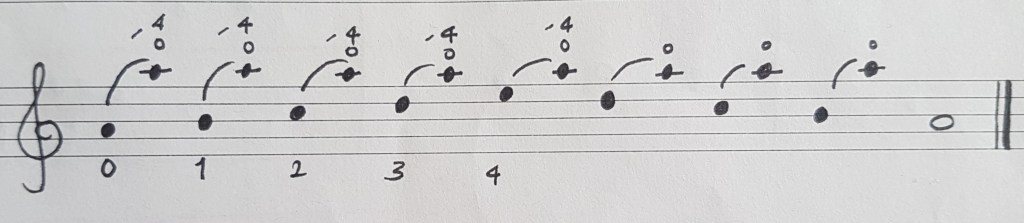
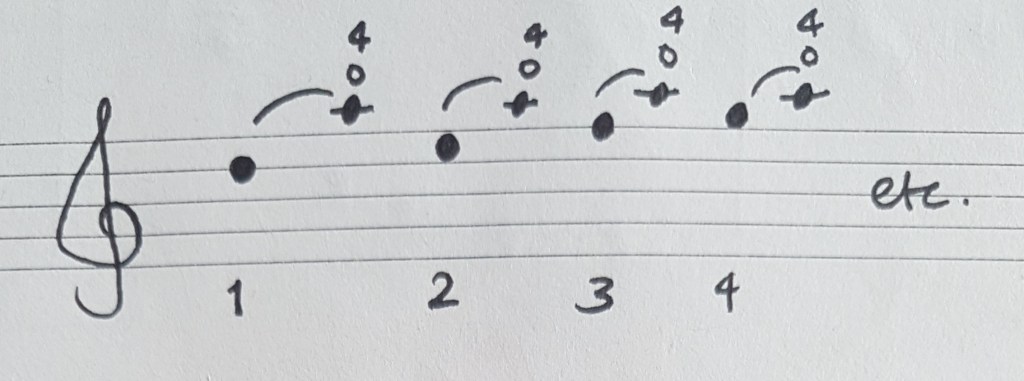
- Try the opening phrase from cold as much as you can – every time you walk past your viola!
- More contact with the string at the start – imagine something strong far away. Achieve the p by bow tilt and sounding point (fingerboard).
- Pick a phrase and imagine the sound you want from your vibrato, then try to recreate it.
- Use the bowings from YouTube only as a guide – sometimes you could change bow a little less.
- Practice any problem shifts just up to the first note in the new position. I would suggest repeating until you’ve hit the nail on the head at least 3 consecutive times, but be honest and only move on when it feels ingrained!
Start looking at some more Bach.
Fri 25th Sep 2020
A minor warm-up – Scale and arpeggio in 4th position. When descending in the scale, anticipate string crossings with left elbow swing. Try the arpeggio a little slower to really centre the tuning.
Schumann Romance op. 94
- Be brave with the harmonics – they are higher than you think! They are 4th position, but the light finger pressure means you’ll need to aim a little higher.
- Listen for smooth bowing in the shifts and make the first note in the new position as beautiful as t would have been without the shift.
- Add more drama in sfps and sforzandos with bow speed.
- Watch the YouTube video for ideas on more bow changes.
Mon 7th Sep 2020
A minor warm-up – Scale and arpeggio in 4th position. Keep the 3rd low, especially in the arpeggio as this is the only note which makes it minor!
Schumann Romance op. 94
- Start by playing the first 3 notes strongly
- Keep the tempo quite slow to make sure you centre the notes well – within this, use free bowing for now. Whenever you discover a brilliant bowing, write it in! You’ll often find the 2nd quaver to be a good changing place.
- Look through to find every place you have a harmonic and play each one as an exercise, just with one or two notes either side, very slowly and listening for a ringing tone.
Wed 31st Jan 2018
Your first lesson with me! 😄🎻
 EcoNotes