
Hi Jackie, welcome to your online lesson notes page!
Here is a link to a playlist of music theory videos from the Royal Irish Academy of Music. I think they’re really clear and witty at the same time so I hope they are helpful!

2026 goals
Keep working through theory book
Aim for 5 practises a week
Keep working through scale book to complete grade 2
Fri 20th March 2026
Old Man of Peru
- In the scale, work on keeping 2nd finger on the string for the G# as you play your top A.
- In the piece, make sure you count your dotted crotchets correctly.
- On line 2, make sure your open E matches your 4th finger.
- At the end, count your rhythm well.
Accelerator
- For the C major scale, use the tuner on your phone to check each note. Keep your bowing light and smooth. If a note is out of tune, rather than sliding that finger into tune, return to the previous note and place the note you’re working on again.
- In the piece, work with a metronome set to 60. Make sure you feel the beat in your body before you start, and make sure you keep with the beat right to the end of each of line.
Wed 11th February 2026
C major Scale
- Scale: great work for the most part – just make sure your first note is accurate before you start.
- Arpeggio: make sure your bow keeps away from the bridge.
Accelerator
- Play this with a metronome (crotchet = 60) to make sure every section is the same speed.
- Make sure you end with a descending arpeggio.
- Great accents! Make these notes longer now, as they’re not staccato.
Double Decker
- Keep your F naturals now.
- Keep the bows long and connected on the minims, and actually everywhere! The only time the bow should stop is in the minim rest at the end end of line 2. Listen particularly for this on barlines.
- Remember that what looks like the last bar actually leads us back to the beginning!
A minor
- Get to know A harmonic minor in your scale book.
- In the arpeggio, check the tuning of your top note as you land on it.
The Old Man of Peru
- Check the fingering chart on the previous page for the correct hand shape, and build the fingers up before you start.
- Remember to hold the dotted crotchets for 3 quavers.
- Enjoy the tremolo on the last line! Keep your bow arm relaxed, and it works best in the middle of the bow.
- Use your 3rd or 4th finger for the LH pizz at the end.
Elenke
- A 5 note scale would be useful too, just up to your 4th finger E.
- Check the tuning of an C naturals that have a D before them.
Thu 22nd January 2026
Make yourself a chart for your 5 practises a week.
Fiddle Time Scales
- C major scale and arpeggio.
- Accelerator – think about the patterns before you start. Also, think about how fast you’d like to play the semiquavers to help you find the tempo for the crotchets. Give your accents a bit more of a kick.
- Double decker – keep this slow, so that you can focus on a smooth, long bow.
Wed 10th December 2025
Good King Wenceslas
- Make sure you’ve tested the tuning of your 3rd finger with Pano tuner before you start, and keep your ears open to check that it all sounds right as you go through the piece.
Silent Night
- If you like, practice the hooked minim-crotchet bowing on a D major scale to warm up. Count a steady pulse of 3 beats in your head.
- Practice both the tune and the harmony.
Still, Still, Still
- Practice the last 2 bars at least 5 times in a row as a warm-up, focussing on tuning and neatness in your bow.
- Keep your bow nice and light, as this is a lullaby.
The Holly and the Ivy
- As we talked about last lesson, let your bow and the tune running in your head sweep you along.
- Work on the harmony part.
O Come, All Ye Faithful
- Try to flow through the slurred crotchets.
Thu 13th November 2025
Blue Danube
- Start your practice with Low D, High D from Fiddle Time Scales to unstick your thumb.
- Warm up with a 2 octave D major scale. Play as usual until C# on the A string. Then shift up to 3rd position with your 1st finger, placing it where your 3rd finger would have been (making sure your thumb is opposite the 1st finger). Then top octave is very simple once you’re in the right place! Try not to move your hand up or down the fingerboard. When you shift back down, make sure you have a little contact with the nut.
- See if you can work out how to play the arpeggio too (hint: you already did all the hard work on the 3rd line of the piece in your lesson!)
- Practice the arco parts of the Blue Danube first, and aim for smooth slurs with every note audible.
- Experiment to decide whether you like an up bow start or down bow start for each phrase.
Allegro in G
- Before you start, try to relax your bow hold.
- Start a bit closer to the heel of the bow.
- Make sure your 4th fingers are a tone away from your 3rd fingers (keeping the bow relaxed!). You could just practice the sections in brackets.
Ecossaise
- Keep your C naturals low.
- Make sure you are properly reading the music.
- Whenever you come across a scale of quavers, think of lighting a touchpaper and letting the notes flow. This should work as long as you’ve properly registered what key you’re in, and you’ve identified which note to change direction on. Can the bow lead the way instead of your fingers?
Andantino
- Keep the C naturals low in this too, and let your bow lead in the quaver passages.
Try some new pieces in your Fiddle Time and Upgrade books.
Thu 16th October 2025
Warm up with a silent finger exercise. Rest all 4 fingertips on the string, and then lift each finger up and down several times, to open up the message from your brain. Try to keep the other fingers resting on the string, but not pressing too hard.
Ecossaise in G
- Warm up with G major scale and arpeggio.
- Practice bars 5-8 with a gap between each bar.
Allegretto
- Remember how simple your bow movements are in the slurred quavers.
Fri 26th September 2025
When you play your scales, stand in front of a mirror to check your bow is running in a straight line.
In general, try to count yourself in before you start any piece so that the tempo is set right from the start.
Listen to yourself so you can correct any tuning.
Ecossaise in G
- Before you start, play the notes G A B in all 3 octaves, starting with your open G string.
- You could play a G major 2 octave scale with an extra 2 notes at the top.
- First, practice the piece from bar 17. Notice that we’re not in D major, we’re actually in G major! So no C# in bar 23.
- When practising the beginning, place your all fingers on E string ready before you start.
- In you bow arm, try to relax from the shoulder. Get David to do the heavy arm exercise with David at home.
Try some of your Joggers pieces with the CD.
O What a Beautiful Morning
- Make sure your low C#s are in the right place from bar 17.
- Try out the ideas at the top of this week’s lesson notes within this piece.
Tue 20th May 2025
Andantino & Daisy Bell
- Tuning is the main thing now – keep listening, and thinking about the spacing between your fingers.
The Boys of Wexford
- Start in the middle of the bow.
- Prep your 2nd note before you start.
- When you play the 4th fingers, try to keep your bow light.
- Count 3 beats in all the dotted minims.
- Careful of the rhythm in bars 11-12.
- In bar 22, get right to the tip at the end of the minim, then save bow on the semiquavers. You can practice the quavers like we did in the lesson, starting at the tip with just 2 notes and using hardly any bow, then 3 notes, then 4 etc.
Thu 27th March 2025
Andantino in G
- Practice the quavers in 15 and 16 in 3-note chunks, remembering the pattern of each trio of notes as you work on them.
- Keep the bow light and flowing, especially in bar 20.
We’ll meet again
- Build your fingers up for the first 5 notes of G major to get ready for your 4th finger.
Thu 19th December 2024
Try these BAPAM warm-up exercises before you practice.
Have a look at the Stringzone bow approval service.
Fri 18th October 2024
NOVEMBER CHALLENGE – Make a chart and try to do at least 15 minutes of practice every day.
Ashokan Farewell
- Make sure your bow isn’t too close to the bridge.
- Let the bow float – don’t press. Keeping the bow hold light will help with this.
- In bar 24, make sure the C# is nice and high. You’ll then be able to reach the 4th finger better.
Kemp’s Jig
- Be stricter with the rhythm of your crotchets versus your quavers.
- Let your bow flow – it got a bit robotic near the end!
Thu 19th September 2024
Splashing about
- Practice the pizzicato bits first, without holding your bow. Then try the arco section.
- Only put the whole thing together once you’re happy with the individual sections.
- Remember to keep a strong crotchet pulse throughout, especially over the crotchet rests and minims.
Kemp’s Jig
- Play D major but add half an octave, up to A on the E string.
Fri 26th July 2024
Bow hold tips:
- Find a windowsil or tabletop and tap each fingertip, keeping the fingers curved.
- The stronger the sound on your little finger, the stronger it will be on the bow.
Scales and pieces
- Pick one of these scales: G major 2 octaves, D major 1 octave, A major 2 octaves, E minor 1 octave, C major 1 octave, F major 1 octave, B flat major 2 octaves.
- Once you’ve played the scale, pick a piece to play that’s in that key.
Fri 14th June 2024
D minor
- You’re getting really good at hearing the tuning in this now!
- Once you’ve done your usual scale practice, play the arpeggio with retakes (but first spend a little time with your bow hand’s little finger!).
In Orbit
- Try to land as smoothly on the A and E double stop as you do on the D and A double stop.
- Remember that the angle doesn’t need to change as much as you think! Aim to minimise the dipping sound of the E string with a light touch down.
- On line 2, try not to overthink the harmonics – remember the “fake it til you make it” idea – let your hand move up to meet the body of the violin as you play your open string, then place your finger very lightly – try not to let the surface of the string dip.
- Keep the gap between B flat and C# nice and high in bars 7 and 11.
- Practice the last bar on a loop too.
Ashokan Farewell
- Practice the double stop and your retakes at the same time by playing it on a loop with the two quavers before, followed by a retake.
Fri 17th May 2024
D harmonic minor
- Think of your 3rd finger as the stable finger in this scale, as your 1st finger changes.
- In the arpeggio, make sure your 2nd note is definitely in the right place! Remember it’s the only note that makes this a minor arpeggio instead of a major arpeggio.
Mahler 1st symphony
- For bars 3 and 4, start by playing that rhythm just on Fs, then FGG, FGG, then as written. ALWAYS listen for the sound quality. Watch to make sure your bow isn’t too close to the bridge. If you can make your way through these exercises without stopping your bow, you can hopefully get your bow arm on autopilot.
- For bars 5 and 6, try to position your 1st finger ready for the E as you play the G.
In Orbit
- For the double stops, be really precise with the angle of your bow, then you can relax the bow weight and let the bow move freely.
- Make sure the quavers in bar 5 are evenly spaced.
- For the harmonics, start moving your hand as soon as you hit the open string before them. Once your hand has reached the body of the violin, don’t stretch any further with your fingers apart from to straighten your 4th finger. Place your finger as if it were the needle on a record.
Mon 15th April 2024
Scales
- As you know these pretty well now, focus on sound quality, keeping the bow about halfway between the bridge and the end of the fingerboard.
- Don’t forget slurs in your scales every now and then.
- Experiment with 3-note slurs in your arpeggios (especially D minor).
- In D harmonic minor, see if you can get the gap between B flat and C# nice and big.
Theme from Mahler’s First Symphony
- Try to keep your thumb relaxed as you place your 4th finger (making sure your thumb is opposite your 1st or 2nd finger).
- Always be really conscious of whether your open A at the start of line 2 matches your 4th finger.
- On the 2nd line, aim to get your Gs really in tune (can you make the G string ring?). You can still practice this by just playing the first 4 notes of the bar and holding the G.
- Make sure you move you 1st finger into the right positions in bars 5 and 6.
- In the last 2 bars, can you make your A string ring?
In Orbit
- Never press harder to get the double stops – settle the bow on both strings with the elbow in the correct position.
- If you need a reminder of how to play the harmonics on line 2, check back to p.3.
- The last note of the piece is just using your 3rd finger in its usual position.
Sat 23rd March 2024
Lesson at your house.
Mon 19th February 2024
Theory
- Play the 3 types of D minor as often as you can, thinking through the differences.
- Once you have these clear in your head, try the treble clef exercises in your theory book.
Climb ev’ry mountain
- Make sure your bow if flowing lightly.
- Keep your left thumb opposite your 1st or 2nd finger so that you can reach the 4th finger easily.
- When you play the E flat, try to have your 3rd finger right up close behind it.
Mon 15th January 2024
Lucia: Find Moon River for Jackie!
Sound quality
- Check your bow hold – is it relaxed?
- Proximity to the bridge.
- Straight bow.
Bow hold
- Find a ball of socks or a beanbag to keep in your case to help get the firm/soft feeling in your hand.
- Watch this video for bow help (especially from 12:21):
Theory
- Try to finish another chapter for me to mark next lesson.
Scales
- Start at the Grade 2 marker in your book and work through independently, playing a double-page spread each practice session. Come to me with any questions.
Climb Ev’ry Mountain
- Aim for a flowing bow.
- Keep the bow flowing and light when playing (and anticipating!) a 4th finger.
- Work up to the top of the second page.
- Remember to use small bows for the quavers and count the beats in the longer notes.
Mon 18th December 2023
Mon 27th November 2023
Practice mindfully: In general, try to think positively as you practice – rather than focusing just on the bits that have gone wrong, identify why, and then decide how you can improve it next time. Don’t forget to say “well done” to yourself for the things that have gone well! Noticing these will make them more likely to go right next time too.
Mon 6th November 2023
Warm your fingers up at the start of your practice session by resting all the fingertips on the string and tapping your 1st finger a few times, then 2nd, then 3rd, then 4th. This will strengthen the signal from your brain to each individual finger.
Daydreaming
- Warm up with a TWO octave A major scale and arpeggio, keeping the 3rd fingers nice and high.
- Listen very carefully for good sound quality all the way up and back.
- Use your tuner to help you with the tuning of the scale and arpeggio.
- In the piece, subdivide the long notes in your head into quavers. Bar 1 will become “1 & 2 & 3 G A B”.
- Take a little break at the end of bar 8 to build up E, F#, G# and A, ready for bar 9.
Apple Pie Waltz
- When warming up with C major, make sure you have used your 1st and 2nd fingers as guides to help you find the first note’s tuning. Listen to see if the last note sounds in tune.
- From bar 20, remember to keep using F naturals.
- Try not to slow down at 22 and 23.
Tue 19th September 2023
Apple Pie Waltz
- When warming up with C major, use your G major finger spacings to silently prepare, and aim for a smooth, light bow.
- In the piece, count yourself in “1231”.
- Aim for the best sound with you bow when you’re using your 4th finger.
- Make sure your rests and F naturals are as good in the 4th and 5th bars as they are in the 1st-3rd bars.
- Think of an “oom-cha-cha” pulse before you start and see if you can up your tempo.
- Be braver with using your 4th fingers this week, always trying to keep the bow light as you play them.
- As you play the G# dotted minim on the penultimate line, count to 3 out loud.
The Boys of Wexford
- Just like in the Apple Pie Waltz, set your fingers up on the string silently before you start.
- To help keep your bow light, ask David to come and lift the tip of your bow off the string if he walks into the room. It should easily come off!
Mon 17th July 2023
Aim to practise a little every day. There will obviously be days when the excuses are real! But starting with this goal will be much easier I think. This way you will hopefully be encouraged as you feel more progress being made, rather than your practice sessions being more like maintenance.
Sight reading
- I don’t know how you felt, but I was pretty pleased with your sight reading today! Do keep using your sight reading book, as I remember you being encouraged by the things you were learning as you worked through it in the past.
Up-Grade
- Choose a piece or two from this book to work on each time you practise. If you have any questions, feel free to send me a quick WhatsApp!
Try to keep at least one thing going in each of your books over the summer break. Scrolling down and looking at past lessons’ notes on some of the pieces may help. Remember we are now working on Grade 2 level pieces and scales, so work from pages 11 in Encore and 12 in Fiddle Time Scales.
Thu 22nd June 2023
A major
- In the scale, make sure the C# is nice and high on the G string. If you’re not sure about the tuning, put your tuner on to help.
- In the arpeggio, use the loch ness monster to help you remember the note pattern.
Sweet Betsy
- Excellent tuning on the G string at the start!
- Make sure your G#s in line 2 are nice and high, as if they’re low they impact your 3rd fingers when you return to the G string later in the piece.
- Play lines two and three with your tuner handy, and check the circled notes.
Kemp’s Jig
- Play D major to warm up.
- Think about the names of the first two notes before you begin – are they a tone apart or a semitone apart?
- Just work on the first two lines.
- Make sure your 3rd finger on the A string is in tune – as it’s a D, the key note, it is very important that it’s stable.
Mon 5th June 2023
4th finger exercise – take the first two bars of The Boat to Inverie and play them on a loop, making sure your bow stays light and straight.
Time for Grade 2!
Look in your scales book to see if there’s after p.12 that you want to revise or that we haven’t learnt yet.
Kemp’s Jig
- Bar 1 needs a close 2nd finger in bar 1 for the G natural.
- Bars 2 and 3 have a high 2nd finger for the C#.
- We learnt the first two lines, so see how you get on with the rest of it!
Tue 2nd May 2023
The Grey Dove
- Use “Thames Ditton” to help you with the rhythm of the first bar.
- Memorise the first two bars so you can watch your bow and focus on a neater string crossing in bar 4.
- To check if your 4th fingers are in tune, play bar 5 followed by an open A to check. Try to relax the tension in your left hand and make sure your 3rd finger is curved.
Écossaise
- Don’t set off too fast!
- Before you start, describe the shape of bar 6 to yourself – this will help keep you calm in every bar with this pattern.
Stoppin’ Off in Louisiana
- Count the rests carefully in the 2nd time bar – they will give you some time to reset your brain ready for the next bar.
- Think about the rests in bar 4 and the final bar too.
Greek Wedding
- Aim to keep your 1st finger on the string for the whole of bar 3.
- In the pizzicato, try to keep the beat even.
- Keep the bow moving smoothly from bar 16 onwards.
Tue 18th April 2023
Écossaise (G1 book)
- Spot any places where you keep aiming for the wrong note and practise them in small units until they feel safe.
Stoppin’ off in Louisiana
- On the E string, before you start, play E, F#, G natural, A.
- We have a C# at the start of bars 2 and 4 – that will need a higher 2nd finger.
- Practise bars 7 and 9 open strings to get used to the rhythm (and the string crossing in bar 9).
- If things are getting stressful, just perfect the first 3 notes of the challenging bar, then add a note each time you start to feel safe.
Mon 3rd April 2023
Écossaise (G1 book)
- Work on the finger co-ordination in the quaver passages – they are very similar!
Stoppin’ Off in Louisiana
- Remember it’s low 2nd fingers in bars 1 and 3, but high for the C#s in bars 2 and 4.
- In the bars with some slurred quavers and some separate quavers, see if you can keep the rhythm even.
Muppets
- From 21, make sure your 4th fingers are high enough (check with the open E).
- Get to know the notes and we’ll work on the rhythm a bit more next time.
Tue 21st March 2023
Print off a calendar of this month and next to put up on the wall, then tick off each day you’ve done 15 minutes of practice. Experiment with putting your practice slot at different times of your day to find the best time for you.
Target: tick off all grade 1 pieces in the Encore book for your next lesson. You can search for the titles in your lesson notes to find my past tips.
Our next project could be to learn all the grade 1 pieces in your exam book! You could prepare for this by revisiting your exam pieces.
King George I’s March
- Play a G major scale before you start. Then play the arpeggio, but stop on the top note. The last two notes you’ll have played are the first two notes of the piece!
- Keep an eye out for the slurs in the scales.
- In bar 14, check your 4th finger tuning with the open E.
Mattachins
- Think lots about the rhythm in this one.
- Make sure the tuning stays high, especially as you come back on the G string in bars 6 and 8.
- Don’t forget the change of key and bar 10!
- Play from bar 13, making sure your 2nd finger is up behind your 3rd.
Ode to Joy
- Be aware of what your bow is doing when you’re on your 4th finger – try not to change what you’re doing compared to the other fingers. You can practise this by just playing the first 2 bars.
- Remember not to delay the last note of bar 12. You can work on 11 and 12 together to fix this, remembering that the placement of that last note is dependent on how long the E before it is.
Première Valse
- Focus on your elbow levels to keep your bow on the right string. Concentrate especially on the up bows, not letting gravity win!
Daisy Bell
- Remember your C natural in bar 19.
Mon 20th February 2023
Warm up with some familiar scales whilst focusing on your right elbow levels, especially on the up bows. Imagine your bow running on a train track rather than dipping as you change to the up bow.
Stringbuilder
- Play C major before you play no. 90.
- Work on remembering where fingers have been to help with tuning, and use your 1st finger to help with the placement of the 2nd finger (eg. bars 4 and 9).
- In no. 90, make sure the crotchet at the end of bar 4 leads into the next phrase.
- Have the title of the piece in mind – keep the bowing nice and calm and don’t play it too fast.
- Practise the Half-Step March, thinking in bar 6 about moving your 2nd finger whilst on the 3rd finger.
Tue 31st January 2023
Set up the tuner next to you as you practice and turn to it every now and then to check your 2nd and 3rd fingers.
Stringbuilder
- Warm up for Good Morning with D major. Use your 1st finger as support for your other fingers, to help keep the tuning high enough. Hover your 2nd finger over the F# once you’ve used it (eg. 1st bar of line 2) so it can help you find the 3rd finger in tune in the next bar.
- Count yourself in with two bars of 3 before you start The Tap Dancer. Try sniffing on the rests.
- Use no. 86 to practise keeping your fingers down on the string. Try it first without the bow.
- Enjoy some 2nd finger exercise on p. 20!
Mon 16th January 2023
Stringbuilder
- In Jumping Beans, try to keep the 2nd finger on as you move the 3rd finger. Make sure the 2nd finger tuning is high enough too. See how fast you can get it without losing control of that 2nd finger!
- In Pet Shop, use your 4th finger in the second half and try to match the tuning of the open Es in the first half.
- Practise your quick string crossings in The Cuckoo.
- In London Bridge, try to keep your 2nd finger on between bars 3 and 4.
- Work on A Thanksgiving Song and just keep going through the book as you have been doing!
Tue 13th December 2022
Warming up your fingers – try to keep the base of your fingers at finger-board height and play up the D string D E F# G A nd back down in a slur. Try to keep your bow string all the way through the slur.
Use something small and squishy like my cuddly camel to help get the firm but flexible feeling in your bow hand. To set you bow fingers, rest the screw end of your bow in the palm of your left hand.
Ding Dong
- Can you learn this from memory? You can certainly learn the first half, but don’t worry if the second half evades you!
Tue 22nd November 2022
Humming Song
- As always, warm up with the scale. Play the 2 octave version first, followed by Sweet Betsy. Be careful of the tuning on your 3rd fingers – keep them nice and high!
- Then play the 1 octave version of the scale just before playing the piece, as it doesn’t go lower than open A.
- In the piece, try to keep your 1st finger on when you go up to your 4th finger.
- Keep your bow light.
- Match the tuning of the Ds in bars 2 and 3, 6 and 7, and your As in 10 and 11.
- Always ask yourself (ir check with your tuner!) if your 1st finger is in tune.
Kemp’s Jig
- Think of your E string finger spacing before you start.
- We played lines 1 and 2. See if you can learn the rest.
Tue 14th November 2022
Stringbuilder
- It sounds like you’re making great progress with this – keep up the good work!
Andantino
- Practice the tricky bits before you start.
- Play 15 and 16 open strings. Once this feels easy, build your fingers up on the E string and then play it as written.
- Practice the last line.
- When you’re ready for your run-through, keep a steady, relaxed tempo – especially in the first section!
C major
- As it’s “easy”, how neat can you make your bow on the string crossings?
Accelerator
- Keep your F naturals low.
- In the semiquavers, try to move the bow more by hinging at the elbow rather than the shoulder.
- Dismount gracefully on your long crotchet at the end.
Double Decker
- Again, keep those F naturals nice and low, next to yoour 1st finger.
- Aim for a nice smooth bow.
- In the final bar, remember you need a low 2nd finger again, right back next to the 1st.
- For the Da Capo (D.C.), try to transition back to the beginning without a gap.
Tue 11th October 2022
Stringbuilder
- Go through this on this on your own and ask me at each lesson if you have any questions.
Scales and Arpeggios
- In E minor scale and arpeggio, use your finger
- Think more about the gaps between the notes to help with tuning.
- Start adding C major to your scale practice. Use your tuner on your phone to check your start and end notes.
Somerset Folk Song
- You made a lovely sound in this!
- Count yourself in so that your first note is definitely a crotchet.
- Work on the rhtyhm and bowing of line 3.
Andantino
- Pick out all the quaver bars and work on them individually. Then build them up by adding a bit before and a bit after.
Tue 27th September 2022
Keep your bow pinkie nice and curved.
Practice scales slowly with your eyes closed and really hone your tuning ear. Try to keep your fingers down on the string, in a lazy way rather than by squeezing.
French Carol
- Keep the slurred quavers nice and even on the first line.
- Try not to slow down for the 4th finger. The exercise we did in the lesson was: BBCB,BBDB,BBEB. Keep the bow soft whilst still reaching further with your 4th finger (maybe check its tuning with your tuner.
Somerset Folk Song – Look at this yourself for next time.
Hoe Down
- Still clap the first 4 bars before you start playing. When you start playing, listen for even crotchets on your first two notes and even quavers (not longer on the F#).
- Check the tuning of your Bs on th G string.
Andantino in G
- I actually enjoyed this very much! Keep that flowing bow going, but focusing on string crossing accuracy in the first half and some E string tuning in the second half.
Tue 13th September 2022
Ashokan Farewell
- Keep the scotch snap rhythms super snappy – quick semiquavers and longer dotted quavers.
- Keep the tuning higher in your G string notes.
- All 2nd fingers can be higher (except the G on the E string obviously!
Hoe Down
- Still start this by clapping first.
- In the slurred quaver pairs, take your 2nd finger off a little faster to help keep the rhythm even.
- Careful of the rhythm in bar 9 – the bottom note should be double the length of the following quavers.
- Keep the rhythm strict in bar 13 – long long short short long.
- How quick can the string crossing be in bar 17?
My Favourite Things
- Play the E minor scale to warm up.
Mon 5th September 2022
The Boat to Inverie
- Use the exercise at the start of last time’s lesson to warm, but use a C# instead of C natural.
- Next, play the A major scale and arpeggio.
- In the piece, always keep your bow light and about 2cm from the bridge.
- Do some long notes to warm up, relaxing your arms and imagining the violin breathing.
- Count to 3 on all dotted minims.
Hoe Down
- Count to 4 and clap the rhythm of the first 2 lines before your begin.
- Keep all the quavers even.
Fri 22nd July 2022
Start every practice session with this warm-up, keeping the bow changes smooth and light:

Mango Walk
- Start by playing G major with crotchet quaver quaver on each note. Play this with a metronome set to 105 and think about using half the amount of bow on the quavers. Relax the arm so that you travel on the crotchets and try to move only from the elbow.
- Clap the rhythm first with my recording then with the metronome. Always count to 3 before you start. Notice that the syncopated bars have crotchets on the 3rd and 4th beats. Clapping just straight crotchets or quavers before you start would also be helpful.
- When you start playing the piece, still make sure to count to 3 before you start.
The Honeysuckle
- Warm up with B flat major from Fiddle Time Scales. Use open Ds and As for now as you get used to the sound. Focus mainly on getting the top octave really good, as the first half of Honeysuckle only uses those notes.
- There is only one note in the first half of this piece that’s not on the A string – the last note of bar 10.
- In bars 2 and 3, try to keep your 3rd finger on the string as you place your 4th finger.
Buy and start working through Stringbuilder book 1.
Mon 20th June 2022
Heidenröslein
- Try to hit the ground running with your crotchets in the first bar – imagine playing them before you actually do.
Mango Walk
- Practise the second half first.
- Make sure the rhythm at the start of bar 10 is short and snappy.
- Careful not to slur the start of bars 11 and 15 (and 3 and 7!).
- Remember the low C natural in bar 11 (close to your 1st finger).
- Make sure you’re nice and slow at the start of bar 12.
- Practise from the start adding one note at a time. Make sure each stage feels easy and safe before adding the next note. Think of the up bow crotchet as big breath in. Place your 4th finger on the string before you start so you know your hand is ready for it. When you get to playing that note, remember not to put full weight on the 4th finger – it’s like a toe tap.
Tue 24th May 2022
Boat to Inverie
- Warm up by playing all 5 notes on the A string. Think about whether your left thumb is in the most helpful place.
- Keep the bow relaxed as you play the 4th finger.
Heidenröslein
- Memorise bar 11 and 12, starting with 2 notes and adding one note each time. Memorise the bowing too, and keep listening for crunches.
Mango Walk
- Touch the string with your 4th finger before you start so that it knows where it needs to go.
Tue 29th Mar 2022
Start your practice with Pano Tuner, playing A B C natural on the A string and E F# G on the E string to get your low 2nds in the right place.
Premiere Valse
- Listen out for neat and tidy string crossings, especially when moving to a lower string.
Heidenröslein
- Keep the tempo relaxed on the crotchets so you have enough time to play the quavers.
- Practice bar 12 for a relaxed, smooth bow.
- Think in 2-bar phrases, to help you keep going in your 2nd bar. The A minim is the destination.
- Be even more diligent about your low 2nd fingers! The last line is a good one to practice this on.
Mango Walk
- Be careful to start with your first note in tune.
- Practice the tuning pizzicato so you don’t have to think about bowing.
- Keep all those Cs low on the A string!
Tue 15th Mar 2022
Heidenröslein
- Try not to slow down for the quavers.
- Keep the bow light on the slurs.
- In the second bar of your tune (bar 4), have all your fingers resting lightly on the string.
- Practice bar 11 to get used to the feel of the bowing up to speed. The first half of the bar should have a mainly down-bow feeling in your bow arm, and then a mostly up-bow feeling in the second half of the bar.
Mango Walk
- To reach the 4th finger in bar 1, try to keep your left hand relaxed and open, especially between the base of your thumb and 1st finger.
- Keep all your 2nd fingers low.
- Get used to the bowing pattern in bar 1 by playing crotchet quaver quaver crotchet quaver quaver on one note.
- In 3, 7, 11 and 15, remember your 2nd finger has two different positions.
Mon 28th Feb 2022
My Favourite Things
- To warm up, play an open string version of your first bar over and over, watching in the mirror to check your bow is straight and your string crossings are happening smoothly.
- As you do a down bow, push out (with your right hand away from your body).
- In your 4th and 8th bars, make sure you’re leaving a silent crotchet rest.
- Practice line 3 for smooth bowing and opening out your hand to get the 4th finger in tune.
O What a Beautiful Morning
- Think how the tune goes before you begin so you don’t play it too slow.
- When you get to the chorus (bar 17), the C# on the G string needs to be very high without affecting the tuning of your other notes.
Tue 15th Feb 2022
My Favourite Things
- Tune your 1st fingers before you start.
- Try not to play an open D between the first two notes.
- Imagine singing the tune before you start.
- Let the bow flow in line 3.
- In the tune that’s an octave higher, straighten your left wrist to help reach the 4th finger.
- When you shift to 3rd position, make sure your thumb moves with your hand.
Mon 24th Jan 2022
You can also gently squeeze on something soft (duster, small cuddly toy or ball of socks) to help get the curved shape in your hand before placing it on the bow. This will also get across the idea of firm but not tense.
F major
- To prepare for starting in 2nd position, play DEF (1st position) then F (2nd position). The two Fs should sound the same. Make sure your thumb moves up too.
- When you move onto the A string, make sure your 1st finger moves directly opposite.
- Keep your bow as light as possible.
- Practice the open string version of the arpeggio with a light bow before adding your fingers in. You can alternate between these two versions.
- Don’t forget you can practice the arpeggio with long bows to give yourself time to think – try not to have gaps between the notes.
Two Little Angels
- Find an F as you did in the scale. The play the first 4 notes of the scale to get your fingers in the right place.
- Practice some finger lift-offs.
- Keep your elbow up to help with the bow.
- Try to say the fingerings of the notes in the right rhythm before starting.
B flat major
- When warming up with B flat major, make sure there is a difference between high 4s and low 4s. Sliding your thumb up to opposite your 2nd finger may help you reach your high 4s better.
- Give Edelweiss another go once you’re more comfortable with this scale.
Try My Favourite Things.
Tue 11th Jan 2022
Edelweiss
- Warm up with B flat major 2 octaves.
- Check the tuning of your B flat (A sharp) before you play the whole scale.
- Use 4th fingers in the scale and open strings in the arpeggio.
- Keep your bow as light as you can.
- Remember 1st fingers are right next to the nut in this piece.
- Just learn the first half.
Scales
- Practice in 1st position once to get the sound in your head, then try in 2nd position with your 1st finger on the F instead.
- Reacquaint your self with Two Little Angels in 1st position.
- Have a think about your punchline to Knock Knock!
Fri 17th Dec 2021
Scales
- Print off the 4 scales we chose.
19. Deck the Hall
- Practice bar 3 slowly until the rhythm is even, listen in bar 3 to make sure we can’t hear a B in the middle of your C-A slur – taking your 1st finger off as you play the C will help.
- Aim a little higher with your 3rd fingers on the D string.
21. The First Nowell
- This flowed really well from around bar 4 – see if you can get it flowing right from the start. Imagining the tune before you play will help.
- Don’t forget bars 1 and 2 are a D major scale.
23. God Rest Ye
- On first reading each practice, take it a little slower to avoid hesitations.
- Reach higher with the 4th fingers.
- Try not to hesitate with your bow on string crossings and 4th fingers.
- Practice the first bar of 4 with our guide note, then try taking it out but still putting the finger on for it.
🎄 Happy Christmas!! 🎄
Mon 6th Dec 2021
Scales
- Find your scales list and stick them on the wall!
19. Deck the Hall
- Prepare your low 2nd finger before you start.
- Try not to slow down in the middle and at the end of each line.
- If you hear any squeaks, check the bow angle.
- Listen in bar 3 to make sure we can’t hear a B in the middle of your C-A slur.
21. The First Nowell
- Let any pairs of slurred quavers that act as an upbeat lead into the next downbeat, as if you were singing.
- Look out for crunchy down bows!
30. Child in a Manger
- Try 4th fingers in bar 3 and the first bar of line 3.
29. Infant holy
- Watch out for C naturals!
- Remember not to slur quaver pairs.
Mon 13th Sep 2021
Summertime
- Start by playing A major.
- Identify the sharps and get rid of them to play the natural minor.
- Add a high 7th (G#) to make the harmonic minor.
- To make the melodic minor, raise the 6th and 7th on the way up, then bring them down again on the way down (just ike the natural minor). Try to slide the 1 and 2 lower whilst your 3rd finger is still on the string.
- When you start playing the piece, imagine a hazy Monet watercolour and try to evoke that idea with a light bow. Dare to find out how light is too light!
- Count yourself in at the speed you want to play the whole piece, then make sure your first two notes are the same speed (not slower!).
Ecossaise
- Don’t slow down for the hard bits!
- Practice the repeated block bars separately (bar 5+6), then practice each time it comes with the surrounding notes.
Tue 20th Jul 2021
When slurring your scales, include the top note in your slur.
Daisy Bell
- Keep the bow flowing especially when using your 4th finger.
- Keep the B in 18 short – it’s just a crotchet!
- Keep 28 short too.
Fiddle Time
- Start with A major scale (1 octave, then two). As you play it, think about the journey of BOTH elbows swinging together.
- Run your eyes over the structure of Fiddle Time before you start.
- Aim nice and high with your C#s and G#s (2s on A and E).
- Make sure you change string in bar 18.
- Hold your semibreves for 4 full beats.
- You’ll find a backing track here if you scroll down to the end of the first table. Scroll down even further for a practice speed track.
Start lookinng at Stoppin’ Off in Louisiana and Ecossaise in your Grade 1 book.
Stoppin’ Off in Louisiana
- Use a tuner to help you tune E F# G natural A on the E string before you start.
- Make a feature of the “dancing” 2nd finger.
- In bars 7, 9 and 13, make sure only 1 pair of quavers is slurred.
Ecossaise
- Try to push yourself past any 4th fingers so they don’t slow you down.
- Careful not to get As and C#s mixed up!
- Try not to hesitate after each pair of quavers, especially the first one!
Tue 6th Jul 2021
E string pieces
- Warm up for The Old Woman of Peru with A major. Hold the dotted crotchets for 3 quavers. Do a small tear-drop retake in the rests. Check your tuning on the E string to make sure your fingers aren’t too high.
- E major 1 octave starts with 1st finger on the D string. To get all your sharps in, the hand shape is tone tone semitone (using your 4th fingers).
- Flying High: Remember your “comfortable” hand shape and make sure it stays the same throughout.
- Once a man fell in a well: reach nice and high with that 4th finger!
Banyan Tree
- High 4s
- Long dotted minims.
Tue 22nd Jun 2021
Revisit the Nicola Benedetti video on posture.
The Boat to Inverie
- 4th fingers on your Es, but keep your bow just as relaxed.
- Make sure to always count 3 beats in the bar, especially on the dotted minims.
Menuet in G
- I’ll send you some E string pieces.
- Keep the bow as light as you can, setting it up well right from the beginning and reminding yourself at the end of every 4-bar phrase.
- Aim for higher 3rd fingers above any low 2s.
- Try not to let the slurs disturb your rhythm.
- Nice big tones between all the notes in 17.
- Nice long bows in 22.
- For the second note of 28, make sure your bow and finger arrive on the D string at the same time.
- Practice some old favourites for us to play as duets next time!
Tue 8th June 2021
Great work with your straighter bow! Make sure you don’t forget about the elbow levels for strings crossings as you think about this. You could revisit Daisy Bell for some variety!
Heidenröslein
- Fantastic low 2nd fingers today!
- Try to reach a bit further with your 4th finger in bars 9 and 15, and keep the bow smooth as you do this.
- Practice the finger build-up exercise, also keeping the bow light.
- Make sure you’re moving your 3rd finger enough for the D in bar 12.
Sweet Betsy
- In your A major warm-up, aim nice and high with your high 3s.
- Apply this to the piece too, watching out especiialy in the first bar of line 3.
- Swing your left elbow forwards to help with reaching the G string notes.
Start looking at p. 14 in your Encore book.
Tue 18th May 2021
Premiere Valse
- In the scale warm-up, keep your bow nice and straight.
Fiddle Time
- 2 octave A major scale to warm up – all 1st fingers will be high. Once you hit the A string, remind yourself you are basically playing the grade 1 scale you know so well!
- Think through the geography of the piece before you start, then see if you can play it through without hesitating at the repeat.
- Look out for places where you get carried away with the rhythm and add in extra quavers!
Heidenroslein
- Keep practising last week’s exercises for low 2nd fingers (remembering that we’re in G major!).
- When you get ready to start the piece, build up your 1st, 2nd and 3rd fingers silently. Then take 2 and 3 off the string, but hovering about 1mm above their spots.
- Try to play at a constant speed, so think about how fast you’re happy playing bar 11 and aim to match it in the opening bars.
- Aim higher with your 4th finger in 15.
Tue 4th May 2021
The Boat to Inverie
- Think of how the quavers fit into the dotted crotchet: “1+2+3”.
- When changing string eg. 29, keep the bow light and think of a needle on a record – start moving the bow smoothly as soon as you touch the string.
Heidenroslein
- Low 2nds on the 1st line.
- Try to get to the tip at the end of bar 4 (so maybe start the piece in the middle?).
- Nice and quick with your first notes of bars 4 & 8.
- Practice B A# B A# back and forth as a warm-up for bar 11.
- Another warm-up: G major scale slurring notes:


- Memorise bars 9 & 10 (starting up bow).
- Try to match the tuning of the end of bar 15 with the start of bar 15.
Tue 20th Apr 2021
Premiere valse
- This was a great choice for warming up a nice flowing bow arm.
- Use this now to help open your ears too, noticing any tuning that could be improved.
Heidenroslein
- Keep your bow strokes nice and light unless you have tenuto lines.
- Careful to keep the beat the same whether you’re playing crotchets or quavers. Choose a speed you can play the quavers at.
- Practice your first two bars with the first note of bar 4 just as a crotchet C. Keep the bow moving at the same speed from the 1st to 2nd bars. When this comfortable, put the 3rd finger back in – try to keep the quavers even.
- Watch out for C naturals in bars 4 and 5.
O What A Beautiful Morning
- Buid up your fingers on the D string before you start to help with tuning accuracy.
- The audience may need some help feeling where the downbeat is, so aim for a small crescendo on the first two notes and a slightly heavier F#. The first two notes should lead us to the first downbeat, so make sure you don’t linger on them.
- Always be listening out for tuning, especially keeping 2s nice and high. “Lazy” fingers will help with this, in places like bars 6 and 7.
- Lazy finger exercise on the D string: play E, F#, G, F#, E up and down with nice long bows, making sure you keep the fingers down.
Thu 1st Apr 2021
O What A Beautiful Morning
- In your warm-up scale, think about straight bowing (the top half of your arm coming forward as you head for the the tip).
- Try to make bar 8 a bit more natural – use less bow on the D and release the tension towards the end of the note so you don’t need to retake.
- On long notes (like 19&20, 27&28) keep your bow light and singing.
- From 17, make sure your 1st finger is acting as a helpful anchor, even though you don’t use it much.
Fiddle Time Scales
- A Major Scale – a bit less arm weight on the string.
- Try the first phrase of Sweet Betsy one octave higher.
- Two Little Angels – Practice getting your row of 9 quavers on line 1 with no pausing (make your bow be in charge and don’t let it slow down). Keep reminding yourself of low 1st fingers and a tone between your 2 and 3.
Andantino
- Remember that flowing bow we found earlier in the lesson.
- Each time you start practice on this piece, play the notes in bars 14 and 15 slowly with a tuner.
- Work on bar 16 for low and high 2nd finger positions.
Tue 16th Mar 2021
O What A Beautiful Morning
- 4th fingers in bars 11 and 22.
- Count yourself in 1231 to help the rhythm of the first 2 notes.
- Practice 21-24 a few times til your 4th finger feels as easy as the other fingers. You might like to practice the open string version of this too.
- On your string crossings, try to curve towards the next string you need next, i.e. every note should finish with your bow in the right place to start the next one.
- Practice the new retake in bar 24.
Fiddle Time Scales
- Practice A Major 2 octaves listening out for those high 3rd fingers.
- Make sure you start F Major on F natural (close to 1st finger). Practice it in 1st position, then 2nd position (move your thumb up into 2nd position too and let your fingers just fall into place). Use your Pano tuner to help you!
- Two Little Angels: Keep this in 1st position for now. Play it lots – I know it’s not your favourite, but I promise it’ll start to feel easier if you play it little and often.
Premiere Valse
- Great rhythm today!
- Focus now on dynamics and accurate string crossings.
Start looking at Humming Song. Try to focus on a smooth bow.
Tue 2nd Mar 2021
Fiddle Time Scales
- Keep practising A major scale and arpeggio. Aim for a lighter bow. If it’s gone well, why not add slurs to the scale? Remember to slur from the first note.
- In Sweet Betsy, work on getting your 3rd finger G#s higher.
- F major scale – don’t forget to try this in 2nd position. You’ll need to use all four fingers on both strings.
- Two Little Angels: remember to keep the 1st fingers super low (and your whole hand with them!). Practice bar 3 on its own a few times before you play the piece. Work now on ironing out any hesitations.
- Write your own ending to Knock Knock: improvise a few different options and choose your favourite to write down.
Premiere Valse
- When working with the metronome, make sure you count to 3 in time with the clicks before you start.
- Concentrate especially carefully on the longer notes.
- Tick off the pieces you have learnt on the inside cover of the book and feel free to have a go at any Grade 1 pieces you’ve yet to try.
Tue 16th Feb 2021
Fiddle Time Scales
- Add A major arpeggio to your scale practice. Start with a one octave arpeggio from the open A, then try adding the lower octave.
- In Sweet Betsy, watch out for G#s on the D string and play the last phrase p by tilting the hair and playing closer to the fingerboard.
- Start having a look at F Major and Two Little Angels.
Andantino
- The opening section sounds fantastic!
- Look out for patterns in the quaver groups.
- Practice 13-16 several times in a row, always allowing time in between to assess what you’d like to fix next time. Things to listen out for – high B in 15 and low C at the start of 16.
- In 16, try to slow down gradually – sing it in your head first to imagine how you’d like it to sound.
Premiere Valse
- Make sure you count to 3 before you start, and it can be a bit slower – check with your metronome before you start.
Tue 2nd Feb 2021
Scales
- Don’t forget to practice slurs too, and keep the bow light in these.
Premiere Valse
- Great work on your flowing bow in this piece!
- Use the first two bars to set your crotchet pulse. Use this to help with your rhythm in bar 3.
- Be aware of your elevator elbow in bars 9 and 10 (maybe in a few other places too!).
- Keep the crotchets even in 11 and 12.
Fiddle Time
- Try a two octave A major scale to warm up. Make sure the lower octave’s 3rd fingers are nice and high!
- Whole bow for 4 neats at bar 19, then retake and count 4 beats’ rest.
- Practice bar 27 for neat fingering. Make a gap between the G# and F#, and shorten it each time until there’s no gap.
Sweet Betsy from Pike
- Warm up by playing the first 3 notes of A major.
- Keep the crotchet pulse flowing.
- Try the octave higher challenge!
Andantino
- Think carefully about the finger spacing before you start – flick the G major switch!
Tue 19th Jan 2021
Bow and finger warm up – long bows, and alternating between fingers: 0 and 1, 1 and 2, 2 and 3. Add 3 and 4 if you’re feeling good!
Scales
- In C major, make sure the first note is in tune (use the first 4 notes of G major to help).
- In F major, make sure your thumb is also in second position. Practice the arpeggio too.
- In all scales, try to play them 3 times in a row once you’ve “got it”.
The Boat to Inverie
- Brilliant bowing and tuning!
- Sometimes your dotted minims could be a bit longer – work with a metronome for this, set to 100.
- In the doted crotchet bars, make sure the crotchet lands on the 3rd beat of the bar. You could count yout yourself in “1 2+ 3”.
AndantinoPlay the hardest bits EVERY practice, even if you’re not playing the whole piece.
Make the difference between low and high 2nd fingers very obvious. They are all low from bar 9 until the 3rd note of bar 16, then they are all high for several bars. Think of it like flicking a switch.
- 2nd finger warm-up exercise for bar 16: Slur C and A, then F sharp and A. Play this on a loop. Text me if you want me too write it out for you!
- Play the open string version of this bar every time you practice, even if you’re not playing the whole piece.
- Also play bar 22 each time you play.
- Look at the exercise in the 26th Oct lesson notes.
Mon 4th Jan 2021
Scales
- Read last lesson’s notes and have a look on the VIP page (password violinviola) for practice tracks.
- If practising with a tuner, play semibreves. If you don’t get it in tune, go back to the previous note and try again, keeping it calm at all times.
Let me know if you need any help finding rosin!
The Boat to Inverie
- A Major 2 octaves warm-up. Super high 3rd fingers.
- Great rhythm!
- Silk scarf bowing.
- Dynamics now. Plan out the dynamics before you play. Use bow length to help the hairpin dynamics.
- Think about the tempo markings too.
King George
- G major scale and arpeggio warm-up – let gravity give you a rich sound using the weight of your bow arm.
- Practice the first bar without the upbeat. Make sure you’re playing both quavers in bar 1!
- Think about all fingers when you place your 3rd finger for the first note, then check your first two notes are in tune. Practice finding your first note in tune from scratch several times each practice.
- Play the first 3 notes of bar 7 as long notes with your tuner to warm up the 4th finger.
Mon 14th Dec 2020
Scales – recap your Grade 1 scales every now and then, as you’ll keep coming across pieces in these keys. Work on the Grade 2 scales too, and you could also take a look at the Grades 1 and 2 technical exercises set by a new exam board Sam and I have started using (it’s more COVID-friendly!) here.
O Come All Ye Faithful
- G major warm-up, thinking carefully about 2nd finger positions.
- Up bow start, as for many Christmas carols!
- Aim for a lighter bow: push yourself to the stage where you bow is too light, then come back slightly from there.
- Prep your 3rd finger before you start.
- In the bar with the 4th finger, prepare your elbow early.
The First Nowell
- You’ll also find this in your Fiddle Time Christmas book, complete with useful slurs.
- D major warm-up.
- This has C#s, so make sure they’re nice and high.
The Holly and the Ivy
- Use the Fiddle Time Christmas version.
- If it goes well, record yourself and play the duet part along with it.
- You could also have a go at playing along with Mimi on the advent calendar!
In general, try to imagine the sound you’d like to hear. Remind yourself of that sound every few bars to help yourself keep it up for longer.
Mon 7th Dec 2020
The Christmas Song
- Prepare for your first bar by playing A B C# D with the tuner. Then imagine putting a needle on a record and relax your arm onto the string as you start bowing.
- Aim nice and high for your F# at the end of bar 26.
- Remember you can have a few false starts on the same video, but always make sure you’ve buit your fingers up with the tuner before you start.
Still, still, still
- Let the bow flow smoothly.
- Remember to use more bow on the crotchets to help get the rhythm right.
- You could try this with a metronome.
Mon 23rd Nov 2020
The Christmas Song
- Play a D major scale before you start. Make your right arm as relaxed as possible and try to return to this feeling whenever you feel it tensing up during the piece.
- Practice any tricky spots first. This will include:
- Memorising any bars which you find particularly tricky;
- Practising C#, B, B flat, C natural a few times as long notes with your tuner (for bars 8-9);
- Practising bar 17 open strings;
- Practising bar 26 with the added notes, then doing the fingers but no bow.
- Holding long notes for their full length (imagine a metronome in your head!)
- Get your backing track ready, then get your left hand ready and play the first bar a few times.
- Play along with the track.
Fri 20th Nov 2020
The Christmas Song
- Once you’ve practised a few of the tricky spots, try playing along with this track. There are two bars of metronome at the start – one bar rest and the second bar would be where I play. For the pause, I counted 3 ticks. I’ll send my part over once I’ve finished arranging it!
- Always play D major before you play this.
- Keep your bow as smooth and flowing as you can – aim for no crunches!
- Remember that bar 9 is in half position, except the last note, so really make sure you consciously shift back up into 1st position.
- Wallow in the triplets a bit more! Remember they are longer than quavers but shorter than crotchets.
Mon 9th Nov 2020
Theory Quiz
For the following questions, make sure you have worked out what key each piece is in first.
- In Hoe Down (p.9), find one bar which contains the notes of the tonic triad (tonic = the key note and triad = the notes of the arpeggio).
- In Hoe Down, what degree of the scale does the piece start on?
- In Kemp’s Jig (p.11), how many bars ONLY contain notes found in the tonic triad? Include bars which only have one or two of them.
- In Kemp’s Jig, what degree of the scale is the second note of the piece?
- In Andantino in G (p.12), how many bars start with the tonic?
- In Andantino in G, what degree of the scale is the first note of bar 9?
The Boat to Inverie
- Warm up with the recorder stretch, then play A major 2 8ves. Remember the high 3rd fingers on the G and D strings, then keep this in mind as you play the piece.
- Keep the bow flowing all the way through, especially when you change direction at the heel.
- Try adding 4th fingers instead of open strings (except bars 18, 23 and 27).
- Think a bit more about the dynamics.
Andantino
- Keep practising last week’s 4th finger exercise, but make sure you play all 3 bars! Listen carefully for the tuning on the E string.
- From 13-16, low 2nds and high 3rds.
- Play bar 15 plus a note. Stop on the first note of 16 and hold it, then check it with your pano tuner.
Mon 26th Oct 2020
Theory
- Print off the bass clef cheat sheet from your emails and keep it with your theory things. See if you can answer the bass clef questions in that theory paper without my help!
- Have a look at the rests quiz (attached to the same email) and see if you know the answers.
Theory Quiz
For the following questions, make sure you have worked out what key each piece is in first.
- In King George I’s March, find one bar which contains the notes of the tonic triad (tonic = the key note and triad = the notes of the arpeggio).
- In King George I’s March, what degree of the scale is the dotted minim in bar 8?
- In Daisy Bell, find one bar which contains the notes of the tonic triad (tonic = the key note and triad = the notes of the arpeggio).
- In Daisy Bell, what degree of the scale is the dotted minim in bar 17?
- In The Boat to Inverie, how many bars contain ONLY the tonic?
- In The Boat to Inverie, what degree of the scale is the dotted minim in bar 11?
Scales
- Practice F Major scale and arpeggio in 2nd position (don’t leave your left thumb behind!).
- Add C major to your scale wall.
- Practice your two types of minor starting on G and D – try to memorise them.
- Practice your two octave scales and arpeggios too. Text me if you have any problems!
Andantino
- In the first section, keep the bow flowing when you change direction at the heel.
- Practice this exercise to help with your 4th finger tuning:

Pracitce The Boat to Inverie for next lesson.
Mon 12th Oct 2020
Theory: compete 2017 paper Y and drop it in at my parents’ house.
Scales: We’ll go through all of these next lesson.
Low D High D
- In the first half, smooth bowing with no stops.
- In the second half, light left hand and strong right hand.
- Warm up for the second half by playing an open string with a sow long bow and gradually lowering your harmonic finger onto the string to see how light it can get away with being.
- Don’t forget the crotchet rests!
Andantino
- Work on the first section for smooth bowing and dynamics.
- You can make a p dynamic by:
- bowing at the edge of the fingerboard;
- tilting the stick away from you, so you only use the side of the hair;
- using shorter, slower bows;
- less bow arm weight.
- Remember that the left hand needs to keep the same structure despite the quieter dynamic.
- Troubleshoot the tricky bars in the second half by building it up note by note. Start it this way every practice and it will get stronger and stronger!
Mon 28th Sep 2020
Theory – Send me a list of the year and letter at the top of the papers you’ve already done.
Little finger – Rest the bow on the string at the heel then tap your pinkie a few times to curve it.
Scales & Improvising
- Once you’ve warmed up with a scale, improvise around its notes to free your bow. Why not try it on something easy like D major, then you could play Low D High D to practice your harmonics too (p.3).
- D melodic minor – make sure the F natural is low. Great work on the top of the scale!
I gotta play those fiddle blues
- Keep 2nd finger low on the D string.
- Question the placing of 1st and 2nd fingers on the A string according to the key signature and the accidentals.
Andantino
- Practice tricky bits in smaller chunks, adding a note each time you feel secure.
Mon 14th Sep 2020
The TwoSet video I mentioned is here.
A general technical point to watch out for this week is a curved little finger on your bow.
Scales
- After working on accuracy, follow with a play through of the scale focusing on flow.
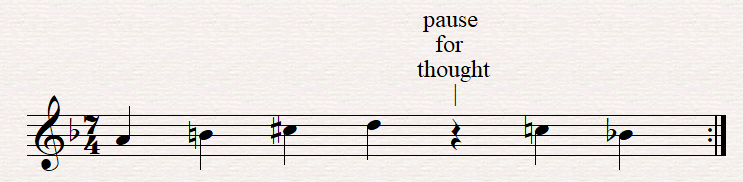
- Practice the top half of your D melodic minor scale slowly, thinking about magnets repelling each other when you get to the crotchet rest:
King George
- Remember flow in this too!
- To warm up, play the first line of Fingertips (Fiddle time scales) on the A and E strings, keeping your A string fingers on the string.
- Practice the first two notes of the piece as semibreves, up bow start, trying to apply the Fingertips technique.
- Try stopping on the F# in bar 11 5 times in tune.
- Practice from the upbeat of 13 with a relaxed bow.
- Find the place in bars 16-17 where you pause and use the troubleshooting technique: practice the two notes either side of the pause, then add a note afterwards, then one before etc. etc.
Mon 31st Aug 2020
Have a go at another Theory paper – I’ll put together a bass clef info sheet for you to have on hand though – I should get that to you on Wednesday. It might be worth doing a bit of revision on the Circle of Fifths before your next paper.
Scales: Don’t forget to listen out for the sound quality – keep the bow gliding smoothly and freely. Practice D harmonic minor and D melodic minor, being particularly aware of the tuning of the 6th and 7th notes.
King George
- In bar 1, make sure you detach the last two crotchets.
- Let bar 3’s scale lead into bar 4 without delay and with a clean string crossing.
- Careful to give a crotchet’s worth of silence in bar 4!
- Practice the first 3 notes of bar 7 for tuning, perhaps with an open E every other time to keep as a reference point.
- Aim higher with the 4th finger in bar 14.
- Sam has brought my attention to a fantastic feature on YouTube whereby you can slow down the speed! Look in the bottom right-hand corner of the video and you’ll find a settings cog. Click on that, then “playback speed” and then choose how slow you’d like it. Then you can play along with the video you found, and then work up to normal speed!
Whenever you’re aiming for a 4th finger note, remember to relax and reach as opposed to stretching and tensing.
Mar 2020
Grade 1 Distinction! 👏
Sat 15th Mar 2014
Your first violin lesson! 😄🎻
 EcoNotes