

2026 goals
Improve bow hold – “teeth” opposite thumb.
- E minor scale and arpeggio, 2 octaves: start in 4th position on the G string
- G major scale 3 octaves: 0123 0123 012/1234 12/123444321\43210 3210 3210 3210
- A major 3 octaves: 123 0123 012/1234 12/12/12343214321 4321\210 3210 321
- G major arpeggio 3 octaves: 02 0/13 1/13 141 3131 30 20
- A major arpeggio 3 octaves: 13 1/13 1/13 141 31\420 1 31
Thu 2nd April 2026
An Chloë
- Keep warming up with G major 3 octaves (scale and arpeggio). Practice the shifts in particular.
- In the piece, work on note accuracy around 17-22.
- Work on getting really comfortable with taking relaxed, musical timing in 21 and 22.
- Make sure the quavers in bar 29 don’t slow you down, so it fits with the piano.
- Practice bars 30-31 for the tuning and timing of your G.
- Keep an eye out for the dynamic details in the final section.
Estampie Royal
- Set a metronome to 50 and clap the first 3 lines before you start playing. Make sure you divide each beat into 3.
- Notice that slurs only happen at the start of bars – try to avoid adding any extra slurs! Especially in bar 5.
- If the first 3 lines go well, feel free to explore further. However, keep looking carefully at the subtle changes in notes, bowing and rhythm.
Fri 20th March 2026
An Chloë
- In your G major warm-up, work on getting the top octave feeling comfortable by repeating it several times. Also, remember to jump all the way down to 1st position after the top octave on the way down.
- In the piece, work on familiarity.
Estampie Royal
- Warm up with A minor 2 octaves (scale and arpeggio).
- Set your metronome to 50 and clap each section before you play it.
- In the piece, open Es are allowed! This is stylistic – the piece is medieval and rustic.
- Watch out for the C naturals.
Sat 14th March 2026
An Chloë
- In your warm-up scale, keep your violin up to help you reach the top notes. Don’t forget the arpeggio, trying to keep your fingers curved!
- In the piece, make sure your first slur is only 2 notes! Starting nearer the heel will help.
- Practice bar 8 to the first note of bar 9 a few times.
Sun 1st March 2026
Old Joe Clark
- Warm up with A major scale and arpeggio, 3 octaves, making sure your posture is tip top.
- See if you can find the piano part at home.
- You’re doing really well with Variation 1 – can you now get the string crossings even cleaner?
- Use a metronome to make sure you’re at the right speed, and sticking to it.
La Rotta
- Warm up with E minor scale and arpeggio.
- Watch out for the dynamics.
- Check the metronome mark.
- Count all the time so that the crotchets are in time without you having to try too hard.
An Chloë
- Warm up with G major scale and arpeggio, 3 octaves.
- We looked at half of this – see how you get on with the rest of it, always remembering good posture and bow hold.
Grade 5 scales (ignore this for now!)
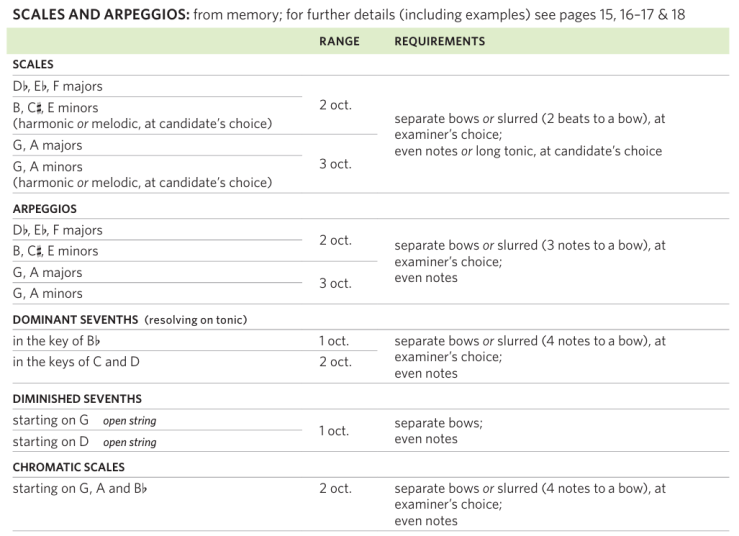
Fri 20th February 2026
Old Joe Clark
- Warm up with A major 3 octaves.
- In the first section, be sure of your D naturals and G#s.
- How accurate can you get this simple piece by next week?
La Rotta
- Warm up with E minor scale and arpeggio.
- In the piece, clap the rhythm of the first phrase before you start.
- Next, really take note of the key signature.
- Play the first phrase and get comfy with the notes (prioritise rhythm over tempo).
- Next, practice bar 11 before playing the whole of the 2nd phrase.
- Then work on the octave higher section.
- Keep 2nd fingers low.
- Learn the rest of the piece at home, being meticulous about rhythms and tuning.
Sat 7th February 2026
In the Hall of the Mountain King
- Challenge: can you record this piece and send it to me by the end of the weekend?
- Practice arco bow whilst you’re getting used to the notes, and aim to get this as accurate and in tune as Traitors!
- Look ahead to help with note accuracy.
- Start slowly.
- Make sure you put the accents in the right places.
- Focus, so we can leave this piece soon!
Old Joe Clark
- Play an A major scale first, as in tune as possible.
- Play the first section thinking loads about your 3rd finger positions.
- Practice from 21 in stages, like in the lesson – play every other note; do the same but play 2 of each note; play alternate open A and E strings a few times. Then put it all together, aiming for a straight. Listen out for the tuning of your 4th fingers.
- For an extra challenge, see if you can keep your 1st finger on the string the whole time!
- Use your 3rd or 4th finger for the LH pizzicato.
- Check the finger diagram to help with bar 38.
Traitors
- When warming up with D minor, add in some slurs (3 or 4 notes per bow for the scale, and 3 notes per bow for the arpeggio).
- Work on getting the pizzicato section more rhythmically secure.
- In the staccato triplets sections at the end of each page, try to keep your bow strokes straight, rather than crescent-shaped.
Fri 23rd January 2026
Traitors
- Keep practising the bowing exercises we did last week, and squeeze a ball or small cuddly toy in your right hand to get the fingers curved.
- Get used to the new fingering in bar 7, making sure you don’t slow down.
- Practice 9-16 for the join. Make sure you zoom the bow on the last crotchet of 12.
- Practice 2 beats before 17, and the first few notes of 17 lots of times to improve the link from arco to pizz.
- Practice 41-42 so that you don’t disturb the flow of quavers on the barline.
- In 42, work on the 5th and 6th quavers being a link between the staccato and the tenuto.
- Sustain your bow 43-46.
- Don’t kick the first note of bar 50.
- In 54, don’t shift down too soon!
- Remember the mini retakes in bars 55-58.
- Let your bow take charge in 71, so that the shift happens quickly.
In the Hall of the Mountain King
- Practice the pizzicato section with your bow on the stand.
- Start slowly, to allow space for the accelerando.
- Hold the bow as close to a normal bow hold as you can whilst you pizzicato.
- Be very careful with your accidentals.
- Leave your 2nd finger on the D string in 10 and 11, 12 and 13 so that the F#s are all the same.
Start looking at Old Joe Clark too.
Fri 16th January 2026
Traitors
- Think lots about articulation.
- Try some of the bow exercises we did in your lesson: hold the bow upright, and crawl your fingers to the tip and back, keeping them as curved as poss. Then tap your little finger before turning the bow to a horizontal position, then back again. Finally, with the bow in an upright position, curl and release your fingers for “bow shapes”.
- Work on your off-the string bowing with a 1 octave D minor scale before you start, plying a triplet on each note. Start with a good bow hold, and try to relax your shoulder blades. Keep your arm movements small.
- Work on the link into the pizzicato section, including practising the shift in bar 12.
- At the start, think about bow distribution – don’t waste too much on your first dotted minim, and try to get back to the heel for your second dotted minim.
- Low B flat b. 24.
- In 28 and 63, make sure you don’t kick the tie.
- Can you make the dynamic contrasts bigger from 37?
- Make sure you get into duplet mode (not triplets!) from bar 55.
Fri 9th January 2026
Traitors
- Warm up with a D minor scale and arpeggio.
- Remember to only retake in the main melody when I’ve written to!
- Set a good bow hold before you start, and check it’s still in place when you get to any staccato passages (like bar 41).
- Keep your 1st fingers low on the A and E strings.
- Play along with the video below at the end of each practice to see how much you’ve improved.
Wed 10th December 2025
The Legend of Ashitaka
- Great job revising this! Just work on the details now, like all the tricky bowing corners, and try to set a good bow hold before you start.
Away in a Manger
- In the octave higher bit, keep the bow away from the bridge and let the bow flow (not pressing too hard).
- Also in the octave higher section, blitz the second line of the song so that you know the notes really well.
Practice the four starred Fiddle Time Christmas pieces, if possible with the backing tracks (which you can find here – if you click on the description you can choose which piece you want).
Mon 1st December 2025
For the concert:
- Away in a Manger (Fiddle Time Joggers) – give it a go with 2 verses, the 2nd of which is in 3rd position and up an octave.
- Revisit the Legend of Ashitaka.
Ländler
- Focus mainly on the 2nd page.
Sun 23rd November 2025
When tuning, don’t be afraid to take the note further out of tune if you can’t work out if it’s flat or sharp.
If you find your left hand has got grippy, try playing some 3rd and 4th finger harmonics in 1st position.
Ländler
- Pick out any bars that you’re stumbling over and work on them in a focused way (eg. bars 5 and 6).
- Prioritise the second page this week – lots of it is similar to the beginning.
Joggers
- As last time.
Sat 8th November 2025
Fiddle Time Joggers
- Learn nos. 23 and 24.
- In 23, make sure you count yourself in before you start, so your upbeat is the right length.
- In 23, practice the bars with quavers in. Also practice the trill, and the links between sections, especially if you are repeating and shifting.
- See how you get on with 24.
- If you have time, look at n. 25 too.
Check last week’s notes for practice tips for Ländler.
Sat 1st November 2025
Fiddle Time Joggers
- Learn the pieces on pages 18-21 for us to go through together next lesson.
- Think about your bow hold and play each scale before playing each piece.
Ländler
- Remember to set your bow hold before you start this piece – it will make the bowing feel much easier!
- Practice bars 21 & 22 at speed, but with a gap between each slur. Be really meticulous with tuning. Make sure you know exactly where the shift is, too!
- Make the best use of your practice time by working carefully on the difficult bits, like we did in the lesson.
- See how you get on with the rest of the piece.
Sat 11th October 2025
Make your right thumb on your bow your technical focus this week.
Fiddle Time Joggers
- Learn the pieces on pages 16 and 17 for us to go through together next lesson.
- Think about key and rhythm with each piece.
Ländler
- Practice bar 17 thinking about the string crossing – start with your bow close to the D string, and make the string crossing a curved motion. In the left hand, remember to keep the finger movements minimal – the 2nd finger isn’t needed on the D string.
Sat 4th October 2025
Keep using last lesson’s notes for your bow hold recap.
When playing Besame Mucho, how many open Es can you avoid? Try to keep thinking about your posture.
Scale of the week
- Keep practising D major 2 octaves (scale and arpeggio).
Ländler
- Warm up with G major 2 octaves, scale and arpeggio. Slur the scale in 4s, and the arpeggio in 3s.
- Remember to start on an up bow.
- Remember to get used to the different bowing at bar 9.
- Bars 17-24 will feel easier with a good bow hold and your left elbow swinging freely.
Wed 10th September 2025
Bow hold – start every practice with:
- Relaxing your right arm by your side;
- Rotate your arm so your ppalm faces backwards;
- Elevate your hand and arm;
- Place your middle fingers on the bow;
- Bring your thumb in;
- Rest your index finger on the bow;
- Tap your little finger on its tip a few times;
- Check that your thumb is still curved.
Scale of the week
- D major 2 octaves (scale and arpeggio).
- Try the “Prelude from Te Deum” (n.24) as a sight reading exercise, write a few things in, and play it for me next lesson.
Ländler
- Warm up with G major 2 octaves, scale and arpeggio. Slur the scale in 4s, and the arpeggio in 3s.
- Remember to start on an up bow.
- Listen carefully to make sure the barline between bars 1 and 2 is neat. Co-ordinate the bow and finger on the string crossing, and step your 1st finger over onto the E string.
- Work on 5-8 bar-by-bar, getting used to where the string crossings are. Work especially on the neatness of bar 6.
- Practice the bar of up bows at 7.
Thu 31st July 2025
Technical Exercises
- Ex. 1: Much better than last week – keep doing what you’re doing!
- Ex. 2: Think about the framework of your left hand in each bar.
- Ex. 3: Don’t forget the C naturals in bar 1! Practice the last 2 bars a few bars to get the link.
Reading Skills
- The last exercise is the only one that needs daily practice! But keep up the good work on the others.
Scales
- Practice finding your starting notes (especially B natural, the “easy” one!).
- Check the tempo markings for all your scales this week.
- For your high scales, keep your fingers curved.
- Try to keep your fingers as light as possible, especially in the chromatic scale.
- In the dominant 7th, touch your 2nd finger to the 1st for the C natural.
Duet
Butterfly
- Tuning and articulation from 28.
- Keep the quavers runs flowing, even if they need to be slightly under tempo for now.
Sat 26th July 2025
Technical Exercises
- Ex. 1: work on fluency from beginning to end of this exercise, looking ahead so that you don’t need to stop at all. Careful to keep the bowing the same throughout.
- Ex. 2: Work on the contrast of the semiquavers (on the string) and the quavers (oof the string).
- Ex. 3: Careful of your tuning in this one, especially the 2nd fingers (both low and high). Keep your left wrist down to help.
Reading Skills
- Make sure you keep practising these – they’re only easy if you’ve been clapping them regularly!
Duet
- Not too fast, so you can be precise.
- Pluck with your finger a bit more on its side.
Scales
- Try and up your scale practice to at least 2 a day.
Prelude
- Aim for super-coordinated bow and fingers in places like 3-5.
- Keep 24 and 26 super short.
- Great work on the dynamics – keep this up, maybe making even less of your quieter dynamics.
The Legend of Ashitaka
- Bowing is still a bit unstable in the opening phrase – make sure all your slurs last long enough.
- To make the f section towards the end have even more impact, aim to use all of your bow.
Butterfly
- From 17, keep the down bow landings light.
- Try to keep going once you’ve reached bar 44!
Wed 16th July 2025
Scales
- Once a scale has gone well, play it right at least 3 times to really cement it.
- In the scales, try to move your fingers ahead of time.
- In the minor scales, split the octave in half in your head. Tell yourself if the next half-octave is low, high or split.
- In the chromatic scale, remember that your 1st finger needs to be next to the nut, and that you don’t need a big shift to get to the Eb on the way down.
- For the dominant seventh, say the note names before you start playing. Be careful that your F#s and C naturals are properly in place.
Before you play all your pieces, please check your bow hold and general posture.
Prelude
- Focus a few practice sessions mainly on the dynamics. Can you keep your f strong for 10 full bars, then give a big contrast for the p?
- Remember to keep the staccato notes super short.
The Legend of Ashitaka
- Starting on the right bow is super important in this piece, as it will help you get crescendos and diminuendos more naturally.
- Let this be super smooth and flowing.
- Careful of the slurring in bars 8, 9, 32 and 33.
- Leave the demi-semiquavers at the end of bar 17 later.
Butterfly
- Aim for crotchet = 130, no faster.
- Try to land gently on your down bows.
Sat 28th June 2025
Prelude
- Before you start playing, choose whether this is going to be a “fixing things” practice, or a “performance” practice. If you’re practising performing, aim to keep going, no matter what. You can remember things to work on as you go, and come back to them afterwards.
- See if you can play the whole thing at about crotchet = 75.
Ashitaka
- Think of the atmosphere you want to achieve before you start.
- Make sure you start on an up bow!
- How dramatic can you make 26-32? The dynamic is very different to the first half.
Butterfly
- Before you play the whole piece, practice the tricky bars. The more you play them, the easier they will get!
- Can you keep the same character in the f passage at 29, keeping the staccato notes light and playful.
Extra tests
- Technical exercises: refamiliarise yourself with these.
- Duet: nice and strong with all your pizzes, especially the accents.
- Scales and arpeggios: play each one with the music first to check slurring, notes and fingering, then from memory.
- Reading skills (clapping) can be found on p. 9 here.
Mon 16th June 2025
City of Stars
- Work on getting the bowing comfy.
Allegro
- Try some metronome work on this, going up one metronome mark each week.
- In the quaver sections, try to keep your right arm as relaxed as possible.
- Work on the sections at 37 and 69.
Butterfly
- Every time you practice this week, play 41, 42 and the first note of 43, aiming to get it clean 5 times in a row.
- Make sure the end of all your up bow slurs are light and short.
- Practice bar 25 to get a clean string crossing, then 24-28.
Mon 2nd June 2025
Orchestra music
- Think posture at all times.
- Keep an eye out for all the details, like bowings, slurs and fingerings.
Allegro
- Make sure you’re only playing this at a speed you can feel relaxed at. If you feel panicked at any point, you need to go back one metronome mark.
- Try to observe the dynamics as you’re doing this metronome challenge.
Fri 23rd May 2025
Scales
- Print these off for next lesson – please!
Technical exercises
- Ex.1 – Work in 2-bar sections – this exercise requires stamina, both physically and mentally, so working in these small sections will help build up that stamina. See if you can keep your left hand in the right position all the time, not just when you need to use your 4th finger!
- Ex.2 – keep aiming for an even more off-the-string bow stoke, plus try not to hesitate at each bar line.
- Ex.3 – don’t let the bow leave the string, and see if you can get into the last bar smoothly.
Butterfly
- Practice from section D to get even more comfortable with the finger movements around the E
The Legend of Ashitaka
- Keep taking care over your new bowings, especially getting used to the tiny retake followed by an up bow in bar 16.
Fri 16th May 2025
Scales
- Print these off for next lesson.
Technical exercises
- Ex.1 – Set a good bow hold to start. Aim to use all of your bow, keeping it quite light. Try to get 3 notes in the first half of the bow, and 3 in the second half of the bow. Practice
- Ex.2 – aim for an even more off-the-string bow stoke.
- Ex.3 – don’t let the bow leave the string.
Duet
- Set a metronome and practice this at crotchet = 90. Careful not to get ahead!
- Keep all the quavers even, especially if you have a string crossing.
- Tuning: remember to keep your left wrist down.
- Sound quality: remember to pluck about a cm over the fingerboard.
Prelude
- Keep playing this piece to keep the standard up.
- Listen for clear bowing, and tuning – especially is semiquaver runs.
The Legend of Ashitaka
- Well done on your timing!
- Use a lighter bow and work on making this sound elegant.
Fri 9th May 2025
Scales
- Print these off and start getting to know them.
Butterfly
- In section A, work on landing more smoothly. How can you use your bow hold to help with this?
- In section B, work now on the tuning of each note in the slurs.
- Remember to hook the first 2 notes of letter C.
- Work on bar 43, including the crescendo. Then try 42-43, 41-43, 40-43, 39-43.
Prelude
- Set your bow hold and left wrist before you start.
- Practice the first 2 bars a few times, for a straight bow and matching staccato strokes.
- Practice any other stumbling blocks in 2-bar units too (eg. 9-10).
The Legend of Ashitaka
- Refresh your memory of this piece this week.
Technical exercises
- Start working on these.
Fri 2nd May 2025
The Legend of Ashitaka
- Don’t forget to start with an up bow!
- Listen for the tone of your first 3 notes – how clear can you get them?
- For good tuning, think about left hand and wrist posture.
Prelude
- Check your bow hold before you start.
- Keep working with the metronome at 60 – see how solid you can get it at this speed.
Butterfly
- Keep working on the points we covered last lesson.
Fri 11th April 2025
Duet
- Don’t forget to play this pizzicato!
- Great job learning these notes – now aim for a resonant vibrato tone, plucking over the fingerboard and with the pad of your finger.
Butterfly
- In section A, work on the confidence of both hands – this means secure finger spacing to help with tuning, and confident down-bow landings after the rests. Try slowing it down a little, aiming more for 100 with the metronome.
- Work on section B with a metronome, starting at 80 and working up to 100.
- In section C, make sure all your staccato crotchets are just as good as the ones in section A.
- Work on section D without the metronome first, to really nail your tuning. Then work on it with the metronome at 80.
Keep playing Ashitaka and Prelude to keep them ticking over. Each time you play each piece through, try to come up with one thing to improve.
Fri 11th April 2025
Duet
- Start by making sure your right hand index fingernail is short. (Your left hand finger nails should always be short).
- You will get a better sound if you pluck just over the fingerboard.
- Try to pluck with the flesh of your index finger rather than the nail.
Butterfly
- Keep working on section C, keeping an eye on your left hand position and your bow hold.
- Work especially on the quaver bars, being really strict with yourself and choosing small enough chunks
Fri 28th March 2025
Butterfly
- Try to play the whole thing at a similar tempo – keep the opening section nice and steady, so that your quaver passages don’t have to go too fast yet.
- Practice 44-47 for shifting and bowing.
- Practice 40-44, first pizzicato and then with your bow, paying lots of attention to the slurs.
- For any quaver passages, practice in chunks, stopping between each slur.
Prelude & The Legend of Ashitaka
- Play these once or twice this week, but focus mainly on Butterfly.
Fri 21st March 2025
Keep a close eye on your bow hold this week.
Prelude
- Practice the bars with 4 quavers several times, so that you are bullet-proof on them.
- Keep track all the way through of whether your bowing is the right way up.
The Legend of Ashitaka
- Well done on this!
- Think more about the dynamics now – the crescendos and diminuendos are quite subtle.
- Work on fig. C for timing and bowing.
- Zoom your up bow at the start of bar 16.
- Work on fig. D especially for bar 20 (bowing and notes). Swinging your left elbow will help with clarity.
Butterfly
- Practice D major, still working on smooth shifts that don’t disturb your bow. Adding ghost notes will help with this. Keep your left wrist straight as you shift.
- In the piece, keep working on the quaver slurs for clarity, tuning and ease.
- For section C, start at the heel and spring the bow off the string, making sure you don’t add any slurs that aren’t there.
Fri 7th February 2025
Butterfly
- Practice D major, working on smooth shifts that don’t disturb your bow.
- Great work on the shifts in this! See now if you can keep your left wrist straight when landing in each new position.
- Take each long slur and work on each one separately (noticing which bow each slur starts on). Can every note under each slur have a good sound quality? Check your bow hold, and look how close your bow is getting to the bridge.
- Practice the whole piece now, as we almost learnt the whole of the middle section in the lesson, and the final section is the same as the beginning.
Sun 2nd February 2025
Prelude
- When warming up with your scale, pay close attention to the tuning of any fingers on a new string.
- To help with tuning, start with your left wrist down.
- To help with sound quality, keep an eye on your bow hold.
- Practice bars 27-29 to get them comfortable. Use a bit less bow and keep your 2nd fingers low on the A string. Split it up into smaller sections and try to use your fingers as levers, moving from the base joint instead of using your whole had.
The Legend of Ashitaka
- Aim for a smooth bow throughout, especially in bars 7, 12, 27 and 31.
- Work on your rhythm in section C, especially in bar 15.
- Work on the bowing and finger placement (in the chromatic bit) of bars 17-18.
- Work on the 2nd position section 19-21.
- The main place to fix this week is 22-25 – work on the timing and the notes, as they’re not quite what you expect them to be!
Sun 26th January 2025
Bow hold tip for the week: revisit your rabbit bow hold prep to help your middle fingers be a bit straighter and your grip be a bit looser.
The Legend of Ashitaka
- Warm up with G minor, planning ahead so that your fingers for your flat notes are in the right spot before you’ve even played them.
- Great work on your rhythm so far!
- Main work this week is keeping the A, B and E sections ticking over, but working in detail on the C and D sections. (Within this, practice from the middle of bar 19 to bar 22 to work on your shifting.)
- Remember to start with an up bow.
- Try to keep your bow light.
- Count 2 beats on your minims in bars 8 and 32, and remember to slur them to the quaver.
Fri 17th January 2025
Butterfly
- Practice D major 2 octaves to warm up for this, shifting on the D on the A string.
- Remember to start with an up bow!
- Hold you violin up confidently at the start so that your left hand is free to shift.
- Practice 4-11 to get used to the feel of the bowing. See how smoothly you can land on the down bows.
- Practice 15 -18 slowly, then practice the up bow slurs in building blocks.
- Notice when the quavers are moving in scales – that means less brain work required!
Fri 10th January 2025
Prelude
- Remember the 4th fingers in bars 2 and 24.On the semiquavers, try to relax your right arm a little more, like you do in the string crossings from bar 11.
- Work on your 2nd finger tunings in the downward scales from bar 27 onwards – download a tuning app (I recommend Pano Tuner) and pick individual notes to hold and check.
- Keep looking at the music at all times so that you can see the details and won’t get caught out if you lose the memory thread at any point.
The Legend of Ashitaka
- Add the rhythms now, working in sections.
Butterfly
Fri 13th December 2024
Jingle Bells
- Practice this ready for the concert tomorrow.
Prelude
- Well done with your metronome work!
- Can you make your C naturals lower on the A string?
Fri 22nd November 2024
Jingle Bells
- Work on finessing this – you can improve tuning, posture, bow hold, bowing, sound quality and articulation (staccato).
Prelude
- Keep the tempo down on this so that you can play all of it comfortably at the same speed. I would suggest 100.
Revise your other two exam pieces ready for us to have a go at them next lesson.
Fri 15th November 2024
Shut up and Dance
- Warm up with a D major scale and arpeggio. Don’t forget to shift on the A string! Aim for fluency and a good sound.
- Practice from bar 15 for the bowing and rhythm.
- Be really strict with yourself as you practice this, and look ahead so you know which notes are coming next.
Sat 19th October 2024
Butterfly
- Play D major 2 octaves to warm up. Then try the pattern we played in your lesson, but just one octave, up and down.
- Remember to start with an up bow!
- Keeping the left wrist down will help with the accuracy of your shifting.
- Work in 8-bar sections so that you can work in detail until everything feels safe (the sections are marked in your music).
- Remember the staccato at the start of bar 13.
Fri 11th October 2024
Prelude
- Stick with 112 as your metronome mark until you can play it through without hesitation.
- Also stick at this speed so that you can take in all the details (articulation and dynamics).
- Work to add the staccato articulations.
- Work on adding the dynamics from bar 11.
The Legend of Ashitaka
- Be hyper-aware of naturals and flats.
- Practice your shift lots, as it happens many times.
Butterfly
- Play D major 2 octaves to warm up. You could use the rhythm at the start of this piece in the scale, like we did in the lesson.
- In the piece, make sure you start shifting as soon as you finish the previous note.
- Practice up until the end of the coloured music.
Fri 20th September 2024
Practice tuning with your left hand as you bow the strings.
Prelude
- Keep thinking about posture and your left wrist as you play your warm-up scale.
- Keep working with the metronome, making sure you don’t rush bars 7 and 8.
- Your F natural needs to be lower in bar 9.
- In the string crossings, make sure your bow is super straight.
- Practice bars 21-22, counting your pairs of As and noticing that the scale gets interrupted on the B (like a trampoline!).
- Work on the tuning of your 4th fingers when played near an open string (b. 15, 21 and 30).
The Legend of Ashitaka
- Keep going with your good, careful tuning work.
Butterfly
- Practice D major scale 2 octaves before you start.
- Think about the names of the notes you’re playing when in 3rd position and see if you can work out the tones and semitones between them.
- Go as far as the coloured pencils.
Wed 11th September 2024
Focus for the week – keeping your left wrist down.
Prelude
- In your G major scale, focus on posture and tuning.
- Don’t forget the staccato notes in this piece!
- Every bar in this piece starts with a down bow – keep asking yourself if you’re the right way up!
- Start working your way through the metronome chart for bars 11-22. Remember to keep your elbow at the right height for a double stop, and use as small a movement for the string crossing as possible. Keep the bow light too, as it’s p.
The Legend of Ashitaka
- Warm up with a G minor scale and arpeggio, keeping your left wrist down.
- Play from bar 5-25 ignoring all rhythm and bowing and playing each note as a minim. Aim for good tuning and sound quality, and use this opportunity to practice your shifts.
Use Fiddle Time Runners for sight reading practice.
Wed 24th July 2024
Please please please work on your posture this summer! (please)
Scale practice over the holidays
- Make sure you start work on each piece you play by first playing the scale.
Prelude
- Remember the staccatos in bar 2 etc.
- From bar 3, once you’ve started each scale, start looking ahead for your next starting note. Keep your 2nd fingers nice and low here too.
- Work on the tuning and rhythm of bars 9-10.
- In bar 12, make the C#s indisputable!
- Work from bar 11 slowly with a low wrist to avoid getting used to stopping and starting.
- Pick 1 or 2 sections to work on in detail each time you look at this piece.
The Legend of Ashitaka
- Listen to this as much as you can and follow you part as you listen.
- Next, listen to it again, clapping the rhythms. Pause whenever you need to.
- Make sure you start this at the tip, ready for your up bow upbeat.
Play through as many Runners pieces as you like over the holidays as sight reading practice.
Wed 17th July 2024
A minor
- Play these scales a few times every practice session to get really comfortable with them.
Theme and Variations
- Think about all areas of posture before you start each section: high violin, low left wrist, curved right thumb and pinkie and well-spaced feet.
- Get more familiar with the theme.
- Work on each variation separately, aiming to make each one’s unique feature as good as you can.
Prelude
- Great work on this so far!
- Keep thinking about all your posture things here too.
- Play bars 2 and 24 staccato.
- Turn on your turbo listening skills to listen out for clean string crossings right from the beginning. Working in 1 or 2 bar chunks can help with this.
- Work in smaller sections to get really familiar with everything. Working from beginning to end will result in lots of pauses for thought, and we don’t want to get into bad habits!
The Legend of Ashitaka
- Practice G minor to warm up.
- Set the metronome to 69 and clap the rhythms, holding your hands together for long notes and opening them on the rests.
Wed 3rd July 2024
Keep remembering to drop your left wrist and curve your right little finger.
Choosing Grade 4 pieces:
- Prelude
- The Legend of Ashitaka/Ländler
- Butterfly
Prelude
- Warm up with 2 octaves of G major scale and arpeggio, playing 4 semiquavers on each note. Use little bows, think about posture, left wrist and a straight bow.
- Work in small bite-sized chunks, which I have marked in your music.
- Try not to pause on the bar lines, especially in the semiquaver scale runs like bars 3-5. You can practice this by playing 5 notes from the middle of bar 3, then 5 notes from the middle of bar 4, then 5 notes from the middle of bar 5.
Practice A minor and Theme and Variations
Mon 24th June 2024
Finale from Water Music
- Warm up with D major scale and arpeggio, looking in a mirror to check your left wrist stays straight.
- Play this through for fun, thinking about light crotchets and dynamics.
Ecossaise in G
- With your G major warm up, start by swinging your left elbow side to side. As you play the scale and arpeggio, try to let your elbow swing back as you go towards the E string and forwards as you return to the G string.
- Practice the first 3 notes to work on an independent 3rd finger.
- Work on bars 5-8, listening out for C naturals.
Do your Fiddle Time Scales composition please!
A minor
- Play your warm-ups and scales in the order marked in the book.
- Keep the F naturals super low.
- Try to keep your left hand as light as possible as you play these.
Theme and Variations
- Make sure your first C is natural!
- Practice this as much as you can this week, then start having a look at the variations.
Wed 19th June 2024
Scales
- Keep practising the E melodic minor scale, focusing on the spacing of your fingers on the A string.
Composition
- Write at least one more line for next lesson, and finish it if you can!
Finale from Water Music
- Work on tuning on the E string – it is sometimes a bit high.
- See if you can make the crotchets lighter, like we did in the lesson, imagining your bow is a paintbrush.
Ecossaise in G
- Practice a G major scale and arpeggio to warm up for this. Slur the scale in 2s and the arpeggio in 3s, thinking about the shape of your left are and fingers as you play.
- Before playing this piece, remember to look out for all the scale and arpeggio patterns within it.
A minor
- Practice the scales and exercises in the order I’ve marked them in.
- Think about the spacing of your fingers really carefully so that you can hit the nail on the head first time. Really aim for pure tuning in these.
- Get to know the Theme on p.19. Feel free to try the variations too, but if you don’t get time we’ll look at them next lesson.
Please bring your Grade 4 book next week 😊🎻
Wed 12th June 2024
In everything you play this week, try to be really focussed and keep yourself giong just like you do when you’re playing with somebody else.
Scales
- Keep practising your trio of E minor scales, focusing on sound quality now. Good bow hold and posture will help with this.
Composition
- Play the first line of your composition on p. 11. Improvise the next line, either on your violin or by singing, so that you have some ideas for continuing this next lesson.
Handel Finale from “Water Music”
- Warm up with a D major scale and arpeggio, focussing on posture (including bow hold and a straight bow), tuning and sound quality.
- Work on any stumbling blocks so that this is “performance ready” by next lesson.
See how many composers you can name, starting with all the letters of the alphabet!
Mon 3rd June 2024
Scales
- In E minor, see if you can manage the harmonic minor, then arpeggio, then melodic minor all in one go. Use the slurs and be really precise with your tuning.
In your stride
- Keep your 1st and 2nd fingers together in bar 3 as it’s a G natural.
- Also keep your 2nd finger low in bar 5 for the C natural.
- Listen to your sound quality as you play this – you may need a lighter bow and to play further from the bridge.
- How fluent can you get this for next lesson?
O Leave Your Sheep
- Work on the rhythm in bar 4.
- Try to make a really beautiful sound in this piece.
If you get time, start having a look at 13. Finale from Water Music”
See how many composers you can name, starting with all the letters of the alphabet!
Wed 8th May 2024
E major
- The scale sounded great today!
- Let’s use open As and a 4th finger for the E at the top.
- See if you can the arpeggio to sound a great as the scale!
Hook or by crook
- Check last week’s notes for working on this – it sounded a bit like sight reading again today!
O Leave Your Sheep
- Try to make a really beautiful sound in this piece.
- Work on the rhythm in bar 4.
Pick a Bale of Cotton
- Start by playing the G major scale and arpeggio (sometimes slurred, sometimes separate).
- Try to use a whole bow on the minims in this piece, and follow it with a slur.
- Remember that bar 9 happens the same 6 times!
- See if you can get this, and the other two pieces, performance-ready for next lesson.
Fri 26th April 2024
E major
- Remember to use your 4th finger at the top.
- Practice your arpeggio with slurs.
Hook or by crook
- Remember to start on a down bow.
- Try to make the crotchets a bit longer.
- See if your hooked bowing in bar 4 can sound just like the others, despite the string crossing – the listener doesn’t need to know there’s a string crossing!
O leave your sheep
- Play a G major scale and arpeggio to warm up.
- Count to 3 before you start, and on every dotted minim.
- Add the slurs now.
- In 15-16 and 20-21, see if you can keep your 2nd and 3rd fingers on the string. Keeping your wrist down will help with this.
Start having a look at Pick a Bale of Cotton for next lesson.
Wed 10th April 2024
General technique for this week: Try to keep your bow nice and straight. Ask someone to check for you.
Merrily Danced the Quaker’s Wife
- Keep practising this to get even more comfy with your shift.
E major
- Practice the scale with even notes, separate bows and slurred.
- Practice the arpeggio both slurred and separate bows.
- Play the hooked E minor scale too, trying to get the crotchets a bit longer and smoother.
Hook or by crook
- Practice this pizzicato whilst you get used to the notes, 2 lines at a time.
- Once you’re comfortable, add the bow and make sure you’re doing the hooked bowing, keeping the crotchets nice and long.
O leave your sheep
- Keep getting to know this ready for next lesson.
Thu 28th March 2024
Well done on your scales last week – now do the same for your arpeggios too (play them 3 times in a row with no hesitations or mishaps).
Merrily Danced the Quaker’s Wife
- Once you concentrated on when to shift, you did really well! Keep practising this so that you get even more comfy with it.
- Practice from the upbeat to 9 to get used to the notes – listen for tuning as you do this.
O leave your sheep
- Learn this over the Easter break.
Mock Baroque
- Practice the upbeat to bar 13 and bar 13 several times, making sure you start on an up bow. Do the same for bar 33 and its upbeat.
- You’re very close to having this learnt. Just one last push over the Easter holiday should get you there!
- Keep bowing in mind at all times please!
Fri 22nd March 2024
For any scales you practice this week, see if you can play them 3 times in a row with no hesitations or mishaps. Add some slurs in every now and then too!
Mock Baroque
- Fantastic posture in this Merryn!
- Make sure every dotted quaver-semiquaver pair is hooked.
- Practice the last line for the shift and the bowing, keeping your wrist down.
America
- 3 bowing landmarks for you: Down bow in bar 5, up bow in bar 17, down bow in bar 27.
- In bar 8, think about the shift coming up in the next bar.
- Practice bars 9-12 to get a high B in bar 10 and and open E and high C# in bar 12 (think about this at the end too).
- Play 22 and 23 (starting right at the tip) until they feel super comfy.
- Do the same with bars 24 and 25, thinking lots about the G#’s tuning.
Merrily Danced the Quaker’s Wife
- Practice this for next lesson and maybe look at the next piece too!
Fri 15th March 2024
America
- Practice bars 9-12 to get a high B in bar 10 and and open E and high C# in bar 12 (think about this at 31 too).
- Work now on not making bar 21 too long! 😅
Mock Baroque
- See if you can nail the rhythm in bar 13!
- I’d love to finish this piece next lesson, so work in detail on any stumbling blocks so that we can say goodbye to it soon.
Merrily Danced the Quaker’s Wife
- Look ahead so you know whether to shift as soon as you hit an open string.
- Think about the rhythm and bowing.
Sun 10th March 2024
When practising at home, always work in these steps:
- Think about what you’re about to play and look ahead for any places where you need to concentrate the most.
- Play it, but pay attention to what goes well and what needs work.
- Think about how you could improve it.
- Pick out any bars that needs special attention.
- Have another go.
- Always remember to keep your left hand fingers soft!
Mock Baroque
- Start your practice at line 5, working on a relaxed left hand and a low wrist (thumb up towards the ceiling).
- Keep this piece going in the background as you work on other things.
Chase in the Dark
- Play A harmonic minor to warm up.
- Follow the practice steps at the start of your lesson notes.
- Think about the rhythm before you begin.
- Careful to play C naturals in bar 9, and a nice high D!
- Work on bar 17 too.
Keep practising America!
Thu 15th February 2024
As you’re sitting down quite a bit to practice, make sure your feet are flat on the floor and you’re sitting as upright as possible, with your violin up nice and high.
Think of your chin rest as a jaw rest rather than a chin rest – your posture was great today after this breakthrough! Keep an eye on your left wrist still though.
Mock Baroque
- Well done on your up bow retakes!
- Remember every bar in this piece starts with a down bow, so if you find you’re the wrong way up, go back and investigate where you think it went wrong and see if you can fix it.
- Become an expert on the rhythm in bars 13-16.
- Make sure you shift with the whole hand in bar 14, keeping the fingers and thumb light.
- Line 17 confidence in tuning.
America
- In bars like 6, make your tenuto notes heavy and long.
- Count the beats in bars 13 and 14.
- Make sure you start 17 on an up bow – all bars in this section start up bow.
- In bar 25, remember this is a lower voice so you need the D string.
Sun 11th February 2024
Scales
- Remember to always play your scales and arpeggios both separate bows and slurred.
Mock Baroque
- Please have this ready to play through to me next lesson.
- Be super careful with the tuning of your E flats and any other 1st fingers.
- Careful of the different rhythm in bar 15, compared to bar 13.
- Watch out in bar 17 that your 2nd note is a B flat.
- Keep an eye out for hooked bowings throughout.
America
- Warm up with A major scale and arpeggio, both separate bows and slurred.
- Give the 3-crotchet bars longer bows.
- Pay lots of attention to the bowing symbols in the middle section, from bar 17.
- If you have trouble with bars 24-25, try a little slower. Aim to get them right 3 times in a row like we did in the lesson.
Sun 4th February 2024
America
- When you shift to 2nd position in the second line, make sure you only move your left hand up a tiny bit (a semitone).
- Start bar 17 in the middle of your bow with an up bow.
- For bar 18 and 20, practice by stopping the bow at the heel just before your down bow just like we did in the lesson.
Mock Baroque
- Work really hard on getting the rest of this piece up to the same level as the first two lines.
- Remember to do your up bow retake on the 3rd beat of bar 8 and 12.
Tue 30th January 2024
Chase in the Dark
- Warm up with an A harmonic minor scale and arpeggio.
- Make sure you start on a down bow.
- Look out for C naturals!
Mock Baroque
- Keep warming up with your scale and arpeggio, focusing on posture and bow hold.
- Play the arpeggio with slurs. Stop at the end of each slur whilst you think about the next 3 notes.
- Practise your composition, focusing mainly on the bowing of bars 3 & 7 and give it a name.
- In the piece, keep your bow flowing as if everything was crotchets, with a little skip at the end of the bow for the dotted rhythms.
- Practice the bowing in bar 8 lots so that you do an up bow retake in the rest.
- Get as far through this piece as you can!
Thu 18th January 2024
B flat major
- Great work on the scale! Keep up the good work, and your violin 😅
- Remember to practice the scale with slurs too.
- Play the Fit Fingers exercise and see if you can make up a descending version of it too.
- Practice the arpeggio until it feels safe, then add the slurs there too.
Composition
- Give your piece a title and some dynamics.
- Practice your piece!
- Feel free to change any notes along the way if you feel inspired – after all, you wrote it!
Mock Baroque
- Think before you start – how do I know my first note will be in tune?
- An exercise for just before you start: keep your 4th finger in place, lift up your 3rd finger and step it onto the A string. Go back and forth between the A and E strings a few times before letting it rest on the A string. Now you’re ready to start!
- Great work on line 1!
- Work on line 2 to get it as comfy as line 1. If you make the same mistake a few times, play it in smaller chunks and make sure you have thought about exactly what went wrong so you can fix it.
Cornish May Song
- Warm up with a G major scale and arpeggio.
- Keep your C naturals nice and low.
- In bars 9-10 and 13-14, work on the slurring.
Wed 10th January 2024
Can this be the year that you get comfy holding your violin up I wonder? Whenever you put your violin up, start with the violin in “statue of liberty position” before bringing it down onto your shoulder and getting your chin comfy on the chin rest.
B flat major
- Think about each note and finger before you play it.
- Start adding the slurs, pausing between each one to think about all the notes in the next slur before you play it.
Mock Baroque
- Practice the first two lines.
- Watch out for the dotted rhythms with hooked bowings.
- In bars 5 and 7, make sure your bow and 4th finger are super prepared to change string as soon as you play the F.
Tue 19th December 2023
Jingle Bells
- Keep an eye out for all the down bows – only 2 beats on all your minims, followed by lots of retakes!
- Work on your staccato from line 4 – can your staccato be just as good at the end as it is at bar 19?
- Keep an eye out for 4th fingers along the way.
Away in a Manger
- Play an F major scale before you begin, thinking about low 1st fingers.
- Remember to start with an up bow.
- Get your Mum to watch to make you’re using 4th fingers everywhere they are written.
Thu 23rd November 2023
General aim for the week – be really mindful in everything you practice.
Medieval Tale
- Practice this “sadly”, keeping your bow calm and being very precise with your left hand to make the rhythm tight.
- Feel free to look at the next piece or two.
A major scale
- Make sure your C#s and G#s in the bottom octave are a tone away from your 2nd finger and the other 3rd fingers are low.
Out of the Question
- Practice this well, thinking about tuning all the time. Practise the bottom line of the Chorus and player 1 in the rest of the piece.
B flat major
- Read what I have written at the top of the page before you you start and really think about it.
- All low 1st fingers need to be right next to the nut.
- Try to keep your left hand relaxed and don’t press too hard with your bow.
Tue 14th November 2023
Keep reminding yourself not to press your fingers down too hard!
A major
- Think about high 3rd fingers on the G and D string before you start.
- Tap all 4 fingertips on the string before you start and notice how curved your fingers are. Try to keep them curved as you play the scale and arpeggio.
Out of the Question
- Practice this so that we can play it together and do some composing next lesson!
B flat major
- Use an in-tune 1st finger on an A before you start to help you find the starting note.
- Keep all your other 1st fingers right next to the nut.
- Try to keep your fingers curved.
Mock Baroque
- See how much of this you can learn for next lesson.
Wed 8th November 2023
Technique: think of the curved fingers on both hands and keep your left wrist low. Remember that your little finger shouldn’t be on the screw of the bow!
Keep Fit
- Keep this for one more week to really get the memorising secure.
A major 2 octaves
- Aim for really clear tuning and a fluent speed on the scale and arpeggio.
- Start looking at this on p.6 and try the pieces on pages 6.
- Learn page 7.
Banyan Tree
- Start with your wrist down so that you can reach your 4th finger easily.
- Keep the C naturals low.
- Remember the retake at the end of line 1.
Heat Haze
- Count the beats and clap the rhythm of bar 1 before you start.
- Make sure all dotted crotchets fall on a down bow.
Look at nos. 4 and 5 too.
Sun 5th November 2023
Technique: think of the curved fingers on both hands and keep your left wrist low.
Keep Fit
- You’ve done a great job of memorising the first half of this! See if you can get the second half just as good.
- For any places that trip you up or slow you down, identify patterns, scales and arpeggios like we did in the lesson.
Start the Show
- Whilst getting used to your new violin, listen really carefully to the sound quality – are you bowing too close to the bridge? And is your right elbow helping you stay just on the intended string?
Work on the first 5 pieces in the Fiddle Time Runners book.
Wed 27th September 2023
Scales
- In G major, think about your tuning lots.
- In the arpeggio, keep your bow straight to make a good strong sound.
Keep Fit
- Become an expert at this for next week!
- Remember to look ahead.
- Keep your right little finger curved, and make sure your thumb is opposite your middle finger.
Fiddle Time Runners
- Practice any of the first 5 pieces, then try some of them with the backing tracks (link at the top of this page).
- In Start the Show, remember your retakes.
- Always aim for a strong sound, straight bow, good posture and bow hold.
Fri 21st July 2023
G major scale and arpeggio
- Focus on tone – is your bow making a nice strong sound?
- Work on your arpeggio bowing – looking at the music will help, but try to memorise it in the end.
Keep Fit
- Try not to have a “thinking” note at the start of this – if you spend a few more seconds thinking before you start and then hit the ground running. This will help keep the bowing the right way up.
- Always be listening to the sound quality – play between the bridge and fingerboard, and use a bit less bow to keep everything neat. Bow hold and left hand posture will help too!
Over the holidays, keep working through your scales book always thinking about our focus of intonation and sound quality.
Sun 10th July 2023
Well done on all your hard work this last week, you’ve made lots of progress!
Contredanse
- Excellent lead in at the start!
- Aim for much more difference between p and f now.
- Try your best to keep an eye on the bowings, especially the slurring in bar 31.
- Look out for any notes with upward arrows and work on the tuning of these.
Chiquilín de Bachín
- Remember the down bow at the start!
- Keep your bow strong when playing your 4th fingers in 14 and 30.
- In 22, how smooth can your bow land after the retake?
- Work on 31-34 for your 2nd finger tuning.
- Remember to open up your hand for the F# tuning in bar 35.
- Try to crescendo right to the end of the F# in 38.
- Keep an eye out still for slurs in 40, 42 and 44.
- Work on the tuning in 44.
- Get comfortable with the shift and bowing in bar 46, starting your practise with the long B.
- In the first pause in the 2nd time bar, get right to the heel so that you have enough bow for the last note of the piece.
Shadow Wizard
- Remember the down bow at the start!
- Keep your notes nice and smooth in the first two phrases.
- Make sure your notes are really clear going from bar 5 to bar 6.
- See how obvious you can make the dynamics on line 2
- Slurs to look out for: bars 23 and 32.
Aural
- Sing out nice and clear.
- Clapping: remember to keep it quiet for the first two bars so you can really listen out for the main beats.
Sight reading
- Remember to notice the key signature and time signature before you begin.
- Have a good practise in the time you are given.
- Just keep going – even if there are little mishaps!
Thu 6th July 2023
Contredanse
- Start nearer the middle of the bow and try not to use so much bow for the p sections.
- Make sure the down bows after the two ups are confident and clear.
- Work on getting your dynamics really obvious, using more bow for the f sections.
- In the 2nd section, make sure your 2nd fingers are low in the turns.
- Try not to slow down at the end of the sections.
- Fab arpeggios! Make sure all of this last section is f.
- Try to get the slurring correct in the last few bars.
Chiquilín de Bachín
- I love the mood at the start of this piece!
- Remamber to retake at 22.
- Work on reliable notes at 35-37.
- At 37, practise saving bow at the start of the F so you have enough left for the crescendo.
- Can we have a stronger sound at 38?
- Remember to shift at 46 to the F natural.
- Work on the slurring from 46.
Shadow Wizard
- Remember to start with a down bow!
- Be smooth in the phrases at the beginning, with no gaps unless there are rests.
- Watch out for the slurs in 23, 24 and 25.
- As soon as you’ve played your harmonic, get busy finding your E flat ready for bar 29.
- At the end, try using your 3rd finger for the pizzicato.
Sun 25th June 2023
Contredanse
- Check the metronome speed before you begin and keep it in mind as a goal as you practise.
- In section 1, aim for clarity in bar 7 (plus the slur!).
- At the start of the second section, make sure your finger spacing is right for the turn.
- Practise lots from the middle of bar 14, first in 4-note blocks, then all together.
- The third section is sounding pretty good! Just focus on the appoggiaturas (grace notes) now, as they always seem a bit of a surprise.
- In the final section, try not to hesitate after each downward arpeggio.
- Spend the most time on bar 31.
Tue 13th June 2023
Remember to check you have a curved finger on your bow this week.
Shadow Wizard
- Remember the E flat and F# are a tone and a half apart – work on getting this tuning really good in your first bar.
- Your slurs are often made up – keep your eyes open to make sure you’re doing what’s in the part!
- Make sure you shift in the rest at bar 7 – then you’ll be really ready for bar 8.
- Practise bars 12-15 thinking lots about the accidentals and slurring. Practise 20-23 straight afterwards as they are similar.
- You’ll find bar 26 easier in the middle of the bow. Count to 6 as you play the semiquavers.
- At 30, keep your 1st finger on the string as you play the open D string.
- Think about the finger spacing for the E natural and F# at 32.
- Follow the instructions on the last line to get the the dynamics really creepy at the end (“sul tasto” = over the fingerboard).
Tue 23rd May 2023
Sight Reading
- Try to do one of these each practise session.
- Remember to look at the key signature and really think about the sharps and flats.
- Play the scale and think about which notes need to be sharp or flat.
- Try clapping the rhythm.
- Have a little practice.
- Once you’ve decided to give it a go, try not to stop.
Scales
- Practise all your 1 octave scales and arpeggios (major and minor).
- Before you play your arpeggios, say the finger numbers.
- In your minor arpeggios, aim lower with your 2nd finger and higher with your 3rd finger.
- Add your 2 octave scales.
- We didn’t do them in the lesson, but can you work out the fingerings for the 2 octave arpeggios and try playing them?
- Once you feel you know them all, start using your scale envelopes again.
Sat 20th May 2023
Contredanse
- Work mainly from bar 8 – sorry we hadn’t looked at these sections before!
- In the 2nd part, practise the turns and keep an eye on where there are slurs and where there aren’t.
- In the 3rd part, it’s all very straightforward, but make sure you don’t play a G at the end of your trill.
- In the 4th part, warm up with a 2nd octave G major arpeggio – make sure your left wrist is down!
- Try not to hesitate when getting to the next pair of crotchets.
- Practise bar 31 in two halves, getting used to the slurring and notes.
See if you can learn to the end of Chiquilín de Bachín.
Mon 8th May 2023
Scales
- Practise A flat major, E flat major and E major scales this week, with long tonics. Use your 4th fingers in these scales.
- Stop and think: what will the fingering be for the arpeggios of these? Practise these too.
- Practise the chromatic scale too – remember to keep your left wrist down.
Chiquilín de Bachín
- Listen out for your tuning on the F# in bar 20.
- Practise playing from bar 34 to the first note of 35 5 times, then from 31 to the same place 5 times. Things to look out for: curved bow thumb, curved bow pinkie and left wrist down.
- Practise 35-38 5 times in a row too. It will help to link the sound F# in 35 with the one in 37.
- Practise getting bar 44 in tune.
Wed 26th April 2023
Keep checking your bow pinkie and thumb are curved.
Chiquilín de Bachín
- Remember to hold the minim in bar 10 for two whole beats and not to do a retake.
- Learn the section from 31-45 now, always thinking about your 2nd finger placement (especially in places like bar 33).
- Remember the 4th finger and D# in 44.
Contredanse
- Aim for a bigger gap between your 3rd and 4th fingers.
- Work on getting bar 7 up to the same speed as the rest of this section – keeping the crotchets a little slower may help you with this.
Shadow Wizard
- Focus on making as nice a sound as possible with your bow.
- Practise up to bar 19.
Tue 28th March 2023
1 Octave Scales
- 3 things to think about before you start – high violin, low left wrist, good bow hold.
- Think about the fingering of the arpeggios before you start playing.
Shadow Wizard
- Play a G harmonic minor scale before you start and think LOTS about the E flat to F# spacing on the D string.
- Make sure the crotchets are longer than the quavers in your first two bars – it might help to sing these bars whilst clapping the quavers on each crotchet you sing.
- In your third bar, make sure you’re holding the E flat for 4 whole quavers, whilst also slurring it to the other notes in the bar. Write “slow bow” above this bar.
- Working on this first phrase is really helpful, as it will make the 3rd position phrase feel much easier.
- From 12, leave your bow on the string in the rests and imagine an echo in those breaks so the rests are long enough.
- Write a 1st finger at the start of bar 24 (3rd position).
- Try playing up to and including bar 27.
Thu 9th March 2023
Contredanse
- Warm up with the bowing exercise from last lesson.
- Watch out for really low 2nd fingers.
- Please do look at the music as much as you can, especially when you’re learning bar 7!
- When practising bars 7 and 8, start in the middle of the bow.
Chiquilín de Bachín
- Check last lesson’s tips first (4th Feb).
- Practise from bar 15 for bowing.
- You played some really good G#s today, but see if you can get to them a bit quicker. Remember the audience doesn’t need to know that a note is tricky to get to, we just want to play them a nice a tune.
Shadow Wizard
- Keep warming up with the G harmonic minor scale like you did last week.
- See if you can get to bar 19 at home. Make sure you work out the tones and semitones carefully.
Sat 4th March 2023
Shadow Wizard
- Warm up with G harmonic minor. Play it with good posture and a straight bow.
- Play the scale again, but stop at the top.
- Pay special attention to the gap between E flat and F# as you’ll find it in your first bar of this piece.
- Aim for light left hand fingers and a low left wrist.
- Practise the first 8 bars this week.
Contredanse
- Warm up with G major, but using the bowing pattern we’ll use in this piece:
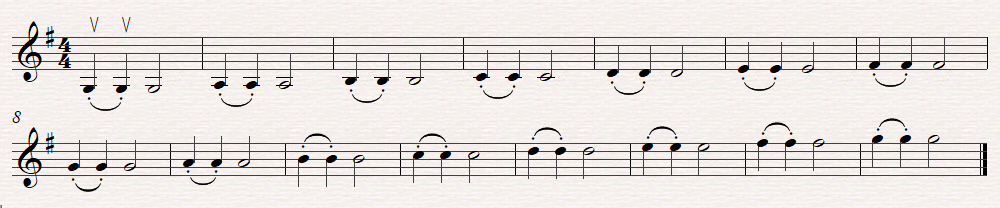
- Try the first half, even though we didn’t try much of it in the lesson.
Sat 4th February 2023
Chiquilín de Bachín (G3)
- Keep reminding yourself to keep your left wrist down.
- In your first bar, see if you can put your 3rd finger down with your 2nd finger touching it. It’s good to try this in bar 16 too.
- Try really hard to get the slurring right so you won’t have to unlearn bad habits.
- We learnt up to bar 30 today.
Scales
- When you play any scale, try to concentrate on a straight bow. This will help the sound quality.
- In Haunted House, start with your bow in the middle. Play quietly and on the sfz shoot to the end of the bow immediately.
- Make sure you play the second half with left hand pizzicato.
- Start looking at the next piece too.
Fri 27th January 2023
Great work on your aural again! Try to describe the music you’re listening to on the radio at home – major or minor? Ritardando or accelerando? Smooth or detached notes? Etc.
Two Little Angels
- Set your hand up by setting up your tones (1-2 and 2-3) and semitone (3-4).
- Make sure your thumb is opposite your 1st finger.
In Orbit
- Practice D minor first.
- Practice the slurs.
- The harmonics on line two are exactly halfway between your nut and your bridge. You can find them easily by imagining the shoulder of your violin attracting the side of your hand like a magnet.
- Make sure you spot the difference between bar 7 and bar 11.
- Also in bars 7 and 11, make sure it sounds Arabian (B flat, C#).
Try to keep your left elbow off your side as you practice this week.
Now have a look at G harmonic minor and those two pieces.
Sat 21st January 2023
Remember these tips from last week:
- Violin up;
- Left wrist down;
- Feet flat on the floor;
- Look through the music before you play to check for any patterns (scales/arpeggios) or tricky bits you need to watch out for;
- Keep looking at the music!
Two Little Angels
- Try this in 2nd position now.
- Keep your eyes open for any rhythms that aren’t quite what you expect!
Mahler 1
- Make sure your tuning is really good, especially the F naturals.
A harmonic minor
- Make the F natural even lower.
- Make the G# even higher.
Old Man of Peru
- Keep all the Fs low.
- If you’re not sure about your finger spacing, check the A minor finger chart.
Keep going in this book.
Two new books to buy:
- Fiddle Time Scales 2.
- Grade 3 violin book.
Thu 5th January 2022
Our aim is to tick off all of the Fiddle Time Scales pages as soon as possible! Have a look at where we got to and start reminding yourself of old pieces. See how far you can get before the next lesson. Things to focus on:
- Violin up;
- Left wrist down;
- Feet flat on the floor;
- Look through the music before you play to check for any patterns (scales/arpeggios) or tricky bits you need to watch out for;
- Keep looking at the music!
Thu 8th December 2022
Jingle Bells
- Don’t forget, just because it’s Christmas music we can still aim to play our absolute best!
- Take the time to check your posture and bow hold before you start.
- Keep your eyes on the music and be on the lookout for any bars that you could work on to make them better.
Wed 9th November 2022
A minor
- Remember the B and C are a semitone apart (fingers together).
- Work on your tuning on the E string too, with the F natural and G#.
Castle on a Cloud
- Focus on using your 4th finger in bars 4 and 16.
- In the middle section, focus on the slurs.
- Try to keep your left wrist down at all times, then you’ll always be ready to use your 4th finger!
- Try to keep looking at the music, and to keep going whatever happens!
Thu 3rd November 2022
Castle on a Cloud
- Practice A harmonic minor to prepare for this (p. 22 of FT Scales).
- Then practice the first and last sections.
- Next, play C major before playing the middle section.
Wed 19th October 2022
The Ceilidh
- Again, remember your up bow in bar 2!
- To help play in time with the metronome, put your bow on the string early in bar 2.
- Focus on getting the first of every 3 quavers with the metronome beat.
Allegretto
- For the staccatos, try to have your bow off the string about 1/3 of the time.
- Be very careful with the tuning of your 2nd fingers.
- Work on bars 11 and 12 for bowing and tuning.
Wed 28th September 2022
The Ceilidh
- Warm up with A major scale and arpeggio, 2 octaves.
- Remember your up bow in bar 2!
- If your tuning gets out, make sure you are near the nut with your first finger!
- Aim for no scratch on the last note, and at least 3 beats.
Castle on a Cloud
- Only practice your nemesis bars!
- Start just with bar 12, focusing on bowing.
- Remember that C is the only note on the G string in this section, and each time you’ve played it your bow needs to be ready for the D string.
- Practice bar 13 plus the first note of 14, focusing on the bowing ans rhythm at the end of 13.
- Try to have your bow straight, between the fingerboard and bridge.
Mon 19th September 2022
Ceilidh
Allegretto
- Practice the slurs on the trills until that bowing feels natural.
- Practice bar 2 for the bowing and getting from the E to C cleanly.
- Be bold with your staccatos – the bow should be on the string a little longer.
Thu 15th September 2022
The Ceilidh
- Practice this now with the metronome set 60.
- Think about your posture before you start playing – hold the violin up high and curve your little finger on your bow.
- Make sure you play an up oow in bar 2!
Allegretto
- Practice bars 4, 8 and 16 on their own before you play the whole piece. Try to the bowing right 5 times in a row each time.
- Get more familiar with the second half.
Castle on a Cloud
- In the first half, remember your crotchet rests.
- Play and sing the middle section loads!
Wed 13th July 2022
Castle on a Cloud
- 3 things to remember at the start:
- Always start by reminding yourself to hold your violin up!
- Imagine you’re whispering at the beginning – it’s pp!
- Make sure you wait on the rests.
- Practise the middle part much more than the outer sections because it’s less familiar and it doesn’t get repeated.
- Let the bow float over the string, and try not to use all of it – just the middle section of the bow.
Scales
- Check the grade 2 list – can you spot any scales you did for grade 1? Practise those ones you already know.
Wed 29th June 2022
Castle on a Cloud
- Well done on some patient work on the middle section today.
- Keep both hands as relaxed as you can as you practise this bit.
- Practise moving from one bar to the next.
Thu 9th June 2022
The Ceilidh
- This is sounding really great now! Just a few more tiny things to imrove:
- Make sure you start in bar 2 with an up bow!
- Higher on your 4th fingers a low wrist will help!
- Higher on the D# in bar 10.
- Don’t forget the rest in bar 17.
Castle on a Cloud
- Start with your violin nice and high to help with those 4th fingers!
- Make sure you count the rests properly in the 2/4 bars.
- Make a secret bridge between bars 12 and 13 to help you get from the C to the A (keep your 3rd finger down to help you find the A).
- Careful not to play an E at the end of bar 13!
- Once you’re more comfortable with the notes in the middle section, think more about the bowing.
- In bar 15, count the 5 note slur by thinking of hippopotamus.
Allegretto
- Try to practice this first! Check last week’s notes.
Thu 9th June 2022
Castle on a Cloud
- Learn the first 11 bars.
- Try practising bars 4 and 6 with a break after the 2nd slur to give yourself time to get your fingers in the right place.
- Make sure you are silent on the crotchet rests.
Allegretto
- In bar 2, low C natural and use your 4th finger (a high violin and a low wrist will help!).
- In bar 4, the trill is C and B.
Ceilidh
- Practise the high 3rd fingers in bars 6 and 10.
- Make sure you start your quavers with an up bow slur!
Thu 26th May 2022
Ceilidh
- Warm up with A major 2 octaves.
- Keep working with the metronome, but if something goes wrong, work on that bar on its own for a bit.
Castle on a Cloud
- Swing your left elbow to help you reach your 4th finger.
- Start your practice with this so that you have more time on it!
Try to fill in the minors on your circle of fifths.
Thu 12th May 2022
Do a Deer
- Start on C on the G string.Most Fs are F natural, so keep your 2nd finger next to your 1st finger.
Ceilidh
- When playing with the metronome, make sure you are fitting 3 notes into each tick.
- Find any places where you fall off the wagon and practice those spots. Then add a note or two either side.
Castle on a Cloud
- Learn the first two lines.
- For C naturals and F naturals, careful there’s no air between your 1st and 2nd fingers.
Allegretto
- Learn the trill bar only. Try not to change bow until the last note!
Wed 27th Apr 2022
Ceilidh
- Be sure of your 3rd finger – is it high (bar 10) or low (everywhere else)?
- Practice with a metronome set to 50. Play a bar, then prepare for the next one for 4 beats, then play the next bar, then pause for a bar again etc. Count yourself in “1+a2+a3+a4+a”.
- Keep your bow as light as you can in the quavers.
Thu 21st Apr 2022
Two technical things to focus on this week:
LH – keep your violin up!
RH – push out in front of you on your down bows to keep your bow straight.
Ceilidh
- Think about your elbow height in bar 1 to help get both strings without pressing. Keep your right shoulder low too.
- When adding the acciaccaturas (the tiny grace notes), make sure they are quieter than the main note.
- In bar 2, add your fingers silently one at a time, with good spacing. At the same time, get the bow to the middle, ready for the up bow slur.
- At the end of bar 2, make sure your two quavers are the same length and speed as the ones in bar 3.
- Aim for a smooth bow in bar 7, just like in bar 1.
Fri 18th Mar 2022
Well done today Merryn, I’m so impressed with how everything had improved since last lesson!! 🥳
A Major 2 octaves
- Practice the scale and arpeggio, then:
- Start learning Sweet Betsy from Pike.
Start having a look at your Grade 2 pieces. Look through them first and notice all the instructions you are given.
Fri 25th Feb 2022
C major
- Even notes on the scale.
- Think about the first TWO notes of the arpeggio before you start playing it.
Double Decker
- Try to keep your bow as neat as possible.
- Your 2nd fingers still need to be lower in the 2nd bar of each line and the last bar of line 4.
- Make sure you’re not inserting bar 3 in between bars 6 and 7!
Y Delyn Newydd
- Try the first half of this a bit faster.
- Practice with a metronome and work your way through the list we wrote on your music. You’ll need to be really controlled and stick to the same speed in both halves!
A Major 2 octaves
- Warm up by playing A major, remembering the high 2nd fingers for C# and G#.
- Now add the bottom octave, with high 3rd fingers on the G and D strings.
- Next play the one octave A major arpeggio.
- Then add the bottom 3 notes to make the 2 octave arpeggio. You could draw the A major Loch Ness Monster in your book to help with this.
- If you get time, start learning Sweet Betsy from Pike.
Fri 11th Feb 2022
C major
- Even notes on the scale.
- Think about the first TWO notes of the arpeggio before you start playing it.
Accelerator
- Try to keep your violin up and your left wrist down.
- Concentrate more as the piece goes on!
Double Decker
- Aim for long smooth bows with no silence between bars.
- Keep listening out for low 2nd fingers.
Y Delyn Newydd
- Practice the second section more to get it just as good as the first half.
Wed 2nd Feb 2022
Remember to play your scales with even notes now.
Accelerator
- We got up to 100 with the beatbox metronome. Work up to that from a lower speed in your practice.
- In the semiquavers, keep your shoulder relaxed and try to only move from your elbow, not your shoulder.
Double Decker
- Work on your tuning in this one!
- Try not to crunch when you play the double stops.
- Work on get this more fluent, especially the D.C.
Y Delyn Newydd
- You’re nearly done on this one!
- Work on concentrating a bit more in the second half.
Tango
- Start learning this. You can play all the notes, so focus on rhythm!
Fri 21st Jan 2022
The New Harp
- Before you start, play A B C natural D on the A string.
- Focus in bars 3-4: low Cs.
- Focus in bars 5-6 high Es.
- Focus on rhythm over the first 4 bars.
- In the second half of the piece, work on your low 2nd fingers.
C Major scale and arpeggio
- Give yourself a score out of 3 for your low 2nd finger tuning in the scale.
Accelerator
- Practice this with a metronome and try to keep going, but choose your speed based on the semiquaver section.
- Check your 2nd finger tuning by setting up a tuner and looking at it just on the 2nd finger notes. Try to hold that note until you see it show green.
- Practice the last line lots so that you know the change is coming!
Double Decker
- Don’t press harder when you’re on two strings – focus more on getting the angle right.
- Try to keep your bow angles very shallow (when on the G string, be as close to the D string as possible without touching it and vice versa).
- As with everything, keep those 2nd fingers low!
Fri 14th Jan 2022
C major scale and arpeggio
- Play the scale with even notes (play G major with even notes now too). Don’t forget this will affect the pairing in your slurs.
- Work even harder on keeping your 1st and 2nd fingers close together.
- Keep your fingers relaxed in the arpeggio.
- Add 3 note slurs to the arpeggio.
Accelerator
- Careful of the tuning on Fs and Cs.
- Try not to have a big rest at the end of each section.
Have a go at Double Decker this week.
What’s in your Sandwich
- Have another go at the writing exercise with notes of the arpeggio.
The New Harp
- Watch out for even more low 2nd fingers!
- Slurs: try not to add them where they aren’t written!
- Watch out for rhythm, especially when you have slurred crotchets.
- Try not to have a gap between the first and second bars.
Sun 12th Dec 2021
Mock Grade 1 Merit 120/150 🥳
Wed 8th Dec 2021
Keep practising those scales and be super careful about whether it’s slurred or separate bows! Try not to use too much bow – keep it nice and neat!
Hornpipe
- Make sure you start in the middle of your bow for a neat up bow – think about this in your 2 bar’s rest at the beginning.
- Try this a little faster and try to keep going!
Ode to Joy
- Violin up, wrist down please – this is the easiest piece, so the one you can think about this the most in!
- The icing on the cake would be your slurs!
Drunken Sailor
- Please look at the music!
- Work on doing the right bowing in 13, 15 and 17.
Wed 24th Nov 2021
Practice one sight reading exercise every time you practice. Why not record yourself and play them to me next lesson?
Drunken Sailor
- Practice the new bowing in the middle.
- Practice your crescendo near the end.
Hornpipe
- Aim to make the weak bits just as string as the strong bits!
Check all your metronome marks!
Wed 17th Nov 2021
Hornpipe
- Practice bars 8 and 9 so they get more reliable.
- Work on the 2nd half of this for bar 17. Keep your eyes on the music, and stand far enough back from the stand so that your bow can travel in a straight line!
Wed 10th Nov 2021
Scales
- Practice an open string version of your G major arpeggio to help with a clear bow (GGDDAAEAADDGG)
- Practice the top of your G major arpeggio to keep your 2nd finger curved, back next to your 1st finger.
Drunken Sailor
- Keep looking at your music!
- Remember your 4th fingers.
- 1st finger on both strings at the start.
Wed 3rd Nov 2021
Scales – keep your left wrist down and watch out for 2nd finger placements, especially in E minor. Also think about trying to keep your head straight and your violin up.
Hornpipe
- Practice bars 8 and 9 the most in the first half.
- Start working on the section after the 2nd time bar.
Ode to Joy
- Keep your eyes peeled for those slurs!
- Practice the bars before your tied Fs.
Drunken Sailor
- Practice the whole of this piece now – you’ve learnt it all!
- Try not to play this too fast as it will be neater slightly slower – we can always speed it up nearer the time of your mock exam!
Fri 22nd Oct 2021
Ode To Joy
- Great work! Add the dynamics now.
Hornpipe
- So impressed with your work on bar 8 in today’s lesson!
Wed 13th Oct 2021
Ode to Joy
- Check the tuning of the fingers on the D string before you start playing using the piano.
- Keep reminding yourself about the slurs.
- Keep remembering to keep your head straight.
- Hold your last note for 2 whole beats.
Hornpipe
- Start by playing a D major scale and stop at the top, ready with the first note and an up bow.
- Keep an eye out for slurs, and quavers without slurs.
- Play up until and including the first time bar.
Drunken Sailor
- Try to put your 1st finger on both strings at the start.
- The first 2 bars use odd number fingers. The next 2 bars use even number fingers.
- Make sure the quavers are double the length of the semiquavers.
Fri 8th Oct 2021
Practice your scales using your purple envelopes. Pick 3 to start each practice. Work on being gentler with your bow.
Ode to Joy
- Keep working on those slurs!
- Work on getting bar 14 right 3 times in a row each practice. Remember that it starts up bow and that you need your 1st finger on both strings.
Wed 29th Sep 2021
Li’l Liza Jane
- Warm up with A major, thinking about keeping your head straight and your left wrist down.
- Think lots about your tuning.
- Listen for good sound quality (not too close to the bridge).
- Count your beats in the longer notes.
E minor
- Start using your 4th finger.
- Can you get the arpeggio from memory?
Ode to Joy
- Warm up with a D major scale and arpeggio.
- Work on the slurs and 4th fingers.
Wed 22nd Sep 2021
Li’l Liza Jane
- Read ahead, especially at the end of each line.
- Try to stand up as straight as you can, without resting your elbow on your side.
Wed 15th Sep 2021
Li’l Liza Jane
- Try to look ahead – maybe even ask someone to cover up the bar you’re playing!
- Think about your posture – violin on your shoulder and standing back from the music so your bow has room to be straight.
Flying High
- Practice this for a smooth straight bow.
Keep practising your scales.
Thu 22nd Jul 2021
Fiddle Time Joggers
- Calypso Time: Well done with how you worked on this in your lesson today, you showed real patience and concentration! You can leave this piece now.
- Rocking Horse: Look through the structure of the piece first, then count yourself in before you start. We just did up to line 3 but start looking at lines 4 and 5 too. Keep your bow flowing all the time.
- Start looking at Patrick’s Reel.
Thu 1st Jul 2021
Start every practice with scale pick’n’mix.
Fiddle Time Scales
- In E minor, make sure the 1st finger is high enough on the A string.
- Somerset Folk Song: make sure you start with an up bow. If you like you can still start with crotchets on the first line, but then try it with the dotted rhythm. Watch out for the slurs and remember the 4th fingers. Try to keep your bow halfway between the bridge and the fingerboard.
Fiddle Time Joggers
- Whenever you play an old favourite that doesn’t take up too many brain cells, try to focus on things like using a straight bow with a curved little finger.
- Calypso Time: Try not to make up the notes from bar 19! Playing it a few times (3 times right in a row?) will help with this.
- Knock Knock: Make sure you’re not playing a minim in bar 2! Practice the last line for confidence.
Thu 24th Jun 2021
Fiddle Time Joggers
- Calypso Time: Make sure bar 14 is just a 2 beat note to give you time for the retake. Work with the backing track for one more week on this.
- Knock Knock: Retake in the crotchet rests and see if you can keep your 2nd finger on the string in bars 3 and 7. Try not to hesitate for your quavers! Practice this without the track first, then with it once you’ve got more familiar with the notes. Dig your accents at the end!
Fiddle Time Scales
- In your arpeggios, make your last note 3 beats long.
- In your scales, remember to make the first note long. These can be a bit faster now.
- Somerset Folk Song: Practice the first line starting up bow all crotchets. Try the last line like this too (starting with the upbeat at the end of line 3).
Thu 27th May 2021
Keep an eye this week on keeping your violin up on your shoulder properly and your left wrist down.
Fiddle Time Scales
- You can play your scales a little quicker now.
- See if you can play E minor arpeggio without the book!
- Somerset Folk Song: start in the the middle of your bow with an up bow. Try to stay mainly in the lower half and learn as much of it as you can!
Fiddle Time Joggers
- Keep playing old pieces with the backing tracks!
- Calypso Time: Careful of rhythm in 13 and 18, and keep an eye out for rests! Start putting this with the backing track now, always remembering to look ahead so you know what’s coming.
- Start looking at Knock, knock!
Tue 18th May 2021
Great work on your scales! Focus on getting your arpeggios just as good as your scales.
Fiddle Time Scales
- French carol: Keep practising this to make sure it’s all the same speed with no hesitations.
- Somerset Folk Song: start talking yourself through the notes of this one.
Fiddle Time Joggers
- Playing with the backing tracks has really helped your overall playing! So make sure you pick one piece each pactice to “perform” (not always the same one though!).
- Calypso Time: Play A major to warm up for this piece. Count to 4 before you start to help with your rhythm, watching out for the minims in particular.
Well done on some great work this week!
Thu 13th May 2021
Keep a special eye on your left wrist this week!
Fiddle Time Scales
- G major 2 octaves: think about low 2 on tha A string before you even start playing.
- Think through all your scales and arpeggios before you play them to try and get them as good as possible first time.
- French Carol: Practice this with the repeat and see how flowing you can get it. Think about the “Andante” tempo before you start, and the C natural in bar 4. Learn the 2nd line in little chunks before putting it all together.
Fiddle Time Joggers
- Lazy Scale: Practice the first 3 bars with the piano a few times before you play with the backing track.
- Feel free to start looking at any other pieces too – we’re getting close to the end of the book!
Tue 4th May 2021
Excellent job on your scales! Just remember about low 2s on the A&E strings before you start playing G major.
Joggers: Try to do more work with the backing tracks in general.
Tue 27th Apr 2021
Scales
- Practice your scales without slurs this week. Try to keep your bow straight, especially at the tip.
- A job for Mum – make sure there isn’t a gap between Merryn’s neck and the violin. A reminder to put it on her shoulder should fix it.
- French Carol: Think about your 2nd finger’s journey before you start – when is it high and when is it low? Work on your 4th finger tuning at the start of line 2. Try not to change the rhythm with your bow as you reach for the E. Get to know the 2nd line better.
Joggers: Try to do more work with the backing tracks in general.
- In The Groove: Get used to playing this with the backing track.
- Lazy Scale: Put your bow on the string ready, then count 12341. Careful to get the slur in the right place!
Tue 20th Apr 2021
Check your bow hold at the start of everything you do this week – rest the bow on the string and tap your little finger on its tip. Hold you violin up nice and high, on your shoulder and not on your front and keep your left wrist down.
Fiddle Time Scales
- Play a different scale and arpeggio each practice: D major 1 octave, A major 1 octave, E minor 1 octave or G major 2 octaves.
- Fast Food: Great 2nd fingers in the 1st half today! Can they be just as good in the 2nd half? Remember the retake at the end of line 2.
- E natural minor scale and arpeggio: this sounded great today! Remember to keep your violin up nice and high.
- French Carol: Remember when you count yourself in that the beat is quite slow. Use an open A at the end of bar 1. Practice the first line in 3-bar chunks and the 2nd line in 4-bar chunks. Watch out for the slurs! The play the first line all together and we’ll look at the second line next lesson.
Fiddle Time Joggers
- In the Groove: After all the low fingers in your Scales pieces, make sure your tuning is nice and high in this piece. Retake your bow in every minim rest.
- Lazy Scale: Keep pratising this, counting carefully “12341” at the beginning.
Tue 23rd Mar 2021
Scales
Fiddle Time Scales
- G major scale – careful of the low 2 on the A string.
- G major arpeggio – practice the top 3 notes up and down a few times to get the top feeling more secure.
- Fast Food: work on line 2 for a quick string crossing, practice the retake at the end of line 2 and the 2nd half for low 2s and bowing.
- E natural minor: nice and high with 3 and 4 on the A string. The high 3 will help the 4th finger’s tuning.
- French Carol: C naturals on the A string here too. Start adding slurs.
Fiddle Time Joggers
- In the Groove: Great work on this! Get used to playing it with the track this week.
- General Joggers practice: play as many pieces as you can from this book with the backing tracks.
- If you have time, start looking at Lazy Scale (p.26).
Tue 16th Mar 2021
Fiddle Time Scales
- Don’t forget G major has 5 minims in it!
- Try the G major arpeggio slower. The maximum it ever needs to be is crotchet=104, but why not practice it even slower for now.
- Fast Food: Low C naturals! Try not to have a gap between bars 6 and 7. Work on lines 3 and 4 so they flow (looking at the music helped a lot!).
- What’s in your sandwich? Watch out for the low Cs at the start of bar 3.
- Keep practising E natural minor. Someone could play it on the piano for you first so you get used to the sound.
Fiddle Time Joggers
- In the groove: Use a 4th finger at the start of line 2. Start putting this with a backing track or the piano part.
Look at P.15 and have a go at playing a duet with yourself.
Tue 9th Mar 2021
Fiddle Time Scales
- Please practice these with the tracks linked above.
- Keep think about a nice straight bow in your scales.
- Fast Food: Spend quite a bit of time on tuning in bars 1, 5 and 6. Make sure the second half is the same speed as the first half.
- What’s in your Sandwich? Use your scale hand shape to help you get the first note in tune. Spend some more time on the middle line.
- Add E minor to your scale practice. Remember to watch out for the tuning on the A string, just like the 2nd line of Fast Food.
Fiddle Time Joggers
- Start looking at In The Groove (p. 24)
Fri 5th Mar 2021
Fiddle Time Scales
- Every scale you play: how straight can your bow be?
- Work hard on making sure you’re slurring only 2 notes maximum in the scales.
- FAB arpeggio practice! Keep up the good work. If you’re stumbling a little, just slow it down a bit so you can think ahead.
- Fast Food: Think about finger spacing before you start. Low 2nd fingers, and practice the recorder stretch to help reach your 4th finger. Add the rest of the piece.
- What’s in your sandwich? Practice this now you have your composition written in.
Tue 23rd Feb 2021
Scales
- Keep working on a straight bow at the tip when doing long bows.
- Watch out for 2nd finger positions in G major 2 octaves.
- Practice your scales without slurs sometimes – why not flip a coin to decide whether to slur or not?
- Log in to my VIP area with the password violinviola to find play-along tracks for all your scales.
Ring My Number
- Careful not to slur this!
- Careful not to add a G in the 3rd bar of line 4!
- Great work on this piece Merryn 🙂
Fast Food (p.9)
- Question before you start: what’s special about 2nd fingers on the A string?
- 4th finger in bar 6 – practice the first two bars of this line up and down a few times to strengthen your pinkie. Feel free to practice the same finger pattern on other strings too!
- Learn the second half, and have a look at the next piece too if you get time.
Sat 13th Feb 2021
General technique – try to keep your left wrist away from the violin.
Scales
- In G major, remember your low 2nd fingers on the A and E strings.
- Memorise the G major arpeggio Loch Ness Monster.
Fiddle Time Scales
- Have a go at recording yourself playing Follow me, then play along with your video as a round.
- Keep learning Ring My Number. Remember that Da Capo means back to the beginning!
- Start looking at the pieces on page 9.
Fiddle Time Joggers
- Cattle Ranch Blues – Hold the minims nice and long so that bar two starts up bow. Well done with your backing track playalong!!
- Keep practising Rocking Horse and pick another one or two pieces too.
Remind yourself of Hornpipe as we’ll start looking at this again after half term.
Tue 2nd Feb 2021
Scales
- Practice your straight bow in these, remembering your elbow needs to come forwards from the middle to the tip.
Fiddle Time Joggers
- Cattle Ranch Blues – Practice the last two bars for long minims and “shivering” at the tip. Start practising it with the accompaniment.
- Rocking Horse – remind yourself of the structure before you start. Because of the slurs, you only need to change bow on the barlines.
Fiddle Time Scales
- Practice the pieces on page 7.
Tue 26th Jan 2021
Fiddle Time Joggers
- WOW Stamping Dance was great!!
- Cattle Ranch Blues – practice the second line first, trying not to hesitate between the bars. Try singing it too! Then put the whole piece together, also with no hesitiations. Play the tremolo in the upper half.
Tue 19th Jan 2021
I think Merryn’s violin might need a bit of a tune!
Fiddle Time Joggers
- Stamping Dance: With the track, so remember the repeat! Well done for all your work on this 🙂
- Summer Sun: Remember you don’t need any 3rd fingers! Hold the semibreves for 4 full beats. Make sure the first note of bar 10 isn’t too long. Start putting pairs of lines together.
- Cattle Ranch Blues: Warm up with D major.
Tue 12th Jan 2021
Scales
- These can go a little faster now.
- Careful when you’re slurring that you slur the right notes!
Fiddle Time Joggers
Use two stars and a wish when you’re practising: two things you did well and one thing you’d like to do better next time through.
- Stamping Dance – Practice this with the backing track now. Keep your eyes on the music! Be ready for line 2 by making sure you retake your bow.
- Summer Sun – Practice this with the track too.
Tue 5th Jan 2021
Scales
- Aim for a straight bow at the very tip in D major. Imagine you’re making it wonky the other way and this will help it be straighter.
Fiddle Time Joggers
- Lazy Scale – we used this as a sight reading piece. Work on it again, noticing the slurs, but also pick another sight reading piece. Play the relevant scale before you try each sight reading piece.
- Ready Steady Go Now – Try to keep your left wrist low to help with your tuning. Add the second half. Careful to play the crotchets in 10 and 14 nice and long.
Tue 15th Dec 2020
We Wish You a Merry Christmas
- Sing each line of the carol before playing it.
- When you’re happy with putting it all together, add the piano accompaniment!
Fiddle Time Christmas
Some more to try: 1, 2, 3, 4, 8, 10, 12, 16, 18.
Sight Reading
To help improve this, work through the string sheets, especially the G and D string ones. Also try a different piece from Fiddle Time Joggers each practice.
Tue 8th Dec 2020
Deck the Halls
- After your official warm-up, play the first bar plus 1 note 3 times in a row to make sure you won’t get in a muddle when you go over onto the D string!
Scales
- Keep practising them all, but especially G major 2 octaves, including the arpeggio.
- Keep the top note of the arpeggio nice and low.
Follow Me
- Build the fingers up from the D string before you start to help with tuning.
Hornpipe
- Start up bow.
- Keep 2nd fingers nice and high.
- 4th finger on the 2nd line! It’s best to learn this as soon as you can.
Tue 1st Dec 2020
Deck the Halls
- Warm up with a G major scale.
- Before you play the piece, do this warm up:

- Start practising Away in A Manger.
- Keep playing your scales and Fiddle Time Joggers pieces!
- Start practising Away in A Manger.
- Keep playing your scales and Fiddle Time Joggers pieces!
Tue 24th Nov 2020
Scales
- G major scale 2 octaves. Don’t worry about the slurs! Try to get the minims and crotchets precise and think lots about your 2nd finger being close to the 1st on the A and E strings. (This will mean there needs to be a big gap between 2 and 3 on the A string).
Deck the Halls
- To warm up, practice C A F# A a few times, like we did in the lesson (A2, A0, D2, A0). Play with the piano to get tuning really good.
- Another good warm up would be to play the first bar plus one note and someone can join in on the piano with octave Gs at the start of bar 2.
- When you’re ready to play the piece, get your hand ready by playing ABCD on the A string.
Distant Bells
- Switch the bowing switch in your head! Separate bows for bars 1 and 2, slurs for bars 3 and 4 on each line.
- Practice singing the finger numbers of bar 4, then playing the notes to get used to missing out the F#. Can you then play bars 3 and 4 right 3 times in a row?
- Practice with the track/piano accompaniment.
Tue 17th Nov 2020
Watch my posture video – might help with the neck issue…
Scales
- Now you’re familiar with the notes, think about your sound quality. Are you bowing straight? And is your first note just a little too long?
- Careful with tuning of 2nd fingers.
- Try the rhythm game at the bottom of the G major scales page. Can you make up some rhythms and write them in the box?
Follow Me
- Practice this and have a go playing it as a round.
- Make sure you start bar 6 with an up bow!
Distant Bells
- Add the slurs.
- Add the dynamics.
- Can you name the finger numbers in the last bar of the line? That will help you get the notes right every time. Can you see it’s a D major scale with one note missing?
CHRISTMAS!!
Practice the piece I send you on Thursday! Think about your violin hold (low left wrist) and bow hold, as you’ll want it to be good when you’re watching yourself back on camera!
Tue 10th Nov 2020
Scales – try to play them without the book! Try to keep your right elbow at the right level for each string to avoid tickling the other strings.
Super Sprinter – it’s sounding great! One last thing to fix – 4th fingers in bar 2.
Start looking at Distant Bells in Fiddle Time Joggers. How many D major scales can you spot in this piece?
Hornpipe – add the slurs and see how much further you can get.
Tue 3rd Nov 2020
Scales – Keep up the good work on these! Remember there’s one thing to focus on in each hand, and your 2nd fingers could go higher – keep listening out for the tuning.
Super Sprinter – Don’t forget the 4th finger, and see if you can up it to 100!
You could start having a look at the pieces on p. 7 too.
Listen to the rhythm – Careful that all the note lengths are right, especially semibreves, and crotchets that happen before rests.
Stamping Dance – Higher 2nd finger in bar 5, and keep the bow on the string after the crotchets in bars 9, 10, 13 and 14.
Hornpipe
- Start at the tip for your up bow slur.
- Work in little chunks of about 2 bars.
- Once you’re happy with the notes in one chunk, see if you can spot the slurs and add them too!
- If you find it hard to get your brother’s hornpipe out of your head, look your piece up on YouTube and sing along following your music.
Great work today, well done!! 🎻👏
Tue 27th Oct 2020
Scales
- Keep left wrist down to help with 2nd finger tuning;
- Don’t let the bow go wonky at the tip (thinking of the hand extending in front of the body might help).
Super Sprinter
- Same point as in scales for tuning of 2nd fingers;
- Can you get it up to crotchet = 80 this week?
Step, Skip, Jump
- Keep tempo on the 2nd and 4th lines – careful with the crotchet rests and rhythm of the last bar!
Revise the names of the dynamics, including the word dynamics.
Stamping Dance
- Practice with the track to make sure you are keeping the 1st line’s tempo throughout.
- Long crotchets in bars 9, 10, 13 and 14 (so don’t take your bow off the string!).
- Remember to play the 4th line!
Mon 19th Oct 2020
Scales
- A Major – WELL DONE on putting the slurs in today! Flip a coin to decide whether to play it slurred or separate bows each time you practice.
- Your C#s could have been a little higher.
- Think your way through your arpeggio before you play it to avoid false starts.
Super Sprinter
- Use shorter bows to help you play faster.
- Play at crotchet = 60 now, and if it goes well, try even faster!
- Try not to pause before bar 2.
- Check out this tool for helping to bow straight and see if you can make one out of a loo roll tube!
Step, Skip, Jump
- Can you spot where the arpeggio is?
- Careful to make the last bars of lines 2 and 4 different rhythms.
Fri 9th Oct 2020
Scales
- Remember to use the upper half for the crotchets on the way up, and the lower half for the crotchets on the way down. I think it would be good to put that marker back on your new bow (the little piece of string).

- Don’t worry about slurs this week – I’ll help you with that again next time you’re here.
Low D High D
- Read last week’s notes again. Keep looking at the music and aim for a performance of this next lesson!
Super Sprinter
- Try to keep your bow cleanly on the A string for the first 5 bars.
- Don’t forget your 4th finger in bar 2!
- Start to practice it with a metronome, starting at crotchet=50. If it goes well, push yourself up to 60!
Fri 2nd Oct 2020
Hooray for your bigger violin! Hold it up nice and high and remember to stride with your fingers to make them in tune.
General reminder: left wrist down. This will help with finger tuning.
Straight bow warm-up – Nice long down bows on your open strings to practice straight bowing. Stop in the middle and at the tip to do a seesaw and check it’s straight. Your hand should travel out in front of you to help this.
D Major Scale and A Major Scale
- Practice separate bows for tuning
- Then practice with slurs – nice long bows! And don’t panic if the tuning goes off when you’re concentrating on your bowing.
Low D High D
- 3rd finger ready before you start!
- Don’t forget up bows on the harmonics on the 3rd beat of the bar.
- When playing harmonics, rest the thumb against the body of the violin.
Super Sprinter
- Be brave! You can play this!
- Remember to keep your bow working well even when going tricky things with your left hand.
- 4th finger is a tone away (a gap) from your 3rd finger.
Learn Stamping Dance in Joggers.
Fri 25th Sep 2020
General reminder: left wrist down. This will help with finger tuning.
Listen to the Rhythm – Sing the song first. When playing it, careful to use a straight bow for the semibreves (bow hand out in front of you). Pick another piece in this book (using 3rd fingers).
Scales – both D and A major keys. In arpeggios, think before you start, especially about what your 2nd note is!
Fingertips – Hold last note for 4 full beats with a straight bow.
Low D High D
- Take a moment to read pencil markings before starting;
- Remember the 2nd half uses harmonics! Try not to take the bow off the string, so the harmonics in bars 9, 11 and 13 are on up bows.
Super Sprinter
- Start by describing it to Mum or Dad: what note patterns are there?
- Learn the notes – no need to worry about using the metronome yet, unless you get really good at it!
Fri 18th Sep 2020
D Major Scale – great work using the middle marker! Make sure your violin is a bit further back on your shoulder, elbow is off your side and left wrist is straight, not scrunching up against the body of the violin. Why not turn over and try the A Major scale and arpeggio too?
Fingertips – also think about your left wrist here. Again, keep up the good work!
Low D High D
- Again, think about left wrist.
- 3rd finger on before you start
- Use swinging elbow to move your fingers over other strings
- If you have trouble finding the harmonics in the 2nd half, they are exactly half way between the bridge and the nut! Hardly touch the string – it shouldn’t dip under the weight of the finger at all.
Fiddle Time Joggers
- Work on Listen to he Rhythm in particular, and you could try singing it to help understand what’s going on in the music.
- Also play some other pieces in the 3rd finger section for sight reading.
Here are my mandolin videos!
Friday 11th September 2020
D Major Scale – Please could you attach some string to the middle of the bow stick as described last week? This should hep Merryn stick to the upper half of the bow as the scale ascends. 2nd and 3rd fingers could be closer together.
D Major Arpeggio – Sing the note names and fingerings before playing.
Fingertips – Try to describe the patterns in the piece before you start – what is the same in each bar? And what changes, and how? Keep your eyes on the music when you’re playing!
Also try to keep the fingertips on the string as you go up the scale. If your fingers get in the way of the A string, check these things:
- Is your violin high enough?
- Swing your left elbow forwards;
- Is your left wrist down? Try not to grip the violin with a tight fist;
- Can you feel the A string under your fingers? If so, move your fingertips closer to the G string.
Start looking at Low D High D.
Travellin’ Slow
Keep looking at the music and look ahead – can you plan how to get to the next note whilst you’re waiting on a long semibreve? Always listen to whether you’re making a good sound all the way through long notes.
Hornpipe (Grade 1 book)
(Or should I say “hornpie?) 😄 We’ll start looking at this together next lesson, but why not look at the piece and talk through the things you can see and recognise? Things like the key and time signatures and whether you can spot any scales.
Merryn was quite slow and chatty today – I’d love to see her listening more next lesson and I might have to start keeping count of how many times I need to ask her to stand up! See you next week!
Friday 4th September 2020
It was great to see Merryn in person today and she did really well! I’m assuming lessons every Friday at 4pm until half term, but let me know if anything changes.
*Try to remember to righty-tighty your bow at the start of every practice session and lefty-loosey at the end before you put it away again.
Tiptoe Boo
To help play the first bar in time, listen carefully to the first bar of the introduction and then count to 4 out loud in the second bar.
Lazy Cowboy
Listen out for any scratchy sounds and remember there are two ways to fix it – not pressing too hard with your bow, and not bowing too close to the bridge.
D Major scale
Play the minims with a whole bow and the crotchets with half a bow. You could tie a little bit of string or ribbon around the wood of the bow to use as a marker for the middle of the bow to help with this:
Remember we have F# and C# in the key signature. If you forget their names, remember Father Christmas!
Think about your right elbow lowering when you go onto the A string, then coming back up when you go back onto the D string.
D Major arpeggio
Sing it first, with note names and then with finger numbers.
Follow your D Major scale and arpeggio practice by choosing any piece from you Fiddle Time Joggers book that is in the same key (that means it shares a key signature with D Major).
31st January 2020
Merryn’s first violin lesson! 😄🎻
 EcoNotes