
Welcome to your lesson notes page Roderick!
Fri 25th July 2025
Just a quick reminder to think about a parallel bow every now and then this week!
Largo
- Great tempo now, well done!
- Now add the dynamics, especially noticing the crescendos and diminuendos.
Dussek Menuett
- Make a difference between the dotted rhythms and the straight quaver rhythms (err on the side of overdoing it, lingering on the first note.
- Remember to aim high with the B in bar 1 and the D# in bar 3.
- In bar 1, keep your 2nd finger on as you play the B.
- In bar 7, whenever you stop to practice the rhythm, make sure you’re still separating the last 2 up bow quavers.
- Practice from the end of bar 16 very slowly whilst you get used to the notes.
Sun 29th June 2025
Handel Largo
- Keep a consistent tone right to the end of all your long notes – this way the second note shouldn’t be noticeably louder than the end of the first note.
- Keep the quavers relaxed, especially at the end of 9 and bar 13.
- Work on the tuning of 32, making sure the E and C# are both very low.
Sun 25th May 2025
Allegretto
- When doing ex. 90, make sure you know how far you’re shifting each time.
- In the piece: to get to the harmonics, slide your finger so that there’s no open string sound.
- Careful of your tuning on the F# in bar 14.
- Watch out for the retakes at the start of each new section.
- Watch out with the tuning on the last few bars – again, make sure you know the gaps between the notes.
Largo
- Always err on the slower side.
- Make your bow changes calm to help the mood of the piece.
- Work on shifting with no gap at bar 25.
- Work on even semiquavers in bar 32. If they are ending up dotted, try reversing the dotted rhythm a few times. It should then even out in the middle.
Sat 3rd May 2025
Allegretto
- Warm up for this by playing ex. 90 (making sure all Bs, Gs and Cs are natural).
- Next, practice the first half’s shifts (both as written, and backwards) before you start practising this piece.
- The shifts down are the hardest – make sure you are always thinking about the ghost notes.
- Practice the shift in bar 23, making sure you always think of the spacing.
Largo
- Listen to a metronome set to 80 before you start.
- Aim for a regal, relaxed feeling.
- Make sure your first note sounds just as sure as all your other notes.
- Despite the slow tempo, bar 8’s semiquaver still needs to be quite snappy (after a long dotted quaver).
- For the shift at bar 12, try to shift without bumping your violin, and have a little break in your bowing so that we don’t hear the shift.
Tue 25th March 2025
Have a read about the harmonic series if you get time!
Allegretto
- Focus mainly on your bow in this piece – how smoothly can you start the first note?
- Make sure your first note of bar 6 matches the tuning of your harmonic.
- How smooth can you make the shift in bar 7? Try not to let go of your 4th finger too early.
- For the harmonics, make sure you are rocking your hand towards them, as well as reaching for them.
- If practising from a tempo, make sure you start with an up bow.
Largo
- Remember to play this piece really slowly.
- Try to keep all notes the same dynamic – it’s easy for the shorter notes to stick out.
- In bars 8 and 9, count “1+2+piccadilly | 1+2+3+”.
- Work up to the first note of bar 15.
- Have a search on YouTube for “Largo from Xerxes”.
Sat 8th February 2025
As much as possible, make sure you are telling yourself note names as you practice this week. Hopefully this will make you more familiar with them all.
Valse Sentimentale
- Work on the last line slowly with really open ears for the tuning.
- After the last note of bar 16, make sure you slide your 3rd finger rather than lifting and replacing it.
- Whenever you are working on tuning, have your tuner open and ready to check.
A Little Piece
- In the warm-up scale, make sure you give yourself enough time on the landing note of any shifts to check their tuning.
- When checking tuning in the piece, watch out especially for Gs in 3rd position and C#s in 1st position.
E major scale
- Practice this slowly with your tuner.
Sun 26th January 2025
Valse Sentimentale
- Make sure you count yourself in, so that your rhythm in bar 1 is solid.
- Keep working on the tuning, making sure you’re aware of tones and semitones.
Ex. 92
- Make sure the B grace note on the shift down is in the same bow as the D, and you don’t get your 2nd finger involved until after you’ve landed.
95. A Little Piece
- Now that you’ve warmed up in D major, this piece will hopefully be a little easier.
Ex. 93
- Start in the middle of this scale. Play D E D a few times, then C# D E D C#. Keep widening your focus with more an more notes. Try to get your hand to spring back into shape after the harmonic.
- Don’t be in a hurry with the the grace notes – take the time to really hear the tuning.
- Go back and play The Ash Grove (n.28) to try out this scale.
Sat 11th January 2025
Valse Sentimentale
- In bar 17, try to keep your 3rd finger on for the F#s.
- In bar 18, make sure the C# is really up close behind the D. You may even need to nudge your 4th finger out of the way a little. Careful of you 2nd finger’s tuning in this bar too.
- Careful of the rhythm in the last 2 bars.
Ex. 92 & 93
- Don’t be shy about the grace notes! They need to be in tune too – especially the B as you shift back down towards the end.
- On the harmonic at the top of E major, keep the bow strong.
Wed 11th December 2024
Gentle Maiden
- Check the tuning of your 4th finger at bar 18 a few times.
- Make sure you practice linking bar 20 to bar 24.
- Remember to swing your left elbow in 24 to help with consistent intonation.
Valse Sentimentale
- Practice this in 4-bar phrases (as marked in your book).
- Bars 5-6 are what is known as a hemiola.
Sun 24th November 2024
Meeting of the Waters
- Be very mindful of how you find your first note, to ensure that it’s in tune.
- Always be listening for tuning, and how different notes relate to each other, e.g. making sure your As are all in tune with each other in the first 4 bars.
- In the second phrase (from the mf) listen for the tuning of the B and C# – they should match on the way up and down.
- Slow the tempo down so that the character is relaxed – this will give you time to listen better too.
Gentle Maiden
- Not too fast with this one – keep the speed gentle, like the title!
- Count carefully in the section from bar 13 to make sure you’re not adding any extra dotted rhythms.
- Work on the tuning of C# B A in bar 24. The B may need to go higher.
- Work on the tuning of 26 with a tuner.
- Go to the end of this piece now.
- In the last few bars, focus on keeping your E and D nice and high.
Sun 10th November 2024
Study
- Focus on either notes or tempo, not both at the same time, for now. Eventually you should be able to get the timing and the notes together.
Gaelic Song
- Start by warming up with the exercise I’ve written in your book. The example I’ve written starts with the G string – play the harmonic first and then listen out for the same sound quality and intonation as you play each string’s exercise.
- Play through the piece for your own work – I don’t need to hear it again.
Meeting of the Waters
- Remember to start with an up bow, starting in the middle.
- Check the tuning in bars 2 and 3, matching your As and keeping the F# high enough.
- Watch out for the tuning whenever you shift for one note.
- Tempo is flowing well, and the rhythms are good too.
Shifting on the Same Finger
- Try this exercise at home.
Gentle Maiden
- Start with an up bow near the heel.
- Watch out for tuning on the 4th finger at the start of bar 6.
- Make sure all dotted crotchets and rests are observed.
- Look out for when rhythms are dotted and when they aren’t.
Sun 27th October 2024
Study
- See how you get on with upping the tempo in this – try dotted crotchet = 55, then 60, then 65, then 70. Always keep listening for tuning.
Gaelic Song
- Warm up with the exercise we came up with in the lesson: in 3rd position on the G string, play C D E F harmonic G. Do the equivalent exercise on each string.
- Remember the slur in your 1st bar, and to start that bar with an up bow.
- In the harmonic bars, keep the bow as strong as it was for the other notes.
- Work on your pp in the 2nd half – play over the finger board, use less bow and play in the upper half of the bow.
Meeting of the Waters
- Remember to think about the swing of your left elbow as you play your A major scale and arpeggio. You can use the open strings in the arpeggio!
- Take each shift in the piece and practice them separately, rather than using the scale with bespoke fingerings. Work especially on bar 14 for the tuning of the F#.
- Start with an up bow, but near the heel.
- Try to keep the tempo consistent from one 4-bar phrase to the next.
Sun 13th October 2024
Do some work this week with a tuner on finding exactly how your 1st finger feels when it’s in tune in 1st position. Which part of your finger touches the nut, and how much in touch with the nut does it need to be?
Study
- Don’t start too close to the heel of the bow to help with the flow, and smooth bow changes.
- Remember to swing your left elbow as you move across the strings.
- Play from bar 13 for 4th finger tuning in bar 14.
- Play from bar 25 to the end, being particularly careful of the notes in bar 26.
Gaelic Song
- Remember the slur in your 1st bar.
- Keep practising the harmonics and the notes around them.
- Work on your pp in the 2nd half.
Meeting of the Waters
- Play an A major scale and arpeggio before you start, again thinking about your left elbow (start with it swung to your right).
- Start with an up bow, but near the heel.
- Try to keep the thought of the upbeat quavers running through the dotted crotchet and crotchets in the following bars.
- In bars 1-2, work on matching the tuning of your open string A to your 4th finger.
- See how you get on with the rest of the piece.
Sun 22nd September 2024
Exercises in Gliding…
- Good work on your shifting on line 1! Now see if you can get the 2nd line shifts just as good. Try to think more about the distance you’re shifting, and to hear the destination note in your head before you shift.
- In any double stops, make sure both notes are ringing as clearly as each other.
- Make sure you’re not pressing too hard with your fingertips – this will help with accuracy in the shift.
- Remember: if it starts to hurt, make sure you take a break!
Study
- In bars 1-4, try to have smooth bow changes on the barlines. For bar 4, this might mean shifting your hand slightly later.
- Whenever you change string under a slur, make sure the bow remains smooth.
- At the start of 12, make sure your fingers don’t move away from their spots – just hover them above.
- In bar 14, remember to play both 4th finger notes as sharps.
- Believe your eyes in this piece, not necessarily your ears – very few bars have the same combination of notes, so it may not sound as you are expecting.
Gaelic Song
- When you count yourself in, count in subdivided crotchets: “1+2+3+”.
- Keep an eye out for all the little details – shifts and slurs especially.
Thu 5th September 2024
Exercises in Gliding…
- Only work on 2 lines each practice – either 1&2, 3&4 or 5&6.
- Even when you’re exploring the notes, be precise with the rhythm of this exercise.
- Always be conscious of what you’re feeling under your fingertips. If you can feel the string that needs to be open, it won’t ring clearly.
- On line 2, if your open string doesn’t match your 2nd finger, check your 1st finger notes before you change the 2nd finger.
- Make sure you’re not pressing too hard with your left hand fingers as you shift.
- You may find it easier if you move your fingers slightly to your left, further over the fingerboard (so when you’re playing on the D string, have your fingers touching the G string a little too).
- On line 3, remember to only shift a tone and a half.
Study
- Start by playing the top octave of a D major scale and arpeggio (starting 1st finger on the A string in 3rd position), listening really carefully for the tuning of the 3rd and 4th fingers.
- Keep making sure your bow is straight.
- Aim for a strong, consistent sound quality on all 3 notes, especially the high Ds.
- In bar 5, think carefully about your 2nd and 3rd finger positions.
- Try to remember the tuning of bar 5 to help you pitch the notes at the end of bar 6.
- Do the same with the B in bars 7 and 8.
- Make sure you notice the difference between bars 9 and 10.
- Keep going in 4-bar chunks.
Sat 15th August 2024
Handel March
- Get used to the B at the start of bar 21.
- Make sure the bowing at the start of bar 26 is definitely sounding like 2 separate bows.
- In bar 28, work on getting the sound of a retake, even though you’re not retaking here, so that it matches the character of the next 2 bars.
Exercises in Gliding…
- Make sure your first shift is only a tone and a half (to C natural).
- Work on resting the bow on both strings for the double stops.
Study
- Start by playing the top octave of a D major scale and arpeggio (starting 1st finger on the A string in 3rd position).
- With all the string crossings in this study, it’s really important to keep the bow straight.
- Work on getting the F# and C# high enough in bar 1.
- Look very carefully at any bars similar to bar 1, as there are some very subtle differences.
- Work in 4-bar chunks.
Sat 27th July 2024
March
- Work on the trills and their slurs (make sure the one in bar 14 starts on the upper note (F#).
- Start 3 bars from the end and practice up until the D in bar 31. See if you can get in tune 5 times in a row before adding the final trill and dotted minim. If you struggle with this, do some sliding shift exercises on the A string with the 1st finger. You could hold an open D underneath as you do this. Another exercise you can do is written at the bottom of your page.
- If you get a whistling E string, give the string a good clean and focus on straight bowing.
Sat 6th July 2024
March
- In your warm-up scale, be extra careful on the way down that your fingers are high enough as you change string.
- Before you play the piece, do the retake warm-up at the bottom of the page. Remember to use a short bow and keep the bow straight as you take it off the string.
- Next, remember you can check the tuning of your 2nd note before you start playing the piece.
- Work on the tuning and bow clarity of bar 11.
- In bar 13, make sure you’re not spending too long on the 2nd beat. Keep an eye on your bowing here too.
- Spend some time getting used the the trill in bar 14, then practice the trills near the end too.
Sat 15th June 2024
Buy the Jigs, Reels and Hornpipes book I’ve sent you a link for.
Concerto for Two Violins
- Warm up with D melodic minor 2 octaves. Careful not to over-reach for the raised notes on the way up and lowered notes on the way down.
- When playing the arpeggio, start in 1st position to practice your shift on the A string.
- In the piece, try now to go for some of the “forceful” character in the first line.
- Don’t forget to shift your hand down as you play the Ds in bar 15, ready for bar 16.
- Practice bar 15-16 several times to get used to the double string crossing.
- Make sure you start feeling the pulse of the quavers in bar 19 so that you’re ready to count in bar 20.
- Try to avoid slowing down on the barline of 25.
- Work on your tuning from bar 25 onwards.
March
- Warm up with a D major scale and arpeggio, keeping your elbow swing in mind.
- In the piece, notice how the notes in the quaver and crotchets are in step on the first line.
Sat 25th May 2024
Concerto for Two Violins
- Keep playing ex. 74 as a warm-up.
- Play bars 13-15 a few times before, listening to tuning, then back to bar 10 to put it all together.
- If you find that you are hesitant at all, just slow the overall tempo down a little.
- Try to feel the 3-time pulse as you play this, putting a little more emphasis on the first note of each bar. Hopefully this will help you to feel the length of the quaver bars without having to count every quaver, freeing you up to think ahead.
- From bar 20 onwards, start thinking about the notes in the 2nd half of each bar as soon as you play the first note of the bar.
Serenade
- Start the piece in the middle of the bow so that you have enough bow to for the tie and slur which follows.
- Keep the slur to the E smooth and only tug on the B. You might like to just play bar 8 a few times first, before adding the dotted crotchet onto the beginning of the bar.
- Careful to keep the quavers in bar 9 steady, just like those in bar 8.
- Practice the shift in bar 14 by playing a 1st position mini scale of D0 E1 F#2 G3, then in 3rd position play G1 A2.
- Watch out for the tuning in bar 19, checking the A with your open A.
- Move your bow very slowly at bars 21-22.
- For now, leave out the grace notes in bars 23 and 25.
- In this section, any up bow quaver upbeats need to be near the heel.
Sat 11th May 2024
Concerto for Two Violins
- In bar 6, think about playing all the semiquavers with the same emphasis despite the bowing being “upside down”. A bit more contact with the string may help.
- At the start of bars 7 and 9, make it sound as if the first two notes are separate bows.
- Keep the F natural nice and low in bar 12. Use your tuner like we did in the lesson, starting at the beginning of the bar and stopping on the F. Hold it with a smooth bow and try and get it to settle in the middle at least 3 times in a row.
- Remember to keep your hand in place for bar 13.
- Use my exercise to help you get used to and notes in bars 20-25. When you go back to the actual bars in the piece, take a very small retake on each quaver rest.
- Aim nice and high with your E in bar 27.
Gounod Serenade
- Ignoring the first two notes, practice the bowing of bar 7 into bar 8, keeping the slur smooth and only tugging on the B. You might like to just play bar 8 a few times first.
- Learn the rest!
Sat 20th April 2024
Technical focus: Think about a straight bow quite a bit this week, minimizing sideways drift.
N.74
- Try not to start this cold – play some scales and arpeggios to warm up (such as G, D and C major).
- Keep working on bar 4’s shift so that it can be accurate even at the playthrough speed.
- In bar 11, the B naturals could still go a little high.
- See if you can up the tempo so you can play 4 notes per bow.
N.75
- Be really careful to centre every note’s intonation in your warm-up scale (especially the last 2 notes).
- In the piece, always be listening for intonation, especially in the 3rd position E string notes.
Concerto for Two Violins
- Make sure the 2nd note is a clear F natural.
- Keep the quavers steady at the start.
- Try bar 10 slowly a few times before putting it up to speed. Do the same with bar 12.
- Keep the F natural in the last beat of 12 nice and low.
- Be aware of the tones between all notes in the last beat of 14.
- Watch out for up bows and B flats from bar 21.
Sun 6th April 2024
N.74
- Always practice this exercise with open ears, listening very carefully especially when your have the same note twice in close proximity in different position.
- Practice bar 4 thinking about the tone and a half shift to the ghost note (D) and then placing the F (4th finger) a tone and a half above the ghost note.
- Use the open Gs I’ve pencilled in to help you in bars 5 and 8.
- On the 2nd line, watch out for low Fs, high Bs and low Cs. If these are correct, the last note of the piece should sound right.
N.75
- Keep this for one more week to really get comfortable with the shifts and intervals between your fingers.
- See if you can make your bow changes smooth, in keeping with the mood of the piece.
Song for Freedom
- Keep warming up with D minor scale and arpeggio.
- Keep working on the link between bars 4 and 5, pausing after the dotted crotchet and restarting with the quavers.
- See if you can get all your dotted rhythms snappier.
77a. Vivaldi Concerto
- Make sure you have played a D minor arpeggio before you start working on this.
- Keep your F naturals nice and low.
- Keep your As nice and high.
- In the semiquaver scales, identify the where the semitones are to help you play them faster.
Sun 17th March 2024
N. 75
- See if you can up the tempo of this now.
- Try not to press with the bow – let it glide over the strings.
N.74
- Work lots on the 2nd line to make sure you’re not adding any unwanted F sharps or B flats.
- Once you’re comfortable with that, increase the speed on this too, and graduate to 4-note slurs.
Allegro (La Rejouissance)
- Practice this for a play-through next lesson, remembering the light bowing on the quavers.
Song for Freedom
- Warm up with D minor scale and arpeggio. In the scales, try to keep track of which number note you’re on. When you’re working on the piece, the 1 octave version might help (starting on open D).
- Work on finding your starting note silently.
- Work on the link between bars 2 and 3, and bars 4 and 5.
- Look now at the dynamics too.
77a. Vivaldi Concerto
- Work in small chunks.
- Careful not to slip into the major key in this piece – the notes to look out for are F naturals, C naturals and B flats.
- As you play all the open strings in bar 7, move your hand down to 1st position.
Sun 3rd March 2024
G arpeggios
- Alternate between the major and minor arpeggios a few times, really noticing what needs to stay the same and what is different.
- Work on the tuning of the octave in bar 6. Think of it two ways – your 1st finger is shifting a tone and a half, and it’s replacing your 3rd finger.
N. 74
- Play this slowly, with a full bow for each pair of slurred notes and a strong tone. This lets you think ahead.
- Watch out on the second line that all Fs and Cs are natural.
N.75
- Aim for a stronger tone with your bow.
- Make sure the string crossing in bar 5 is clean.
Allegro (La Rejouissance)
- Keep practising this for reliable tuning.
- Well done with the rhythms and bowings!
Song of Freedom
- Remember to start in 3rd position!
- Practice bar 3 (starting up bow) for the separate bowing. It will feel a little awkward, but if you use very little bow on the semiquaver it will work.
- Practice from the upbeat to bar 5. Make sure that, despite the shift, the upbeat sounds like a quaver and not a crotchet.
- Take care of your tuning when you’re on the G string near the end.
Sun 4th February 2024
Purcell Minuet
- Notice the difference between hooked bowing and smooth slurs.
- On the grace notes, keep your bow smooth.
D major
- Get your D and G (1st finger on the D string) in tune before you start.
Handel Allegro
- In the first first section, work on a lighter bow. Think “banana bowing”.
- Watch your rhythm at bat bar 7, and in 10, 11 and 12 (count 3 quavers within all of the dotted crotchets).
- Work on the bowing from bar 13, making sure your tied quaver sounds like a full crotchet.
- Use the last bar to work on your 4th finger tuning, as it comes straight after the equivalent open string.
Ex. 72-75
- Try these at home.
- In n.74, practice first with 2-note slurs and then with 4-note slurs.
Song of Freedom
- Play all 3 D minor scales in 3rd position to warm up. Make sure your 6th and 7th notes are really in tune to make the differences really obvious.
- When practising the snappy rhythm and bowing of bar 3, make sure you start with an up bow.
- See if you can make bar 11 sound like bar 9 despite the different bowing.
Thu 11th January 2024
Scales
- As you play your scales this week, try to watch how close your bow is to the bridge. Try to keep the distance consistent, with a straight bow.
- In C major, check the tuning of your 1st finger on the E string.
- Make sure you start F major on F natural, not F#.
- Don’t forget to practice the arpeggios of each key too. You could link them to the scales if you like, by starting the arpeggio on the last note of the scale.
- In D major especially, start with your left elbow further forwards to help with reaching the 4th finger F#.
- Also in D major, on the way down, check the tuning of your 3rd fingers.
Peasant’s Dance
- Work on a straight bow in this too, whilst still having a free-flowing bow.
- Try to give the crotchets a lighter feel, rather than sustaining all the way to the end. Why not play a section holding the bow higher up, see how it sounds and then try to simulate that sound holding your bow in the usual place.
Allegro (La Rejouissance)
- As with the crotchets in the Peasant’s Dance, try to get a bit of lightness to the bowing of the quavers here.
- As you change string at the end of bar 1, try not to use too much bow.
- Practice the shift in bar 3 so that all the quavers have matching intonation.
- Work on the bow distribution in bar so that you don’t have to retake in the rest. The way to do that is to use a longer, lighter bow on the As.
- Careful not to rush the double up bows in 5 and 6.
- Listen out for the end of bar 7 to see if your Es have been in tune.
- Watch out for the tuning when you shift down in bar 11.
- If you’re finding the bowing at bar 13 tricky, practice it on one note like we did in the lesson.
Watch this video about baroque bows.
Sun 17th December 2023
Keep an eye on your left thumb as you concentrate on tuning – it should be closer to pointing upwards that backwards.
C major scale
- Keep listening out for those 4th fingers on the way back down.
Polly Put the Kettle On
- Make sure you’re swinging your left elbow and keeping your left wrist mostly straight as you work on this.
- Despite needing a low 1st finger in the first half, remember not to let the 1st finger sit right on top of the nut, but beside it.
- Remember that when you’re in 2nd position you can check your 2nd fingers with the open string below.
D major scale
- Check the tuning of your 1st fingers on the way up as you change string.
St Paul’s Steeple
- Remember to start this on an up bow.
- Check the tuning at the start of each bar, and of your top Ds in bars 5 and 9.
In the extra time you have between now and your next lesson, revisit some old favourites and sight read some of the pieces further on in the book.
Mon 4th December 2023
When tuning with the tuner, make sure you play with a slow steady bow and let the tuner really settle. If the A ever registers as 439 it’s too low.
Every now and then, try to remember to stop and identify the names of the notes you’re playing.
C major scale
- Fantastic tuning on the way up!
- Now think about the swing of your left elbow as you come back down the scale.
- Spend some more time on the arpeggio (with the tuner) this week. Check the 4th fingers on the way down in particular.
All Through the Night
- Try practising the first 4 notes of this with your eyes closed to really make sure you are using your ears.
- Do the same with bars 9-12.
Polly Put the Kettle On
- As you play your warm-up scale in 2nd position, think about the tones and semitones and the note names.
- Keep thinking about the way you shift between line 1 and 2.
Sun 12th November 2023
Scales
- Keep working with the tuner on this, especially at the very beginning and on the upper strings.
- If one note is out of tune, rather than adjusting that note in isolation, go back to the previous note so that you improve the placement of the note and get used to the feeling of the spaces between notes.
- You may find a lot of your problems will work themselves out if you make sure your tones are a little bigger.
Polish Folk Tune
- Warm up with the F major scale in 2nd position.
- Remember to use the F octave to help you find the first note of the piece.
- Remember the shift to 1st position on line 2!
D major 2 octaves
- As usual, make sure any guide notes you use to find your starting note are in tune. Ply the scale and arpeggio.
- Skip the D minor for now unless you have spare time.
- Start having a look at St. Paul’s Steeple if you have time.
Sat 28th October 2023
When going down to 1st position to check notes, make sure you give yourself time to really listen to the tuning of those guide notes.
Attempt to incorporate the tuner into your practice as a tool – use your ears and touch in the first instance and just use the tuner to double check key notes.
C major
- Start by playing all your 1st fingers with your open strings to wake your ear up.
- Always listen carefully to the tuning between the last note on the previous string and the first on the next.
- Take your time and think about the precise placement of every finger as you go.
Men of Harlech
- Following on from the C major scale, find your first note using the octave Gs (open string and 1st finger on the D string) then building up the fingers.
- Practice the shift at 10 using a D as your guide note.
Polly put the kettle on
- For your 2nd position C major scale, remember to find your first note with your 2nd finger just by moving up one semitone from 1st position.
- For the 2nd position tuning on the 2nd line, pick out the notes F (E4) D (E2) B (A4) and D (A2) and play them back and forth a few times to get used to the 4th fingers moving and the 2nd fingers staying opposite.
F major
- Play this just as 1 octave, in 2nd position, starting with your 1st finger on the D string.
Polish Folk Tune
- In bar 4, make sure the double up bow is in the character of the piece, ie. quite smooth.
- Keep the tempo very relaxed.
- Make sure the F naturals on the last line are really low.
Sat 7th October 2023
All Through the Night
- Play the scale and arpeggio in 3rd position before you start.
- Keep the 4th finger really low.
- To achieve the f, use a whole straight bow and play a little closer to the bridge.
Men of Harlech
- Keep practising the shift at bar 10, but always make sure your D is in tune at the start of the shift.
- In bar 19, make sure you don’t slur the quavers. Try to play the quavers near the tip so you have enough bow for the two up-bow crotchets.
Polly put the Kettle On
- Try a C major scale in 2nd position before you start, and even before you start the scale, check that your C and F in tune. Your 1st finger will feel like it has had to reach back.
- In the first half, focus on keeping your bow straight.
- When you practice the second half, make sure you start with the last two bars of the first line.
61. F major
- If you like, you could practice this in both 3rd and 2nd position. I much prefer this scale in 2nd position.
Polish Folk Tune
Try the first half of this in 2nd position too.
Fri 22nd September 2023
Keep reminding yourself that 3rd position isn’t where the hand meets the body of the violin.
53. For He’s a Jolly Good Fellow
- Slow this right down and count with the “1+a 2+a” beat.
55. John Peel
- Practice getting the first 3 notes to sound clear. Starting with a down bow and having a straight bow will help.
- Watch out as well for a string sound quality on the 4th and 3rd finger notes on the D string in bar 8 and 16, making sure the bow moves deliberately to the D string.
56. and 57. C major
- Play these slowly and use the tuner for reference.
58. All Through the Night
- Use the alternative bowing.
- Make the dotted rhythms a bit more pronounced.
- Your 3rd and 4th fingers were very in tune, we just had to bring the 1sts and 2nds up a bit.
59. Men of Harlech
- Make the dynamic contrast between this and All Through Night. Achieve the f with a straight bow, flatter bow hair and a heavier arm. Moving a little closer to the bridge will also help.
- Try to keep remembering that the slurs aren’t smooth in this piece.
60. Polly Put the Kettle on
- Play the first line in 1st position.
- Move to 2nd position for the majority of the 2nd line, thinking about the new spacing.
You might like to buy this for some more 6/8 practice.
Sat 9th September 2023
52. The Harp that Once
- Try this with the new fingering.
53. For He’s a Jolly Good Fellow
- In bars 10 and 12, make sure you count properly so that the semiquavers are the right speed.
54. Sing a Song of Sixpence
- Keep practising changing from arco to pizz at the end.
Tue 22nd August 2023
In all these 3rd position pieces, always be listening for the open strings ringing in sympathy with 1st fingers.
50. Will Ye No Come Back Again
- Play the G major scale very mindfully before you start – maybe even use a tuner.
- In the piece, watch the tuning of your 2nd fingers in the scale between 13 and 14.
51. Swanee River
- Work on neatness of the string crossing in bar 9.
- In bar 10, make sure you’re not using too much bow on the D crotchet – this will help you play the second up bow.
- Practice the last 4 bars with the pause, letting the bow get to the tip before continuing with the next up bow.
52. The Harp that Once
- Try this one a little slower.
- Be ready for the different rhythm at the start of bar 3.
- Also in bar 3, work on the tuning of your A – make sure the gap between 3rd and 2nd finger is right.
- Think of bar 12 a little like the pause bar in Swannee River – take your time and don’t rush into the next note.
53. For He’s a Jolly Good Fellow
- Warm up with D major for this one.
- Even though you know this very well, make sure you are thinking carefully about the rhythm and time signature.
Tue 1st August 2023
42. Third Position Study
- Remember that we shouldn’t rest the hand on the body of the violin in 3rd position – 4th position is where that starts.
- Listen for the tuning of your As from bar 2.
- Keep your bow moving smoothly even when you’re listening hard for the tuning.
44-46. Scales and arpeggios
- Try the scales sometimes without the bracketed notes – they are only there to check your tuning.
- Aim a little higher with your 3rd fingers in the arpeggios.
- Aim a little higher with your 4th fingers on the arpeggios.
- Aim to hold the last notes of the arpeggios for 6 full beats.
47. Exercises in the Third position
- Use these to practise straight bowing, especially if you stray into the upper half of the bow.
- 3rd and 4th fingers will need to budge each other out of the way slightly.
48.
- Think about the pattern before you start, focussing mainly on the 1st and 3rd note of each bar.
- Remember to aim really low with your 4th fingers.
- When the sharps start appearing from bar 5, aim nice and high with your 3rd fingers.
49. Hot Cross Buns
- Use a fast bow for the staccatissimo martelé bowing, especially in bars 2 and 4.
- Add the dynamics.
50. Will ye no Come Back Again
- Watch out for the tuning of your As in this too, checking them at the end of your 4th bar.
51. Swanee River
- “Sostenuto” means sustained, so keep the bows nice and long and connected.
- Careful of the rhythm in bar 7 – it’s a bit faster than you would expect. Make sure you keep the first two beats of the bar in one bow.
Fri 14th July 2023
42. Third Position Study
- There are lots of really good things in this, so it’s just finishing touches now.
- Listen to any places where you change string and change to a down bow to make sure you’re not crunching.
- Make sure any long notes at the bottom of double stops have a consistent sound.
- Make sure you’re playing the right note in the middle of bar 23!
43. The Shepherdess
- Watch out for the rhythm of the repeated notes, especially the end of bar 2 and the start of bar 3.
- As you move over onto the G string with your 2nd and 3rd fingers, make sure your tuning doesn’t go sharp.
- Try to think more in 2 instead of 6 (1 & a 2 & a).
Pastime with Good Company
- For bar 21, remember to look at my post-it note – hopefully it will help slightly! When clapping the rhythm, try to feel the missing semiquaver with your hands.
- If you trip over bar 24 at all, go back to playing the semiquavers with open strings until the string crossings are safe again.
- Work also on getting the semiquavers neat in bar 27, with a nice high 4th finger and a quick string crossing to the open A.
- In the last bar, to make the slur neat, add some breaks. In the first break, make sure your slur starts on 3rd finger and that the F# and E natural are in place.
Tue 27th June 2023
Pastime with Good Company
- The general rule is that the semiquavers need to flow better (using less bow) and the longer notes (especially dotted crotchets) need to be stretched.
- At the start of bar 15, use “piccadilly” to help your semiquavers to flow – using less bow nearer the middle will help too.
- At the end of bar 15, remember not to rush the second half of the bar. The words that might help this bar are “piccadilly piccadilly circus circus”
- Make sure you’re using your 4th finger in bar 18.
- Bars 18 and 24 have odd string crossings, so practise them with open strings. Once this feels comfortable, add the fingers and do a few versions alternating between open strings and with fingers.
42. Third Position Study
- This is sounding great! Now you can use it as a warm-up before looking at the next few pieces on this page.
69. Lavender’s Blue
- Practise this in 1st position to start off with, then if you choose to you can try it in 3rd position.
Sat 3rd June 2023
Exercise 41
- Your bow work was excellent in this.
- Although tuning was generally very good, keep this for another week to really work on consistency of tuning throughout each line, especially the 1st finger on the last line.
Valsette
- At bars 51 and 52, try not slow down.
- Can you crescendo more at 66, and then play ff?
- Louder pizz?
- Make sure you have a 2nd finger at the top of the chords in 92 and 108?
- Careful of the notes in 112 and 113.
- Look at the dynamics into 153: it’s suddenly louder.
- When practising your repeated quavers, remember to start with a curved finger that can move in sympathy.
- 165 change.
Exercise 42
- Remember to hold the dotted minims for the whole bar.
- Feel free to look at the next piece if this goes well.
Pastime with Good Company
- When you have a quaver upbeat before semiquavers (the end of 23, 24 and 26) make sure your upbeat is double the length of your semiquavers.
- Work a little more on the rhythms on the last line, a bar at a time.
Sat 20th May 2023
A reminder to be mindful of straight bowing this week.
Valsette
- When working on the string crossing in bar 66, try to keep your 3rd finger on a little longer (not touching the E string).
- We tried some fingertips exercises to help with this. The first was AAEEBBEEC#C#EEDDEE, keeping the fingers down on the A string. The other was playing bar 66 just up to the open E, holding the E as a long note but keeping the fingers on the string.
- Check the notes of the chord in bar 92.
- At 165, just think of the F# as you approach the chord.
- In the quaver sections, remember to try and hinge mainly from the elbow, not the shoulder. You can set that going with some slightly slower, longer bows before speeding it up.
- Remember there’s no open G at the bottom of the chord in 171.
Pastime with Good Company
- Careful not to jump into the beginning of bar 16 too soon – you need to leave space for the silence after the staccato before it.
- Try to subdivide the dotted quaver in 21 into semiquavers.
- From 23, make sure your up beats are long enough.
- Practise the last bar with a space just before the demisemiquavers. In the gap, get your fingers into the right place.
Eta Cohen ex. 41
- Make sure you play this in 3rd position!
- Keep this really slow and flowing to give you time to really listen for the tuning.
- It’s important to keep the bow light and smooth throughout, changing the height of your right elbow if you’re not quite getting both strings.
- Try to make bow changes as unintrusive as possible.
Try exercise 42 and piece 43 too if you get time.
Mon 8th May 2023
A reminder to be mindful of your bow hold a little more this week.
Valsette
- Practise getting a more controlled touch-down after your crotchet rest in bar 7 and all other similar places.
- Listen for clarity in bar 66 and tuning in 67.
- Listen for tuning in the section 77-84.
- Try to change to pizzicato quickly, just extend your index finger from your usual bow hold.
- To get more resonant pizzicato, pluck over the fingerboard and with the pad of the finger instead of the nail.
- Make sure you’re playing the right notes in bar 92.
- At 153, make sure you’re only moving from the elbow – this will help you play this section at the same speed as the rest of the piece.
- Practise 164 into 165 a few times, aiming for a slightly higher F#.
Pastime with Good Company
- In bar 14, imagine the minim as a crotchet with a crotchet rest after it, enabling you to do the retake.
- In the first two beats of bar 15, think about using double the amount of bow on the quaver as you do on the semiquavers.
- At the end of bar 15, there should be a slight lift on the quaver to save you from jumping in too early on the next bar.
- In bar 18, stop the bow at the end of the crotchet, then carry on in the same direction for the up bow semiquaver start.
Tue 4th April 2023
Valsette
- Great work up 52! All you need to focus on there now is the hairpin dynamics.
- Give yourself a little more headspace before you start bar 53.
- Practice from bar 77 with single crotchets instead of quavers.
- At bar 85, take your time for now getting to the pizzicato (hopefully with an index finger, not the middle finger!). Practice going from fist to bow hold a few times.
- At bar 91, keep your 2nd finger on. To prepare for the chord, you’ll only have to move your 1st finger.
- In 95, start the arco up bow.
- For the C in 112, just rock your left hand up to extend your 4th finger.
- Careful of the tuning on the G at the start of 113 – only a tone behind the A.
- Hold the tied crotchets for 3 quavers in the line that starts with bar 115.
- We looked up to the end of 122.
Pastime with Good Company
- Again, you’ve done some good work on this!
- As well as trying to work out where you’ve got out with the metronome, it’s also a useful skill to be able to fix it as you go on. For example, use the three crotchets at the start of 9, 10, 12 and 13 as opportunities to line up with the metronome. If you’ve worked out you’re rushing, you’ll need slightly longer bows on those crotchets to line yourself up again.
Remember to loosen your bow when you put your violin away.
Sat 18th March 2023
Remember to loosen your bow when you put your violin away.
40. Valsette
- Learn up to the double bar line at 52.
- Be on the lookout for places where G naturals (E string) need to be low and C#s (A string) need to be high.
- At bar 37, tilt the bow to only use the edge of the hairs and keep your bow light (leggiero).
- Try to keep the bow smooth as you change string in bar 42.
Sat 4th March 2023
Think about posture before you start and try to disturb your straight shoulders as little as possible as you bring the violin up.
Village Dance
- Pick out a few spots to practise before you start. Use the tuner to help you with any shifting work you do, but as we did in the lesson, use your ears first and let the note settle before checking with the tuner.
- Work on 34-35 for the tuning of the F#, using an E ghost note to help you.
French Melody
- Practise bars 3 and 4 several times slowly, making sure it feels comfortable before putting it back in context.
- When you put it back in context, make sure your bow is straight and the first note isn’t too long.
Fri 10th February 2023
A Village Dance
- Now that the notes are pretty well learnt, look more at the dynamics this week.
- You’re making a great sound for the quieter dynamics, but places like bar 17 need a stronger tone.
- Careful you’re not rushing the rhythm at bar 52.
- Use the p subito to help make the last section feel different. Practise from there with small bows near the tip and gradually increase the bow length as you crescendo.
- Don’t rush 79 – try to keep the semiquavers running in your head from 78 into 79.
- Remember to focus on one of the notes in the double stop at the end, not both.
Country Dance
- Don’t rush the slurred quavers in bars 2 and 6.
- Make sure your bow is straight so the string crossing is clear in bar 4. It’s really important to remember this all the time you’re practising this piece! If you can hear a little blurriness on the C in bar 4, it will be because the bow is wonky.
- Analyse the dynamics so you know if the 2nd half starts quieter, louder or the same dynamic as the previous section ends. You may find it easier to start quieter, as we have to get all the way to fortissimo at the end!
French Melody
- In the hooked bowing, try not take the bow off the string.
- In the bars with CDEC (3, 5, 19 and 21), careful not to let your 3rd finger be heard between the E and C. The best way to fix this is take your 3rd finger off as you put your 4th finger on.
- Remember to retake after the 2nd time bar.
Sat 28th January 2023
Country Dance
- Listen out for clean bowing – every now and then I can hear the string next door very faintly.
- Shift to 4th position near the end. You can practice a 2 octave scale with this same shift.
- Think about adding the dynamics now.
French Melody
- Warm up with G minor two octaves. On the way up, shift on the D on the A string. On the way down, don’t shift down until the F natural on the D string.
- Remember your first note is only a quaver – don’t play it too long!
- Try to be a bit smoother on the dotted crotchets hooked to quavers.
- See if you can make a difference between bars 2&4 (quaver) and bar 6 (semiquaver).
Village Dance
- For the final chord, think mainly about the F#.
- Aim to “perform” this to me next lesson.
Saraband
- Don’t forget the “Largo” tempo marking.
- We are in F major.
- Start in 3rd position.
- We learnt up to the end of bar 18.
Thu 5th January 2023
Ayre
- Count 3 beats in bar 8 to help get the next bar in the right place.
- Practice the last 4 bars trying to keep your 3rd finger on for the first two beats of the penultimate bar.
The River
- Hold the second minim long enough in bar 20.
- Practice the last 4 bars for the 5 note slur.
French Melody
- Aim for a smooth string crossing in bar 1.
- Count 3 quavers in every dotted crotchet.
- In bars 3 and 5, make sure we can’t hear a D between the E and C.
- To help the bow sound, make sure your bow is really straight.
Sun 11th November 2022
Ayre
- Remember the retake in bar 8.
- Careful to play G natural in bar 2 and B flat in bar 10.
- Practice bars 13 and 14 quite a bit to get used to the 3rd finger being on both strings.
The River
- In bars 4 and 8, only use a little amount of bow for the crotchet to avoid thumping it. This will then leave you enough bow for the next bar’s 4 beat slur.
- Listen for the tuning of your E natural in bar 7.
- Remember your E flats in the second half of this piece.
Village Dance
- Most dotted critchets and dotted quavers are a little too short.
- Staccato notes can be more spiky.
Sat 12th November 2022
Village Dance
- Work on the two bits in the brackets.
Ayre
- Play this without slurs now.
- Keep the bow light.
- Keep your 1st finger on in bar 7.
The River
- Warm up with the G minor scales.
- Identify the two flats you’ll need to play in the first few bars of the piece.
Thu 27th October 2022
Corelli Adagio
- To help with the smoothness of the slur on the string crossing at bar 11,think more about your bow than your left hand. Aim for a more gradual string crossing and bring your left elbow forward to help avoid the E string.
- Make sure you don’t rush the semiquavers in bars 9 and 15.
- Add a trill to the last bar.
Village Dance
- When playing your warm-up scale, play it with some 3rd position but also think about how the E string notes would be spaed in 1st position.
- When you’ve worked at a tricky bit, make sure you practice it in the same way next practice session too, to help cement the work you’ve done.
Tue 4th October 2022
Village Dance
- Work on the tuning of your D# and E in 19 and 20.
- When working on bar 24 and 25, remember the rhythm is made first by your fingers and then by your bow on the string crossing.
- Just practice the shifts in the section from 29-39 before trying it properly. Make sure your left hand is light and you’re thinking about both the distance of the shift and whether the gap between the fingers needs to change as you shift.
Corelli Adagio
- Remember to play E major before you play this.
Thu 15th September 2022
29. Adagio
- Change the way you’re counting this so that you acknowledge the quavers: “1+2+3+4+”.
Village Dance
- To help with bars 37 and 38, find an E on the G string with your 3rd finger, then play E D# E D on a loop a few times.
- For any shifts that are causing you grief, troubleshoot a smaller area – eg. try the CBA between 30 and 31 several times to secure the A shift. As you work on these, always make sure you’re noticing the journey as well as the destination.
- Swing your left elbow forwards to help with reaching the F# at the start of 37.
Mon 29th August 2022
A general reminder this week to keep posture in mind – especially keeping your violin up and your bow straight.
29. Adagio
- Think about the title before you start and think about how that affects the character. This should help with your choice of speed.
- Check the speed with a metronome before you start.
- Keep all bow movements as smooth as possible.
- Make sure you’re using a fast bow on the first note of bar 3 and a light short bw on the 2nd note. This is the same with every pair of quavers before a quaver rest.
- Listen to the sound quality at the p in bar 6.
- Remember to count 3 quavers in each of your long tied notes in 10 and 11.
Village Dance
- Try to get rid rid of any unwanted passing notes in the semiquaver groups in 12 and 21.
- Before working on the G major section (bar 29) play a G major scale.
- In 36, keep your 1st finger light so it’s ready to shift.
Mon 15th August 2022
Village Dance
- Watch out for the C natural at the end of bar 9.
- In bar 20, count the dotted crotchet.
- In bar 27, make sure your fingers are clean in the semiquaver group.
- Be in the lookout for all staccato quavers – these can be shorter.
- From 29, remember the Cs are now naturals.
- Careful not to accidentally play semiquavers in bar 30!
28. The Ash Grove
- Keep the tempo relaxed and the bow flowing smoothly, especially on string crosssings – keeping the angle between string crossings as shallow as possible will help.
- Make sure the minims aren’t too long.
29. Adagio
- Make sure the quaver pulse steady and that each dotted crotchet has 3 quavers within it.
- Watch out for up bow symbols!
- Remember the D#s.
- Whilst it’s great to work in sections, don’t forget to also work on linking all the sections together.
- Well done on these rhythms.
Start looking at nos. 30-32.
Sat 23rd July 2022
22. Hebrew Folk Tune
- Make sure all crotchets are steady. Look out especially for the last 3 bars of line 1, bar 20 and 26+29.
- Retake the bow to start line 2.
- Don’t reach too low for your A#s on line 3.
- Once you’ve sorted the above, start to add the dynamics.
F# minors
- Learn these in 1st position, but then try them in 2nd position once you’re ready.
26. Greensleeves
- The counting for this is 1 + a 2 + a.
- Start with an up bow, but you should have the down bow feeling in your hand already.
- In bar 9, shift the whole hand back to 1/2 position.
A Village Dance
- In 23 and 24, try to travel to the tip so you have enough bow for the upcoming slur.
28. The Ash Grove
- Make sure you start on a B, with an up bow.
- Be on the lookout for D#s – when using a high 4 on the G string, swing your left elbow forwards to help reach it.
Fri 1st July 2022
A Village Dance
- Listen to make sure you have the rhythm right in bar 19.
- Remember the last note of 20 is a D natural!
- Remember to change to a low 2nd finger at the end of bar 21.
- See if you can manage to get your 3rd finger on both strings in 23 and the 2nd finger on both strings in 25. Practice this slowly, but still with a regular beat.
- Try to shuffle towards the tip over the course of the quavers in 23 and 24.
22. Kinneret
- Warm up with B harmonic minor (adding A#s).
- Work on the tuning of the F# in bar 2.
- Make the difference between the low G natural in bar 4 and the high C# in bar 5 really precise.
- Remember to change back to an E natural in bar 5.
Thu 9th June 2022
A Village Dance
- If you’re warming up with a scale, choose something technical to think about as you play it and always have your ears open for good tuning.
- Try the shifting exercise with a tuning app, checking it in the middle of each note.
- For the scale in bar 10, think about the downward shift matching the down bow motion.
- In 16, let yourself get to the tip on the slur, then start the quavers with an up bow in the upper half.
- In 18, make sure your C# is in tune (it was generally a bit low).
- Work on getting the D# in bar 19 nice and high.
Fri 20th May 2022
A Village Dance
- Warm up your ear with a 2 octave D major scale each time you start work on this piece. Shift to 3rd position on the D on the A string.
- Do a slidy shift exercise to start, from D to F# on the A string.
- In bar 1, try to keep the 1st finger on the string to help with the tuning. Listen then for the tuning of the 4th finger E at the start of bar 2.
- When working on tuning, keep the tempo slow.
- Look back in your other books to find a downward shift like bar 11.
- Practice the first slurs in 11, 12 and 13 as separate exercises (on down bows).
Sat 7th May 2022
Scales
- Tune your starting note with a tuner before you start your scales.
- In the E scales, watch out for the tuning of your 4th fingers. They are too high on the way up and too low on the way down.
- Try to keep your hand shape consistent so that your 4th finger is always hovering over its spot, and listen to the 4th finger tuning – especially on the way down.
Song of Hope
- Practice the first bar on a loop to get the bowing feeling comfortable. If you can, try to change string in the quaver rest.
- Hold your dotted crotchets a little longer in bar 2 and 3.
- In the penultimate bar, try to keep your left hand fingers light.
Village Dance
- Start with a D major scale. Pay particular attention to the 2nd and 3rd fingers on the A string being close together.
- Always make sure you start this with an up bow!
- Keep the F#s I’ve bracketed nice and light, with a slight lean on the Es after them.
Sun 24th Apr 2022
Slow Dance
- Just keep the Cs long in the grace notes bars, and make sure there’s no gap between ars 2 and 3.
Scales
- As you practice these, push out with your bow hand to keep your bow straight. Remind yourself of this as you start each new scale.
- Listen out for neatness if you have a string crossing in a slur.
Song of Hope
- Practice bar 7 thinking of 1st position and a sort of “1st and a half” position.
- Practice bar 11 thinking of 1st position and half position, but it might be helpful to play it backwards first.
Village Dance
- Remember to start up bow.
- Try not to accent the staccatos.
- The shift in bar 9 is a tone and a half.
Sun 3rd Apr 2022
Slow Dance
- Play this to me for dynamics next lesson.
Scale of E minor
- Listen to the tuning of your C#s and your last note.
- Start adding slurs (half a bar or a whole bar).
17. Minuet
- Keep playing this just until you feel more confident with it, but everything worked well!
B minor
- Aim nice and high with your 2nd fingers.
- Add slurs to this too.
- In the arpeggio, aim a bit higher with your 1st finger on the A string. Slur this in 3s.
Song of Hope
- When counting yourself in, count “1+2+3+4”.
- Start your first note near the heel, and thereafter pay close attention to bowing directions.
- Remember G natural at the end of bar 2.
- Work in 2-bar phrases.
- If you get stuck in bar 11, try the notes backwards.
Sun 20th Mar 2022
Slow Dance
- Warm up your 4th finger first. Make sure your 3rd finger stays resting on the string and that you keep your hand relaxed.
- To help with the rhythm, make sure you don’t rush into the start of bar 2, and that you don’t rush to the B in the 2nd bar.
- Remember NOT to put a gap between bars 2 and 3 – you can practice this by playing the last 2 notes of bar 2 and the first 4 notes of bar 3.
Hava Nagila
- Start by working on the last 2 bars.
- See if you can get the tuning of your last 2 As to match.
- Try not to rush through the semiquavers in the last bar. Because of the slurs, the bow will be moving at the same speed as it does for the quavers.
Scale of E minor
- Check your open E with the tuning of your 1st finger before you start. The E string should ring if it’s in tune!
- Use your 4th finger on the As and listen for the tuning, especially on the way down.
no. 16
- For the first 2 notes, make sure you use your 2nd finger to help find your G in tune – it should be a G natural.
17. Minuet
- Try to keep your left hand relaxed so you’re ready for your shift at bar 11.
- Work on keeping your bow straight, which will help with accuracy so we down hear whispers of the string next door.
- Remember the gaps between the notes in bar 11 are all tones.
- In 12, slow your bow down as the note progresses. This will give you the diminuendo, and enough bow to hold the note for its full length.
- Another thing to help have enough bow for the dotted minim would be using more bow on the first note of bars 9, 10 and 11 and less bow on the last notes of those bars.
B minor
- Don’t forget C# near the beginning!
Mon 7th Mar 2022
Slow Dance
- Don’t cut the end of the note before the grace notes too short.
- Don’t leave a gap at the end of the grace note bars.
- Slow down slightly in the last two bars.
Hava Navagila
- When practising the last bar, aim high with the 4th finger.
- As you speed it up, make sure the whole bar is faster as a unit, rather than speeding up within the bar.
- When practicing the last 2 bars, make the two E quavers at the start of the last bar very grounded, as they are longer than the triplet quavers in the previous bar.
- Think about the dynamics more when you do a run-through.
A general thing to think about this week – keeping your bow straight.
No. 16
- Make sure you have a strong crotchet pulse in mind, as these rhythms are much more straightforward than your other pieces.
- Keep sharps high, especially the 4th finger D sharps.
17. Minuet
- Remember the crotchets in 3 and 7 need to sound separate – but not too separate!
- Think of the semiquavers in their two beamed groups.
- Keep the bow strong and straight on the semiquavers to sound clearly, not too close to the fingerboard. Remember this is the strongest part of the piece, so keep good contact with the string.
- Try not to rest the heel of your left hand on the body of the violin when you go up into 3rd position.
- Hold the dotted minim for 3 full beats.
B minor
- Remember this isn’t B flat.
- Use your 4th fingers for everything possible.
- In the melodic scale, aim to get used to just the way up, until you’re feeling more confident with it.
- Use the open D in the arpeggio.
Start looking at Song of Hope. You might like to set up a steady metronome beat and clap the rhythms.
Thu 21st Feb 2022
Slow Dance
- Remember that this is a slow dance, so start steadily.
- Warm up your 4th finger by playing alternate As and G# semiquavers for a few bars and listening for evenness.
- Think of the rhythm of bar 1 before you start.
- Practice bar 2 by replacing the CB slur with a C quaver. Keep the bow relaxed as you do this.
Hava Nagila
- Make sure you retake to start the last section on a down bow.
- Practice the last bar very slowly to get used to the new bowing and fingering combination.
- Then practice the last two bars, making sure not to rush the quavers at the start of the last bar.
Page 6
- Always warm up with the scale and arpeggio, listening carefully for intonation.
- In n.16, count yourself in carefully so that your crotchets don’t rush.
- In n.16, use the sheet of paper to help you practice bars 11 and 12.
- In the Minuet, the slurs with tenuto lines should sound like separate bows.
Thu 3rd Feb 2022
I noticed your little finger was quite straight on your bow today, so just remind yourself of curving that this week.
Hava Nagila
- In the first section, make sure all your crotchets are the same length.
- Listen carefully to all your triplets – keep the first two notes lazy and get to the note after the triplet sooner, otherwise there’s a danger it will sound like two semiquavers and a quaver.
- Careful in bar 7 that your first note is a full crotchet.
- Keep the quavers at the start of bar 16 long.
- Practice the last bar and then last two bars slowly for evenness of rhythm.
Scale of E minor
- Remember E to F# is just a tone, no bigger.
Exercise with half position and extensions
- Nice and low with your 3rd fingers in bars 1 and 2.
- In bar 12, remember you only need to dip down to the G string for 1 note.
- For bar 12, do some silent practice keeping your 2nd finger on an F# and sliding your 1st finger from an E back to a D# and back again with as little disturbance to your 2nd finger as possible.
Start looking at Minuet, but keep it quite slow for now.
Tue 18th Jan 2022
Slow Dance
- Listen carefully to your tuning of 3rd and 4th fingers, especially from bar 5.
- Practice bar 2 by replacing the CB slur with a C quaver. Keep the bow relaxed as you do this.
Hava Nagila
- Remember the tone and a half gap between your F natural and G# here.
- Practice the bowing pattern of the first 3 bars on one note.
- Focus mainly on the first 5 bars.
Mon 3rd Jan 2022
Shadow Wizard
- Use this exercise to help you with the penultimate line:

Slow Dance
- Make sure you’re not trying to play your grace notes with your 4th finger!
- Try not to hesitate between bars 2 and 3.
- Make sure you are feeling the bigger crotchet beats, counting in 2 not 4.
- In bars 4 and 12, you could change the C to a dotted quaver to practice your string crossing like we did in the lesson. When you add the rest of the notes back in, listen for clarity on your open A.
- In bar 6, make sure the Cs are landing on the 2nd and 4th quaver beats of the bar.
Sat 11th Dec 2021
Shadow Wizard
- Make sure the E flat in bar 6 and the C# in bar 10 are long enough.
- Play bar 26 in the middle of the bow.
- Work on the tuning in the penultimate bar of the penultimate line. Nice and high on the E and very low on the G in the next bar.
Yearning
- Work on the dynamics now.
Slow Dance
- Check your 1st finger is in tune before you start.
- The scales of A minor and E minor will be helpful as warm-ups for this piece.
- Be very aware of whether your 3rd finger should be normal or high.
- Watch out for the tuning in bar 5.
- Make sure bar 8’s rhythm is even.
- Slow the piece down a bit as you add in the grace notes.
Hava Nagila
- An A harmonic minor scale is a good warm up for this.
- Look out for the bowing symbols.
Sat 27th Nov 2021
Minuet
- Work on bars 13 and 14 with open strings, and then with fingers working on tuning and co-ordination.
- Aim as high as you can for the 4th finger extensions at the end.
Bohemian Polka
- Watch out for the tuning not being too low.
- Remember your retake at the start of the second line.
Shadow Wizard
- Work on the smooth string crossing between bars 5 and 6.
- In bar 26, count 6 pairs of notes.
- In 29 and 31, keep the 2nd finger on for the second half of the bar.
Yearning
- C#s could be a little higher.
- Careful of your rhythm in bars 10 and 20.
Slow Dance
- In bar 2, ignore the grace notes for now.
- Be really careful with the tuning in bar 6.
Sun 31st Oct 2021
General tuning point – get used to feeling the nut with the side of your 1st finger to get your 1st finger intonation consistently high enough.
Bohemian Polka
- Careful of the tuning of your first 3 notes before you set off.
- Watch out for dynamics.
- Take care with your tuning in bars 10 and 14, drawing the 2nd and 1st fingers together.
- Retake for the start of line 2.
- Finish by playing line 1 again.
Shadow Wizard
- Print this off again and work on dynamics.
Minuet
- Hold your minim for its full length before the retake in bar 20.
- Keep everything quavers in 21 and 22.
Yearning
- The first two notes are tenuto, so keep your bow on the string in the rests and lean on the notes with your bow.
- Learn the rest of the piece in 4-bar phrases, starting each phrase by clapping with a metronome set to 69.
- Keep checking that your C#s are high enough.
Sun 17th Oct 2021
Study in G
- Practice this all the way through this time.
- Use a 4th finger on the penultimate note.
Minuet
- Evenly space the last 3 notes of the first line.
- For neatness in bar 10, make sure the crotchet in 9 brings you back to the middle of the bow.
- In 13 and 14, keep the E high and the G low.
- When you’re on the E string, keep the elbow low so we don’t hear any A string.
- Play the notes either side of bar 20’s rest to practice the retake. Add a note before or after each time.
- Keep your 2nd on as an anchor as you reach up for the C with your 4th finger.
- For the bowing in the penultimate bar, use a long down bow followed by two shorter up bows.
The Hope
- Great work on your counting in this!
- Try to keep a bit of brain space available for the B flats!
A Lively Dance
- Make sure you start on a “4” with your counting!
C major
- Play this in 2nd position, making sure your thumb comes up to 2nd position as well as your fingers.
Bohemian Polka
- Remember there’s no slur at the start.
- Try to keep your arm movements relaxed and minimal on the semiquavers.
Fri 24th Sep 2021
Minuet
- Remember the retake at the end of line 1.
- Keep the semiquavers at the end of bar 7 nice and late, then land immediately on the next bar.
- Practice bars 13 and 14 open strings, moving your elbow as little as possible. Only add your fingers when the string crossings feel completely calm.
- Make sure you’re not catching the A string in 21 and 22.
- Keep the quavers even in 21 and 22.
Study in G
- The string crossing motion needs to be more like smooth waves on the sea and less like a switch flicking on and off.
- Listen out in bar 11 for extra D string noises, practising by alternating between open strings and fingers.
Pastime with Good Company
- From the second half, count the quavers in the dotted crotchets to help place the ends of the bars.
- To help get better at counting, try counting out loud in really simple things like scales to get used to it.
Sat 4th Sep 2021
Norwegian National Hymn
- Great rhythm work on this!
- Prepare your low 2nd for the F natural before you start.
- Practice bars 7 and 8 with open strings for neat bowing.
- Practice 9 and 10 replacing the 3rd and 4th beats with crtochets a few times – this should help you not slow down if practiced in alternation with the written rhythm.
- If practising dotted rhythms in isolation, always play the next note too.
- Remember the last slur of the piece is smooth.
- Practice the last 4 bars more than the rest of it as it has a different pattern.
Study in G
- Practice open strings in a dotted rhythm first.
- Try recording yourself playing open strings to hear if it’s even.
Study in Crossing Strings
- Listen to the end of your down bows to make sure you’re in control of them.
- Your bow angle is mch better nut could still be a tiny bit stringhter (moving your hand forwards).
Minuet
- Keep the relaxed tempo in bars 5 and 6.
- Keep the bow concise on the separate quavers in bars 13 and 14.
- As you reach your 4th finger up in the last 4 bars, bring the thumb up with it but try to keep track of where the G# is so that your A knows where to go.
Sat 21st Aug 2021
Study in G
- Always look ahead in this study so you can plan for your string crossings and finger placements.
- If it’s sounding uneven, push the unevenness the other way (ie. playing a semiquaver-dotted quaver rhythm instead.
- Practice a few more times just with the melodic line (missing out the 2nd, 4th, 6th notes etc) as this will make everything more secure.
- If you ever hear a crunch from your bow, you know you need to focus on more horizontal motions.
- 5 bars before the end, get cleanly onto the A string. Pracitce this bar with open strings.
Use your Norwegian piece in Stringbuilder for counting practice and try to weave some counting practice into everything you play. You could also use the reading skills at this link to practice clapping rhythms.
Minuet
- Count to 3 steadily 4 times before you start playing. Try to count the crotchet pulse every time you have a minim and crotchet.
- Practice bars 10, 13+14, 21+22 with open strings for neatness. Use as little bow as you can get away with, especially on the separate quavers!
Fri 6th Aug 2021
Study in G
- Start each variation with a curved little finger reminder.
- Raise your right elbow to the right height for the D and A strings in both .
- Keep moving horizontally, leading with the right elbow. You’ll know if this isn’t quite happening if your A string crunches at all.
- In spiccato, the movement should come from the back of your shoulder, but really tiny as this movement will magnify as it moves down your arm.
- Also in spiccato, always listen to make sure you’re still moving horizontally so as not to get a chipping woodpecker sound.
Study in crossing strings
- Like tiddlywinks, a little pinch with the index finger at the start of the note, and then again as you land on the next string, but keep the bow light in between the pinches.
- Try to keep your bow straight as you do this – think about the position of your wrist as you do this, to keep the bow between the bridge and fingerboard. You can also think about how the bow is intersecting the C cut-outs on the sisde of your violin.
- Make sure you finish each note with the bow ready on the next string.
- Remind yourself every few bars to keep your movements small.
- Don’t forget the C#s in the 2nd half.
- On the 3rd line, try to keep your LH fingers as lazy as possible, just stepping the 1st finger back onto the E string.
4th finger extensions
- Try this a little slower to make sure you’re not getting a harmonic on the extension.
- The normal 4th finger should be slightly curves so that you have the space to reach it out for the higher note.
- Make sure the bow is just as string on the extensions as on all the other notes.
Minuet
- Count to 3 a few times before you start, and maybe even clap the rhythm of the first 4 bars.
- Play and open E before you start playing.
- Practice bars 5 and 6 open strings to get the bow as simple and natural as possible.
Fri 9th Jul 2021
Study in G
- Keep reminding yourself about your bow hold.
- Work on the clarity of the A in bar 12, starting with open strings.
- Watch out for the low C natural in bar 14.
- In the spiccato version, see if you can speed it up by making your movements smaller. Never push yourself past the point where you feel in control though. Keep the angle between strings as shallow as possible. The bow hold is especially important in this bow stroke.
Study in crossing strings
- Make sure you are following all of last lessons’s notes on this.
- Don’t be in a hurry to play the next note – I don’t mind a gap as long as you are getting the clear starts of each note.
- Practice bar 7 for the G#.
- Keep an eye on the bowings.
- Work in small chunks naming the notes and then the finger nnumbers before playing to help with your note reading.
Ex. for the extension of the 4th finger
- Start by playing each exercise in normal 1st position (0A 1E 0E 3A) so you know how it should sound.
- Then watch your tuning once you play the written fingering, especially on the 4th fingers that match open strings.
Sun 27th Jun 2021
Study in G
- Make your string crossings as calm as possible with as small an angle as possible – gentle waves instead of choppy waters. Keep thinking horizontally with your bow movement, especially on the up bows.
- In bar 3, try not to disturb your bow – set it to autopilot for the whole of the first phrase.
- In bar 6, try not to tense up with your bow as you approach the E string note. Listen out for a good sound on your open strings.
- Try bar 8 a few times open string until it’s on autopilot.
- Careful with the notes in 13 and 14 – try them a few times without the open Ds.
- Go back to a slower speed every now and then to help with your control.
- Try the alternate bowings. For the spiccato, check your bow hold first and use your tardigrade to help you!
Study in string crossings
- Start at the tip and use the upper quarter of the bow.
- The bow shouldn’t leave the string.
- Squeeze a little with your right index finger to get the accents at the start of each note.
- Make sure the bow remains a consistent distance from the bridge.
- This has a more militaristic feel to it, so aim for gaps between the notes.
Sun 13th Jun 2021
Pastime with Good Company
- Careful to start all up beats up bow (except the end of 20).
- Work on the last 2 lines for long quaver upbeats, rests in 26 and accuracy (not too fast!) in the last bar.
Shadow Wizard
- Just a bit longer on all dotted crotchets tied to a quaver, plus the penultimate note.
Study in G
- Practice this piece in 4-bar phrases.
- Separate bows: Work on keeping the string crossings shallow and the tempo consistent. Also listen out for neatness of bowing – ask whether you could be using less bow.
- Slurred: try to make your string crossings less angular and more wavy. Always have a horizontal feeling in your bow and try not to let gravity pull you down too crunchily when you play on the higher string.
- To practice just the fingers, play some double stops (ie. bar 1 will be BCDB with a D drone underneath). Keep the bow light as you do this.
- To help get a clear 4th finger, make sure your left arm is rotating from right up in the upper half of your arm.
Fri 21th May 2021
Shadow Wizard
- Hold the ties for long enough in bars 6 and 18.
- Practice 27-29 thinking about the octave frame (1st finger down a tone, then placing the semitone above it for the E flat). Try not to rush through the rests so you can do this calmly.
- Don’t forget the last note is L.H. pizzicato!
Pastime with Good Company
- When practising semiquaver passages like 24 and 25, make sure your quaver upbeats are long enough.
Send me over the next few pages of Eta Cohen when you get a chance.
Sat 8th May 2021
Pastime with Good Company
- When practising the 2nd half, if bow co-ordination is the issue (eg. 24), practice with open strings and be concise, not using too much bow and keeping the string crossings as shallow as possible. A straight bow will help too!
- In bar 14, work on keeping the last note low.
- Practice from 23 replacing the crotchets and quaver rests with 3 quavers to help the rhythm.
Shadow Wizard
- Listen to some jigs before you play this to help get the right feeling of the beat.
- In 6 and 10, hope the ties long enough.
- From 12, imagine an echo in the rests.
- In 22, make sure the tuning of both A flats match.
- Careful not to play 26 too slow.
- You could try giving yourself a task on each beat of rest in 27 and 28: retake your bow, shift your 1st finger down a semiton, place the 2nd finger a semitone above the 1st.
- Look back at last lessons’s lesson notes too.
Sat 24th Apr 2021
Shadow Wizard
- When you shift down in bar 9, think about the placement of your 1st finger F natural.
- Aim high with C# in bar 10.
- Try to imagine constant quavers from bar 12 and 20. Keep the fingers lazy to avoid rushing the first two quavers.
- Count bar 26 as 6 double notes instead of 12 individual notes.
- Remember the harmonic in 27 is in 4th position (hand right up to the body of the violin).
- Practice the transition between 27 and 29 by thinking of the tone shift down to a D and a semitone 2nd finger placement.
- When working on dynamics, take it in 4- or 8-bar chunks. Look at the dynamics before you play and imagine the technical requirements for making the dynamics happen.
Pastime with Good Company
- Always make sure you start with a metronome.
- Give yourself more time on quavers, crotchets and rests. To help with this, think about using a slower, longer bow on longer notes, and give the rests space.
Sat 10th Apr 2021
Shadow Wizard
- Do some work on rhythm without your violin before you start playing. Clap some dotted crotchet beats but sub-divide them into three quavers each in your head (like “hickory dickory”).
- Follow this with practising the first 4 bars. Try to keep counting just as carefully as you were
- Practice bar 7 to the start of bar 8 back and forth to help linking these two sections.
- Keep thinking of “hickory dickory” from bar 12 to help keep the quavers even.
- Try to keep the dynamics in mind too.
- Practice bar 23 (up bow) and the first note of bar 24 a few times. Add the bar before, then go from 20.
- Bar 24 and the first note of 25 are also in 3rd position.
- Use the sul tasto markings on the last line to get a whispering sound, tilting the bow and lightening the weight on the string. Try to match the mood you’ve achieved with a light pizzicato at the end.
Sat 20th Mar 2021
General practice point: try starting with run-throughs of your pieces in some of your practice sessions.
Shadow Wizard
- Practice a one octave G harmonic minor scale to help with bars 16 and 17.
- If the B flat in 17 causes problems, play just 16 and the first 3 notes of 17 a few times. Try to place the 2nd and 3rd fingers for the C and B flat at the same time.
- Practice 23 alternating between 1st and 3rd position, maybe even adding a D octave in between to make sure the 1st finger is in tune.
- Improvising exercise: why not pick a simple tune, maybe from your Stringbuilder book, and experiment with some octave displacement, moving some notes of the melody up or down an octave.
Pastime with Good Company
- Keep your crotchets full lentgth in bars 12 and 13 to avoid speeding up at the end of the 1st half.
- From the second verse, make sure your quavers in the middle of semiquaver runs, like bars 15 and 19, are long enough.
- Practice the final bar in two halves: a scale E flat to G with two Gs at the end, then just the last slur and the minim.
Sat 6th Mar 2021
Pastime with Good Company
- Practice bar 17 a few times. When you’re happy with neatness, add a note. Move onto adding the next note only when you’re happy with the neatness.
- When you’re practising with the metronome, make sure you playing the the last notes of bars 15 and 16 after the click.
- Make sure you start bar 15 on a down bow (retake) and hold the quaver on beat 2 for long enough.
- Try to cover a bit more of the second half.
- Watch out for the down bow at the end of bar 20, and then make sure the 4th note of 21 has a bit of a lean on it.
Shadow Wizard
- Find your 1st note accurately (it was quite flat a few times).
- In any bars finishing with quavers, make sure you don’t lengthen the last one, delaying the start of the next bar.
- Remember the highest notes in bar 8 are like the top of a D harmonic minor scale.
- Remember the B natural in 12 is a high 1st finger.
Sat 20th Feb 2021
Pastime with Good Company
- Great work on this!
- Work on the tuning in bar 14. You can play a one octave G melodic minor scale (just ascending) to prepare.
- Make sure the quaver G in bar 15 is long enough.
- Feel a little lift on the barline between 15 and 16.
- Take your time in bar 17 on the crotchets and quavers.
Start looking at Shadow Wizard.
Sun 7th Feb 2021
Paganini
- Keep this ticking over if you’d like, but I don’t need to hear it anymore unless you have specific questions.
Pastime with Good Company
- Careful of the 2nd finger placement in bar 8.
- Make sure the upbeat to bar 9 is on an up bow – it should be a continuation of the up bow before the quaver rest. Bar 8 starts on a down bow by the way!
- When working with the metronome, really latch onto the crotchets from bar 9 and keep them steady with the beat.
- In bar 14, make sure you don’t fall into the semiquavers (i.e. keep the quavers steady at the start of the bar).
- Practice the two halves of the piece separately for now and try the second half with the metronome at a slightly slower speed than the first half.
- Keep the rhythm precise on the second beat of bar 15.
Sat 23rd Jan 2021
Posture: see if this video helps.
Paganini
- Keep up the the open string practice. Aim for super clean string crossings and a fluid string of notes.
- Once you start putting your fingers back, start with one bar for tuning, then add one note, then another etc. but still keep listening for the tuning of any notes you had to focus on individually, even when you put the whole section together. You can use your tuner to help you with individual notes.
- Watch out in particular for the As on the E string from bar 13, the D on the A string in bar 18 and the G at the start of bar 19.
- From 21, make sure all your 1st and 3rd fingers are in the right places.
Pastime with Good Company
- Great work on the first half! Make sure all your upbeats are on up bows.
- Work a bit on your tuning in bar 4, making the 2nd finger movement precise and keeping the third finger in tune to the end of the bar.
- Practice bar 14 just the semiquavers (tiny bows and 4th finger) and minim, starting down bow. Then add the three quavers before, starting on an up bow in the middle.
Sat 2nd Jan 2021
Key thing – elbow levels for string crossings.
Paganini
- Keep listening out for matching tuning between 4th fingers and open strings
- Watch tuning on 2nd line, esp. 3rd position 4th finger
- Keep observing rests on 3rd line
- Last section – practice your open strings exercise in smaller sections til you feel your bow is relaxed and accurate
- Buy a new E string?
- Use a metronome starting at 45 for the whole of the last section, then up to 50. Next practice at 50 then 55, etc.
- Remember to think about the elbow levels.
Pastime
- Metronome at 100 for the first section.
- Longer 4th note in bar 21.
- Bar 22 keep 3rd finger constant – shifting the hand weight to that finger will help the tuning.
Sat 19th Dec 2020
Paganini
- These are good warm-ups for the second line:

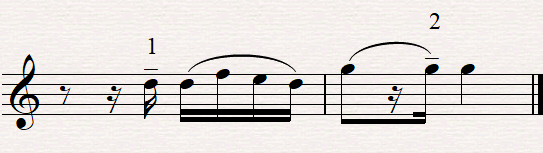
- Aim for higher 3rd fingers on the E string on line 4.
- Remember to hold the crotchet long enough in bar 16.
- Practice the last section in 2 bar chunks with open strings. Use shorter bows and see how neat and precise you can get these string crossings.
Pastime with Good Company
- Here’s a recording of the second half with a metronome set to crotchet=80. It’s ok to slow down very slightly in the last bar.
- When listening to this recording, or a YouTube version, follow your part and clap the rhythms as you listen.
- Here is a tenuto definition for you.
- Think about where you might use 4th fingers.
- Start bar 22 with a nice low 2nd finger.
- Watch out for the rests in bar 26.
Sun 6th Dec 2020
Paganini
- Watch out for tuning when playing the same note with different fingers.
- Keep your rests precise and clear, especially in line 3.
- Keep the crotchet pulse the same when switching to triplets.
- In bar 13, position your high 2nd finger when you play the last note of the bar so it’s ready for the next bar.
- In bar 16, imagine a group of triplets to help play the crotchet long enough.
- Practice the triplet sections in two-bar chunks , and especially from bar 17, try to look ahead and register each triplet group as a whole, ahead of playing it.
Pastime with Good Company
- Play a 1 octave G melodic minor scale to warm up, keeping the 3rd finger’s tuning stable as you move the 2nd finger, plus this exercise to warm up 2nd finger independence for bar 4:
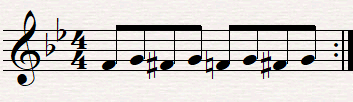
- Don’t rush the crotchets from bar 9.
- Use a 4th finger whenever the note is surrounded by lower notes, e.g. the semiquaver A in bar 14.
- Start looking at verse 2.
Sat 21st Nov 2020
Paganini
Here’s a video of the real thing!
- Watch out for the G and F sharps in bar 2
- Keep the rhythm as good in lines 2 and 3 as it is in line 1, especially observing the rests.
- 3rd section warm-up (repeat a few times):

- Talk yourself through this last section, identifying the arpeggios.
- In bar 21, notice your 1st finger needs to move for the first half of the bar, then the 3rd finger in the second half of the bar.
- Practice doing the p repeats, as suggested.
Study in C
- Slightly lighter with your bow – keep it flowing.
- Careful of 3rd finger tuning in bars 7 and 9.
- Try bowing variation (iv).
Sat 7th Nov 2020
Paganini
- Warm up with an A melodic minor scale to help with the #s in bar 2.
- Practice this scale to warm up (you can practice it two different ways: with the position changes as suggested, and in 1st position to practice string crossings, except the last bar which needs to move to 3rd position regardless):

- Always think horizontally with your bow, keeping it light, especially on string crossings.
- In bar 3, play the first note with a 4th finger, then move to open A after the rest. If this is tricky with the bow, practice the first two notes of bar 1 a few times, then try the first 2 notes of bar 3.
- Always stop the bow for the semiquaver rests. They will help you have time to think ahead.
- In bar 6, move to 3rd position after the rest. Shift back to 1st position after the next rest in bar 7.
- To help your fingers in bar 8, focus on the C being the bottom note.
- In bar 11, use your 4th finger for the D# (think of it like an E flat instead).
Sat 24th Oct 2020
Study in C
- Watch out for 4th finger tuning.
- Practice bars 5, 7 and 9 like so:

- Always keep your bow light and flowing.
Paganini
- Start bars 2, 3 and 4 with 4th fingers.
- Play the p repeat in the upper half of the bow.
Mon 12th Oct 2020
Study in C
- To improve string crossings:
- Slow the tempo down;
- Pick a problem bar and play the open strings version until your bow arm feels smooth and natural, keeping the string crossing movements as shallow as possible;
- Alternate between the open string version and the written notes.
Paganini
- Warm up with a 2 octave A minor scale (both melodic and natural minors will be useful);
- Make sure the semiquaver after the semiquaver rest flows into the following group of notes;
- 4th fingers instead of open Es;
- Shift to 3rd position after the rest in bar 6 and back to 1st position after the rest in bar 7. Use the rest to help you shift calmly and accurately – there’s no rush.
Pastime with Good Company
- A G minor scale would be a good warm-up;
- Feel free to work on pitches and rhythm separately at first.
Sat 26th Sep 2020
Try not to sit too close to your desk so that you can bow freely out in front of you, all the way to the tip.
Tuning
- Play the strings with a long slow bow so the tuner has time to register the sound.
Castle on a Cloud
- When warming up with C major, make sure you use 1st and 2nd fingers to help you tune your first note.
- In A harmonic minor, aim for a higher G# on the D string. Use the tuner to check your first and last notes.
- In the piece, start in the middle of your bow to help with the quiet start.
- Careful of the repeating rhythm you have at the start (quaver, two semiquavers).
- In the second section, make the dotted rhythms a bit more precise.
Minuett
- Use a melodic minor scale, just ascending, to prepare for your first bar.
- Retake for line 3.
Eta Cohen Scales
- In the semibreve scale, aim for a consistent tone all along the bow (not too heavy-handed at the heel) and curl your little finger as you approach the heel.
- In 2, start with a tiny bit of air bowing so that you really touch down lightly at the start of the crescendo, then make sure each note starts the same dynamic as the previous one finished.
- In 5, use the full length of the bow, pulsing slightly to define the crotchets.
Study in C
- A slightly lighter bow.
- Look ahead so you read scales, arpeggios and direction changes rather than each individual note.
- Start to try some bowing variations.
Fri 11th Sep 2020
In general when sitting at your desk to play, make sure you have both feet flat on the floor and sit on the highest part of the chair (is that the front edge?) to keep good posture. You should almost be mimicking standing from the waist upwards.
Angry Tango
- From b.11, test how quiet you can go! You could try out some vibrato here too, but we can work on that together in the next lesson if you’d prefer.
- In 19 and 20, imagine the notes are staccato except the accented note. Try a double up bow in 20 to help with this.
- Careful of the tuning of you last note.
Castle on a Cloud
- Count yourself in out loud with a bar of 3 and a bar of 2. Try to keep counting in your head throughout.
- Start in the upper half near the fingerboard to help achieve pp.
- From 12, keep the bow smooth. Watch out for dotted rhythms vs. straight quavers.
- To work on the end of bar 13, practice just the last note of bar 13 going into the first note of bar 14 – start near the heel despite it being an up bow.
Minuett
- Warm up with D harmonic minor and F major scales, going as high as B flat on the E string.
New Book
- Try the different bowing variations on any scales you play this week.
- Learn the notes in Study in C – we can add the bowing variations once you are familiar with the piece.
Thu 27th Aug 2020
Here is the vibrato video. Take it slowly and gently and always make sure your whole arm is relaxed throughout.
Sat 14th Jun 2014
Your first lesson with me! 😄🎻
 EcoNotes